
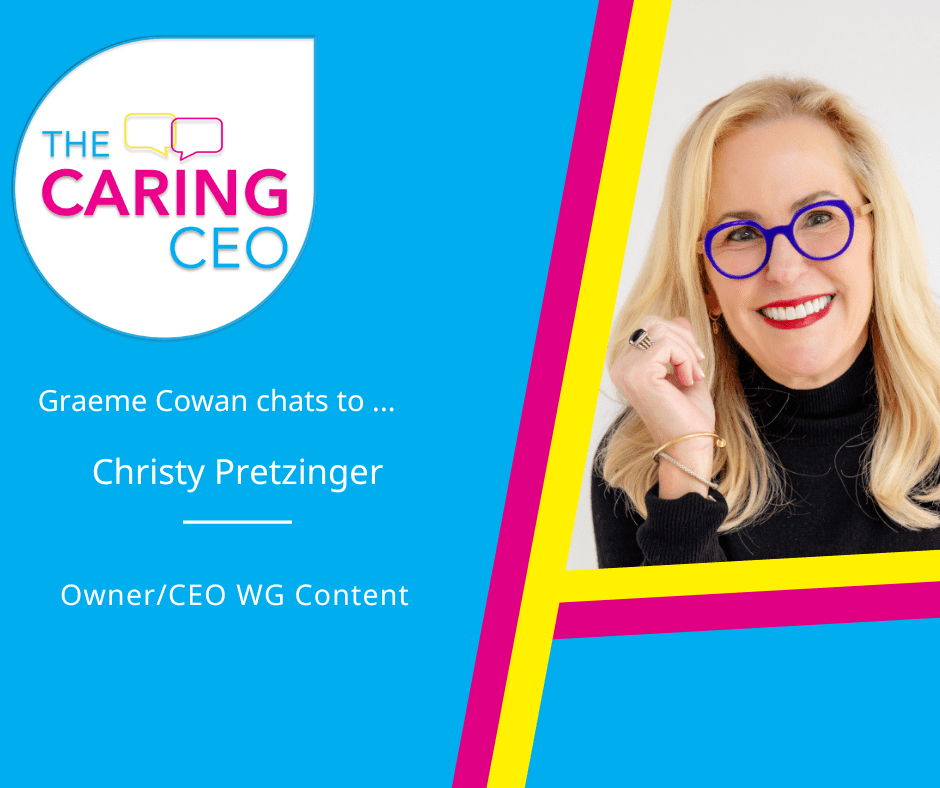
#69 Kindness x Vulnerability = Success, Christy Pretzinger, CEO, WG Content


DISCUSSED IN THIS EPISODE
- What caring in the workplace means for Christy
- How kindness is a fundamental value of an organisation
- Practical ways that she and her team incorporate this value into their daily, weekly, and biannual routines
- The importance of taking short breaks
RESOURCES
Want to learn more about what you can do in workplace mental health training?
Want to to reach out, share a great leader we should interview or learn more about The WeCARE Way, click here to contact us.
Transcript from the interview
Disclaimer: The following transcript was generated using a specific tool. It serves as a convenient method for converting our podcasts into text and allows for easy text searches. However, we kindly ask for your understanding if any typos have inadvertently occurred as a result of the tool’s usage.
SPEAKERS
Graeme Cowan, Christy Pretzinger
Graeme Cowan 00:00
It’s a real pleasure to have Christy Pretzinger on the Caring CEO. Welcome Christy.
Christy Pretzinger 00:06
Thank you so much for having me. Graeme. I’m looking forward to our conversation.
Graeme Cowan 00:10
What does care in the workplace mean to you?
Christy Pretzinger 00:14
Yeah, that’s a great question, because it’s, it’s a it’s a big word, even for only four letters, right? It’s a very big word. You know, for me, care constitutes a lot of things. It would include kindness, which should not be mistaken for weakness, by the way, but it would include kindness, I think, all of the soft skills, empathy, vulnerability, actively listening to each other and as a leader, certainly actively listening to your employees, all kind of rolled into creating, I see behind you like something about building psychological safety, creating that culture. One of the things Simon Sinek talks about is that when you focus on we me is taken care of. And I think that that really having an intention and then paying attention to building that circle of psychological safety encapsulates caring listeners.
Graeme Cowan 01:10
Would you just describing what WG content is involved with your business?
Christy Pretzinger 01:17
Certainly, we do content strategy and content creation for the healthcare industry, primarily very large hospital systems across the United States. There are 34 employees, I believe, and we are all women at this point, but then we have upwards of 100 contractors that we work with, which does include men. And we do all sorts of things. We’ve gotten more heavily into strategy lately, but we do everything from mostly long form content, blogging, physician bios, Peer, peer to peer, content, things like that. So when I say content creation, it’s not in the social media sense. It’s much more complex than that, actually, because frequently we are interviewing subject matter experts who might be a neurosurgeon, and then we need to do the alchemy of turning that content into something digestible at a fifth or eighth grade reading level.
Graeme Cowan 02:08
I noticed that, you know, you actually have kind as one of your four values. How did you come to choose that and go down that path?
Christy Pretzinger 02:18
Yeah, when I first started building the business. Gosh, just about not. Well, I guess it was about 20 years ago. I said to my accountant at the time that if I couldn’t build a business based on kindness, I would go back to being a freelance writer, because that’s what I had been doing, and I kind of forgot about that. Well, not really. I always had the intention, but as most people know, if you are building a business, you’re wearing all the hats and just trying to get things done, and someone asked me once if I had worked for unkind people, and that was why that was my driver. And I had to think about that, and I realized that, no, I really had not worked for unkind people, but these structures within which they worked did not foster kindness. And so what happened, and I can only really say this in retrospect, Graeme, is that the way that WG content is structured. I always say we engineer the structure to allow for the magic of the weaving of the tapestry that is the relationships and the culture. But I didn’t know that I was actually doing that. It was more unconscious, because I think truly, it really mirrors who I am as a person. Kindness is very important to me, and being kind to the person that’s waiting on you at a restaurant or a CEO that you’re speaking with, you should have the same respect and demonstrate kindness to those people. So so I think what happened is, as I built it, people became attracted to that too. They could see that that’s who I was. And so like attracts like, and I kept attracting more people like that.
Graeme Cowan 03:47
I love that story you mentioned. You’ve got 34 employees and over 100 freelancers. How do you embed that kindness each day and each week?
Christy Pretzinger 04:00
Well, our values, as you mentioned, we have four. We are empowered, curious, kind and fun. And so in order to make sure that people really live these out, you have to kind of bring them to life. One of the things I say is that your values should remain constant throughout your organization, you don’t go change them like the flavor of the week, the expression of them may change, but they should remain constant. And I always say that they should be a thread that flows throughout your organization and upon which all decisions can hang. And that’s certainly true at my organization. So what the things that we do, we are all virtual, and always have been, so we are very intentional about the ways that we live these out. So every month we have an all hands team meeting. And prior to that meeting, our HR coordinator says, okay, the value this month is kind. And so she actually solicits nominations for people who have demonstrated kindness in the past month. And so employees get to give each other kudos, and then she pulls a name out of a hat and gives them an award based on that value. So, so that is one of the ways that we keep it alive, but we also really have practices in in mind, in the way that we interact with one another. People don’t speak badly about one another, and if they notice someone changing their behavior, let’s say missing a deadline or showing up late to meetings, and that is not their normal Mo. We encourage people to look at that from the perspective of, I wonder what’s going on, instead of jumping to judgment or anger. So those are things that are kind of baked in to how we do that. And back to when people do the nominations, they don’t just say, like, oh, I nominate Christy. They say, why? What that person did, how they demonstrated kindness, and so that keeps it top of mind for everyone.
Graeme Cowan 05:47
Yeah, I love that. It’s funny enough, I have five values, and it’s care, centered, curious, constructive, and chuckling Exactly. And yeah, you know, I have practices each day to just practice one, one of those each day to keep it going. And so it’s wonderful. You’ve been able to engender that across your whole group, not just your employees, but also your contractors as well. How does that work with clients. What’s your approach with clients to make the most and to show them that you care or you’re kind?
Christy Pretzinger 06:29
Well, our mission is we build relationships one word at a time, and we take that very seriously. We do it with each other, we do it with our vendors, we do it with our clients, and then we help our clients do it with their target audience, whether that’s a patient population or whatever that may be, in terms of of of reaching our culture into our clients organizations, what we have heard back from our different surveys is that, you know, there’s a lot of organizations in the United States who create content, and some of them do it very well. We are certainly not the only ones. We started the category within the healthcare space. There was no one doing this 20 years ago when I started doing it. And the reason I knew that is because I had to define it, had to explain it to people by telling them what we were not. So we created a category. But now again, there are many others. But what we hear from clients, and why they frequently choose us is because they enjoy working with us, and it’s because we are empowered. We’re curious about what their situation is. We always say, you know, we don’t know the sandbox in which you play, but we jump in there and help you dig your way out. And unlike a lot of other organizations who come in and they’re like, let me tell you something, you’re doing this wrong and this wrong and this wrong, we never do that because we don’t know, you know the context. So that’s the curiosity, the kindness is again, non judgmental, understanding where they are, and maybe it’s a big stinking mess, but we’re not going to go off on some judgment thing. It’s like, okay, well, this is where we are. Let’s work on this together and move you forward and then fun. Even though work is hard, sometimes we work really hard to bring fun to the workplace, and we do little things. We have something called moment makers, which is something which in the US, in most hospitals are not allowed to accept gifts from clients, and so we try to do different things to mark moments with our clients. For example, one of our clients, a hospital, actually locally here, their advertising campaign a couple years back was, we’re right here, and then they would talk about, you know, whatever it happened to be, orthopedics, women’s services, oncology, whatever. And so what we did is we did a little video that said, like, I’m right here and I’m so and so, and I’m in Cleveland, and I’m the one writing all of your physician bios, and I’m, you know, Mary, and I’m right here in Cincinnati, and I’m doing all of this. And so all of the people did that and sent it to them to just be like, you know, we recognize that. And, you know, there’s, they’re a very long term client, but it’s just a little, a little way of of acknowledging they put a lot of work into coming up with that. We’re right here. We’re like, Okay, well, let’s further that for them, and take it out to us and give it back to them, you know. So we do things like that, and we do hear back that it does make a difference.
Graeme Cowan 09:06
You mentioned some signing before, and one of Simon’s mentors is Bob Chapman, who wrote a book called everybody matters. And he’s US based. He’s the chairman of very successful business called Barry weimeler, and he is absolutely convinced that you show your care by listening with empathy, having the person understood. And that sort of combines both kindness and curiosity, doesn’t it? Listening to someone feels understood. You’ve mentioned that you’ve got primarily, or virtually totally, a women, woman workforce. How did you come to choose that path?
Christy Pretzinger 09:52
You know, it shows me it wasn’t originally the company was called writer girl. So there’s an element there that I think people would not. Not very men were applying to work there. So it kind of grew that way. And then what also happened is that the first employees referred another person that they used to work with, and then another person they used to work with, or a friend that they and it tended they just ended up being women. So it wasn’t, there wasn’t some big intention. But actually, I’ve asked people about this, and if you think about it, in the US anyway, when you look at hospital marketing and communication departments, which is who we largely work with, they are 95% women. And when universities, the people that study marketing, writing, communication, tend to be women. So it’s kind of a natural outgrowth of that, not necessarily an intention, but on the other hand, you know, for I mean, forever men have been having businesses that don’t allow women. I’m not not allowing that. This just is the way that it grew, and it’s working really well for us. And I see no need to change it,
Graeme Cowan 10:52
yeah. And I would also think that, you know, often women do tend to still take the primary role with, you know, raising kids and being at home and that sort of things. And I’m sure the flexibility also really attracts women as well. Would that be a fair comment? Yes,
Christy Pretzinger 11:09
and we, we have unlimited time off, and we also have they just work the hours that they want to work. And I trust them, they’re adults. They can manage their their lives and their time and get their work done. And I don’t like the idea of someone having to ask permission to live their life, to go to a doctor appointment, to pick up a child from school, to in the US today, to go vote. That is, that’s your time. You get to decide how to do that, and it’s up to you to manage your time, to get your work done. Interesting. I want to go back to what you say about everybody matters. I think I read that book actually, and it’s funny because I have a signature talk going with the book that I have written. It’s coming out in January, and the way that I started is talking about the fact that probably 20 years ago, my dad was still alive, and we went up to a cemetery, a family cemetery, and we were looking at a plot of, you know, they’re all these headstones, and my family has been in in this city for a long time, so there were all these headstones with just first names on him, and then like, two dates, like Fanny and, you know, Joe, and I’m like, who I was. Like, I stood there with my dad, and I said, I don’t know anything about these people. Who are they? And he paused, and he said, I know it’s almost like you want it to say they mattered. And I have held that in my heart for years, and it’s a key element in building this organization, because I firmly believe that every human being, it’s a common thread amongst people, that they need to know that they matter, that their hopes and dreams matter, their fears matter, the things that are important to them matter. And I say frequently to my team that positions are replaceable, but people aren’t. You know, if one of you chooses to leave, the special magic that you bring will be missed, that that matters to people, and I think that’s why we have such incredibly low turnover, too.
Graeme Cowan 12:55
Yeah. And bob chapman talks about an epiphany he had where he was at a wedding, and the father was bringing the bride down the down the aisle, and, you know, passing over and just thinking that the father and the family of this bride just want that person to matter in that marriage, in that sort of situation. And they reflected about the workplace and how long we spend at work. We have to spend more time at work than we do with our with our loved ones and yes, and that was really his thought, that everyone should matter. They should, you know, leave work at the end of each day, feel they’ve contributed, feel they’ve been appreciated, valued, etc. And yeah, it’s a really, it’s a really great perspective, I think. And you know, in probably even more so in this digital world where, you know, everyone’s interacting so quickly and and content, you know, the social media content and all this sort of stuff that you know, actually feeling that your wanted, that you matter, is probably a real primary drive for every human it’s a sense of belonging, isn’t it?
Christy Pretzinger 14:11
I couldn’t agree with you more, and I think to the point of of that people matter, I think about their well being. I mean, I actually do use the word love, because one of the definitions of the word love is wishing the well being of another. So in the interest of the well being of the employees of the organization I started, I asked them, and this was not a this was all carrot, no stick, saying, I would really like you whenever you start your day, every 50 minutes, take a 10 minute break from your technology. Walk away. Don’t take your phone. Don’t go on social media, you know, like take your dog for a quick walk and throw in a little laundry. Do whatever you want. Just get away, to protect your attention span and to protect it almost your sanity, too, because we sit, you know, at desks for all day long, looking at a laptop or computer and the right. Especially they are just, you know, in it, and they really need those breaks and and people have said it’s made a big difference. One of one of our employees is a strategist, and she said she finds that she needs longer blocks of time than 50 minutes. So what she’ll do is maybe work three hours and then take a half an hour break. And she said she couldn’t believe the difference it made at the end of her day. She thought it was normal to be exhausted at the end of her day. And she said, by doing that, she realizes she still has like, half a tank left for her teenage daughter. And I think that’s exactly the kind of thing that you know when you’re basically giving everyone at least an hour a day. You know, practically an hour and a half a day that you want them to not be working. They really know that you’re putting wings to your words, that they really do matter. Their well being matters, and not to mention we know that that’s where innovative and creativity happens in the spaces it doesn’t happen in the boom, boom, boom, boom, boom happens when you have a minute to just kind of Muse and wander, let your mind wander, and sometimes you come up with really great ideas,
Graeme Cowan 16:01
yeah, yeah. I am fully agree with that, and I practice it myself. I put on a 50 minutes, and, you know, try to really focus on work, and then I might go out and play with our Labrador throw the ball, but it’s also outside. We’re right beside a bush or a forest here. And so being in that environment, I think, is also opens the mind up. It gets outside the four walls, and that makes a big difference.
Christy Pretzinger 16:29
Boy, doesn’t it, I’ll tell you, in this world of these screens and all of this digital, you know, kind of thing, it really is important more than more than ever, to get onto nature. In fact, I was just thinking today I’m kind of missing it, because the past couple days, I haven’t had time to take my four dogs for a walk, which is like two long walks, because I can’t do all four, and I haven’t had a time to do it. And I can feel the difference that I haven’t been able to do that.
Graeme Cowan 16:54
I saw that you have four dogs. Is that correct?
Christy Pretzinger 16:57
I do. I know we’re crazy, but we have we’ve got a nice piece of property, and that our backyard is a big hill that’s pretty steep, not good for anything other than dogs. And love it, and they, you know. So we have, we have, we have two golden doodles, one that’s supposed to be a mini, that is not a mini, by any stretch. And then we have a bernadoodle and a sheep of doodle. So lots of doodles. Yeah,
Graeme Cowan 17:20
this just want to jump back to, you know, the kindness and the curiosity when you get something that you’re not happy with. What do you do if you get some content or from one of your providers that you’re not happy with? How do you approach that?
Christy Pretzinger 17:39
Well, I mean, you know, we I kind of use the phrase, many are called, but few are chosen, because we’re pretty picky about who we work with. They have extensive experience and usually in the healthcare field as well. But we also put people through something that we call the WG Academy, and so we have an online learning management system with various training courses for people so that they know how to do it the WG way, as opposed to their way. So people are pretty primed to do things well. But we have, you know, we’ve had an instance recently where we had to stop working with someone. We think she was just working too fast and and really not just kind of getting sloppy, and we had to do a lot of other work on the back end. And what we do try to do with that, though, is we do correct it right away. And once we see where it’s like, oh, this wasn’t just a one off, this is becoming a pattern, we address it immediately as sort of, this isn’t a situation, it’s a freelancer, but it’s that hire slowly, fire fast, where we address it right away. We don’t let something like that fester, and we’re very truthful. I mean, I think that clarity and honesty are ways of being kind as well. And when we spoke with this woman about it, she was horrified and felt terrible that that had been happening and and, you know, wanted to correct the situation. So we always approach it, though, not in a, you know, even if it’s internal, I don’t really like doing a performance improvement plan. I prefer the approach of what I said earlier, that if a manager notices an employee’s behavior changing, saying to the employee, you know, I’ve noticed this. Can you tell me what’s happening? And we were talking about this is something I actually heard Brene Brown talk about, but I’ve listened to her for so many years, I think I’m channeling her brain, but that, that what you what we do is say, if someone says, you know, I’ve got a situation, my mother is sick, that we say that is absolutely appropriate, that you would prioritize that. But what’s not okay is that you don’t tell us that you have a situation, because we need to fill the gaps for you. And if we don’t know that there are going to be gaps, we can’t fill those. And so that is a kind way, but also a clear way of addressing something that is unwanted.
Graeme Cowan 19:51
I love that approach. You mentioned the WG Academy. What’s the content with that? Can you give us a. To an overview of what you take your perspective writers through, and how you think it might be different.
Christy Pretzinger 20:09
Well, it’s funny, because I’m I’m really lucky in that I have a brilliant team, and so I work on the business, not in the business. Years ago, I was very involved with the academy. Now not so much, but I know there’s everything from because the employees go through it as well. So when an employee joins, they may not have been in a virtual environment. So we have a handbook in there that tells them how to set up their office. Because we give everyone a laptop, a large monitor, we give them an Apple Watch. They get ear pod air pods and all the an iPhone, all these things and telling them how to set everything up and what what is covered. So all of those basics of being an employee, kind of an HR, kind of piece for employees. Then there’s everything from the style that we use, which is AP style, that’s what hospitals tend to use. I hope I’ve got that right. I think Chicago Manual is more literary. That’s what we’re using for my book. But AP is what we use in the work that we do for our clients. So we make sure that they understand what that is and refresh their memory about that. We talk about the templates that we use because we have very structured ways of using templates so that everything looks the same all the time, particularly with one client, because several writers might be working with one client, we want to make sure everything they get looks the same. I learned many years ago, when I was still very involved in the business, that was key, that you had to make sure you’d have all these different writers and they all look differently. And I’m like, no, no, they have to all look the same, and they have to use the same typeface, they have to use the same font, they have to use the same spacing, all of that. So we do that. We also talk about plain language. We teach people how to write with plain language. Most of them probably know, but we do have a course on plain language that we also offer to our clients on writing for plain language. So it’s all things like that. Some of it is practical, some of it is is skill related, some of it is technology related. We work with Salesforce, and we have made a very large investment into customizing that tool. And so we have access for that to our freelancers. So they don’t have access to all the business side of it, because we do all of our accounting and project management in that tool as well. But they have access to some of it so they can track, you know, they they can put in their time, they can put in when they’re available, because we have a resource planning tool within there, so that we can help see, like, Okay, this person’s available for 10 hours a week for the next month. Great. We know we can access them for, you know, this project. So some of it is training like that. So there’s all those different kinds
Graeme Cowan 22:33
of things. How has content creation changed in the last five years?
Christy Pretzinger 22:38
For example, again, I’m so far away from it that it’s funny. Sometimes I hear my team talk about something we’re doing. I’m like, I didn’t know we did that. You know? It’s interesting, because for a while, like, blog posts got shorter because nobody’s reading them anyway. Now you have to write these really long ones, all for search engine, which just drives me batty, because I’m always focused on, what does the reader want? What are they trying to get to? And the fact that you just have a have a bunch of words so you can satisfy the algorithm is so anti human to me. I just that. I don’t like that, but I believe that’s where we are. However, we also do things. We’ve done podcasts for people. We’ve done written video scripts. We do, what do you call them the oh my gosh, I the word flew out of my infographics. Sorry that just like flew out of my head for a minute. We do infographics, and we do do some graphic design, in concurrence with the the actual work that we do in terms of changing. I still think that people, their attention spans are just getting shorter and shorter, I notice it myself. I mean, I have been an avid reader my whole life, and now I notice I read much more digitally than I do in books, and I love books, but I find myself when I’m reading a book, after several chapters, I pick up my stupid phone like, for What possible reason? And I’m an adult, you know? I can’t even imagine what children whose brains are still developing? I mean, we’re watching ourselves change before our very eyes, and I’m not sure it’s an evolution. I don’t know what it is, but, but so that has changed. I think that people don’t have the same attention span, so we have to make it as succinct as possible, also, because what we were writing is sensitive content frequently. You know, what can I expect if I’m having heart surgery or, you know, whatever it happens to be, that we are very cognizant of obviously being truthful, and we always get, we don’t make up anything. We get that information from our clients and making sure that that we are very clear in what we’re saying, and also in differentiating the client that we are writing for from somebody else you know. So we need to make make sure that, so that that hasn’t changed, that’s all stayed the same. But I think that I don’t know that the content itself has changed, except now there’s a there’s a push to constantly refresh content, which is nice for us, because it gives us more to do. But again, we are satisfying an algorithm rather than a true. Human appetite and that that that’s interesting to look at it from the balcony instead of from the dance floor. It’s a it’s a little perplexing and troubling to me as a person.
Graeme Cowan 25:13
How do you think AI will change your business?
Christy Pretzinger 25:18
Well, we do have an AI champion, and we have teams working on various aspects of AI. And I think, you know, we’ve AI has been around since the 50s and but in various ways. But then chat GPT burst onto the marketplace, you know, a couple Decembers ago, and everybody in the world, because we like simple solutions to complex problems, says, oh, AI is writing. Well, obviously not. Whoever has had a phone tree that you’ve had to go through to get to a person you’ve been using AI, you know, chat online as AI. There’s a million tools that we use all the time that are AI. So in terms of changing it, I think that that what it’s a tool, just like anything else is a tool. You know, the world didn’t change when the internet evolved into what it is. It changed, but it didn’t drastically change overnight, and everything you know, we evolved slowly. Now, AI is changing so rapidly that it’s hard for anyone to keep up with it, but the way that we are looking at it is more as a way of a tool, like helping, like we have our own internal chat whatever you call it, so it’s a closed system, as opposed to open AI, so that we can use it like, for example, if someone needs to refresh their mind about how we open a project in Salesforce, instead of having to dig through all of our manuals telling you how to do things, you can search for it and get it right like that. That’s efficient, and that’s helpful, and that’s that’s cutting out silly wastes of time. So we look at it that way, and we also try and look at it as a a partner in strategy. In fact, I want to, I wrote this down because we were just talking about it. I’m going to find it real quick because I want to, I want to say it properly, that it’s a driver of growth, and looking at it as a strategic thought partner. Strategy comes from us, the human element of what we want, but they can be a thought partner. So, you know, we all know everything’s all about prompts, and, you know, giving it just such excellent context, and then, you know, using it that way. So, I mean, I’m not a futurist. I can’t tell you how it’s going to change things. I’m not terribly concerned about it replacing what we do, because we are highly human, the fact that we enter interview physicians, the SMEs, and then do the alchemy of getting it. Now, I’m not saying that that couldn’t be done, but you know, their doctors are people, and patients are people, and they still want to communicate with people, you know. And people are bright. They know when they’re being, you know, fed up unto AI. We all know. We see it all the time. And you do a Google search, it’s right there. So I still feel that the human element is, is vastly important, just in the world, but also in the space of healthcare. I could be proven wrong tomorrow, but, but I feel pretty confident that it will continue to be important. Human will continue to be important.
Graeme Cowan 28:13
There you mentioned previously Brene Brown and how she’s been an influence on you. What have been the main messages or themes you’ve taken away from what she talks about.
Christy Pretzinger 28:27
Well, back in 2010, all those low those many years ago, when I was a youngster, I would have gone to my grave saying that vulnerability was weakness, absolutely triple. Double down on that. And then she did her infamous TED talk. And I watched that, I think at the time, I was watching a lot of TED talks, so I stumbled upon it. I don’t even know how I found it, and I watched it probably at least 10 times, and I was like, wait, what? Oh my gosh. Like, I those things are so much a part of me now, but I do remember the wonder and resistance to that when I first was watching that, and then started reading her books and started learning about what that looks like. So I would say that that has become part of my own DNA. Much to her credit, she said she wanted to start a global conversation about shame and vulnerability, and by golly, she’s done it, and it has had a tremendous impact, not only on me as a human being, but also who I am as a leader, and then also how the leaders in our organization behave too.
Graeme Cowan 29:29
What are the benefits of a leader being vulnerable?
Christy Pretzinger 29:34
There’s really a lot. You know. First of all, leading with vulnerability is hard, and if you are a leader, and if you have endured, like most humans, a certain level of what’s the word I’m looking for, of dysfunction in your life, family, work, whatever, and you haven’t addressed that, the more dysfunction. You will allow around you and on your team. So that can be a real barrier to vulnerability. People who have survived a lot of dysfunction find themselves, you know, they tend to be a little more distant. Keep keep that closed off for good reason. So I think that’s a barrier to vulnerability, but I think that that the benefit of it and well, first of all, you have to be have intention to lead with vulnerability, and then you have to have attention, because it is not a natural inclination to be vulnerable. We just simply that’s not most people are not comfortable with that. So you have to really focus on that and learn how to do that. So for me, the benefit of that is that by acknowledging to my team that I don’t have all the answers, that my job really is to have the right questions, that is vulnerable. A lot of leaders think they should know all the answers. I’m always like I have all the answers. Why are you here? You know I know what I know. What I don’t know is what you know. So I want to hear that. And yes, the buck stops with me. I’m the sole owner, but there’s a lot of intelligence, certainly on my leadership team, without my whole without throughout my whole organization, my leadership team consists of incredibly bright and creative people, and I would be really doing the business a disservice if I didn’t avail myself of their considerable talents. And in order to do that, I have to be vulnerable by saying, You know what, Kirsten is a lot better at selling than I am, and she’s out in the marketplace, and she knows what’s going on. I want to hear what she has to say. I can’t say like, oh, well, I don’t think that’s what we need in the marketplace. I’m not out there. I’m not talking to the people like that. You know, my my controller, she’s the one that that forecasts the money and knows all these things and and I listen to her counsel and to to what she’s talking about, because she knows very deeply about those things. So I think that that’s, that’s the Mark I think, of a vulnerable leader, but also of a good leader, is being comfortable with hiring people smarter than you so they can learn what you do and then do it better. And I will say I have been very lucky in that every single person because, of course, as the owner, I’m the only one who’s done every job, and I couldn’t do any of them now, except the one I have. There’s no way every single one of them does does each part of the job that I used to do hands down better than I did. And that’s, that’s a true gift, and that is vulnerable, right to say, like, wow, this person is better at that than I was. But that’s, that’s the benefit of having an organization and, you know, giving people leadership paths and helping them grow, and then the organization grows, and then you as an owner, get to work on the business, not in the business. So that’s another big benefit of being vulnerable as a business owner. Yeah,
Graeme Cowan 32:44
I really love it walking through those steps. And it doesn’t always happen straight away, but it just gives people permission also to be vulnerable as well. And so you’re then really experiencing what’s really going on and what people are really feeling, and what you better off to know of fear than not know it that someone might have. So yeah, I really well.
Christy Pretzinger 33:10
The other thing about vulnerability, Graeme, I think, is that when you, as a leader, demonstrate some vulnerability, and I’m not suggesting you share your bare your soul to people, but when you demonstrate some vulnerability, and this is just true, this is the data that I believe. I don’t know if came from Bernie red or somewhere else that I’ve learned it, but that the person that you’re being somewhat vulnerable with likes you a little bit more, you know. And so it really furthers a relationship and and allows them, to your point, to open up a little bit. And so therefore you can build that relationship, which then, in our organization, is the key to having the culture, which is the core of our organization. So
Graeme Cowan 33:50
I saw also that you’ve been a member of the Entrepreneurs Organization for a long time. Can you briefly explain what that is and what are the main benefits you’ve taken away from that?
Christy Pretzinger 34:00
Oh, happily, that is one of the joys of my life. Anyone who’s listening here who is an entrepreneur, definitely check it out. It is Entrepreneurs Organization. You can just Google it. It’s a global organization. I believe we’re in 70 countries now, and very close to 20,000 members, all of whom are business owners. And in the US, the qualification is that you have a business with a million in revenue and you can’t be fired. So you might be a partner or whatever, but you cannot be fired. Those are the two baseline things. So the benefits, good heavens, when I first joined the core of Entrepreneurs Organization in every country, in every chapter, is the forum experience, and that’s a small group of, really about eight people maximum. Sometimes it goes more than that, but really about eight people maximum, and you meet monthly, and there are best practices and and the the ones that last, like the one that I have been in, they follow the best practices and rather rigidly, to be honest with you about it, it’s not as sitting around talking kind. It’s not a discussion kind of organization. It’s a very structured, four hour meeting once a month, you are not allowed to miss the meeting, and in those meetings, you share with this group of people your top 5% and bottom 5% meaning that you wouldn’t just tell an employee or even a friend some of these things and about business, personal and relationships or family and and then we also do different presentations. You have an opportunity with this group of people who have such varied skill sets in my forum, several people have had successful exits. You know, one to a publicly traded company, one via private equity investment. Another has VC investment and has had several exits from other businesses where he sold. So there’s all of this experience there. And I was in my form probably for at least a year and a half before I really even knew what businesses my form mates were in. Because the common thread there is the business. You’re building a business. What are the challenges? Because there’s so many similarities, no matter what kind of business you’re building, and so it’s a wonderful way to really educate yourself. And also, one of the tenants of EO, which is one of the reasons it’s near and dear to my heart, is vulnerability, that you in that form, you the one of the things we used to say was, it was on our update sheet, get naked fast. So, like, you get multiple fast, you know, and you like share, share the stuff that that’s good and bad, you know. Frequently you could share with somebody in a forum, you know, a big gaff you made with an employee, but you’re not necessarily going to share that with your friend. May not even understand that, you know, but these people do, and so that’s been tremendously valuable to me. I also say that had I been a NEO when I went through a divorce, I highly doubt I would have paid spousal support, because they would have been like, wait a minute, wait a minute, wait a minute. But, I mean, that’s over a long time ago, so I’m okay with that now, but I really do believe that the Council of these people would have slowed me down somewhat, and probably would have changed that situation somewhat.
Graeme Cowan 37:03
That’s a great description of benefits. And, you know, I know a few people that are members, but I really love how you summarize that. I learned things I didn’t know. The get, they get the top 5% the bottom 5%
Christy Pretzinger 37:17
and the thing that, the thing that’s really, really unusual, I think Graeme about EO, is that when you’re doing your updates and form, you are taught to lead with the feeling, which is not the way most humans Connect. We all think that we are rational people who occasionally think, and, I mean, occasionally feel, and we all know we’re feeling entities that occasionally think. And so what? What it trains you to do when you’re doing your update, let’s say you’re talking about a top 5% let’s say you’re really excited, because, you know, you hit a sales goal, and that means you get to go buy this new car or something like that. And so the top 5% the feeling about that would be, I’m proud, I’m excited, I’m surprised. You just you have to access those feelings, and then you give the headline like, oh, we hit X number in revenue. And then, why is that important? Well, because I never thought we could do this, and I’m really excited about I’m proud of my team, and I really can’t even believe this has happened, given the fact that I was a freelance writer, you know. And so you share it that way, but you, but you, you really have to dig to get to that feeling. And the great thing is, in in the forum, the the group is expected to challenge you. If you don’t really go deep on the feeling, they’ll be kind of like, yeah, what you said sounded like there might have been a deeper feeling there. Can you tell me more about about that? And then, you know, you, you’re kind of challenged to go deeper so and that, again, has been, has been a, an amazing thing. And one more thing I want to share, sorry if I can, but this is so great that is unique to to Entrepreneurs Organization is there’s only experience sharing. There’s no advice giving. And that changed the way I parented my son. That changed the way I managed people, the way I lead my organization, and the way my leaders lead the organization. Because nobody gives advice. There’s no shooting. It is always, you know, in my and you can’t even say, Have you ever thought about because that’s moving into advice. It’s more like, well, in my experience, x, y, z, and this is what I did, and it kind of didn’t work out. So there’s that, you know, and it’s so helpful, and it’s kind and it’s much more informative, and it doesn’t irritate people. Most people get irritated when people like, well, you know what you should do, and it’s like, well, how do you know? You know. So anyway, thank you for giving me the opportunity to go on and on about EO, because I just can’t say enough good things about it.
Graeme Cowan 39:33
Chrissy, you mentioned that you’ve just written a book, and it’s about to be released soon. What’s another book and why did you write it?
Christy Pretzinger 39:44
The book is called your cultural balance sheet, keys to creating an environment where people can thrive. And this is another interesting story that grew out of EO, because one of my EO form mates had been saying to me that I needed to write a book. And I was like, yeah, yeah, yeah, yeah. So we were at dinner one night, and. I said some of these people have had successful exits. So we were talking about exiting, and you know about EBITDA, and you know your your financial balance sheet and all of that. And I just happened to say, just occurred to me. I said it’s almost like I look at my business through the lens of a cultural balance sheet. And he looked at me, and he’s like, Well, there’s your book. So that was kind of what drove it. And because culture is the core of our business. We discovered that from some consultants who surveyed all the employees and discovered that. So that really got me thinking about a lot of business owners and leaders might not look at culture as anything that contributes to the bottom line. They think of it as like, you know, pool hall. I mean, you know, pool tables and beer kegs and things like that. And nothing could be further from the truth. It really is to our conversation earlier about creating an environment where people, every single person, needs to know that they matter, that they are empowered, that their thoughts are valued, that their feelings are valued. And so how do you go about doing that? It sounds so simple, but there’s a lot of tools to it that that we employ, and have employed over over the 20 years of building this business. And some of them are really simple. Seem strange at first, but like we start every meeting of three or more people with a meditation, and the intention behind that is to allow everyone to get into the same space, whether it’s all the digital space, but to kind of let go of whatever you were just doing, and to really take a moment be present with the material and, more importantly, the people that you’re going to be interacting with. So we talk about that. We do something that once a month we do something we call the best of me worksheet, and it’s an opportunity for the employee to speak. The manager simply listens, and they fill out a quadrant that I think originated with not Mackenzie, but somebody like that. It’s there’s four quadrants, and the upper left says you get the best of me, when the upper right says you get the worst of me, when the lower left says you can count on me too, and the lower right says what I need from you is. And I tell people, I focus a lot on that lower right quadrant in terms of building a relationship and credibility and trust. Because if someone tells you what they need from you, and you don’t do it, you have blown that relationship, and it has probably taken you a long time to build trust, and you can blow it just like that. So within reason, if you can do that. But what’s great about that? We used to do it, I think, quarterly, and then the employers are like, you know, we can do this twice a year. We these things don’t change that much, but it’s a really nice reminder, and we want the employees to reflect on that, and then, to the best of our ability, we want to know these things about them so that we can craft our conversation, their work and the environment to get the best of them. So those are just two little, two little things that we do to help create that environment.
Graeme Cowan 42:45
That’s great. When does the book come out?
Christy Pretzinger 42:48
Coming out in January. I don’t have an exact pub date yet, but it comes out in January. Excellent.
Graeme Cowan 42:52
I feel like we could talk for much longer, but we’ve actually come to the end of our time. Christie, I’d just like to ask you what I always ask at the end. You know, if you had the opportunity to go back to your 18 year old self, knowing what you know now, what advice would you give your 18 year old self? Well,
Christy Pretzinger 43:14
this one’s kind of an emotional one. I would say you are worthy. You are worthy and you are okay, you know, that would be a big one, because I spent a lot of years not but, you know, 10s of 1000s of dollars on therapy that went through, you know, and lots of reading, and lots of Renee Brown and lots of, you know, lots of personal development, you know, to get to that. But I think that’s a human need, and I think it’s a lack as well. I don’t know why this world. You know, we all come into the world. I think knowing we’re worthy a baby screams and cries and expects to be taken care of, and is, in generally speaking, those cases fortunately. And then somewhere it gets beaten out of us when we start thinking we’re we’re not worthy, we’re not good enough. And and I would, I would definitely tell myself that, ah, fantastic.
Graeme Cowan 44:04
Thanks so much for being part of the Karen CEO, Christy, I’ve really enjoyed our chat.
Christy Pretzinger 44:09
Thank you, Graeme, I’ve enjoyed it too. Thank you for having me.

