
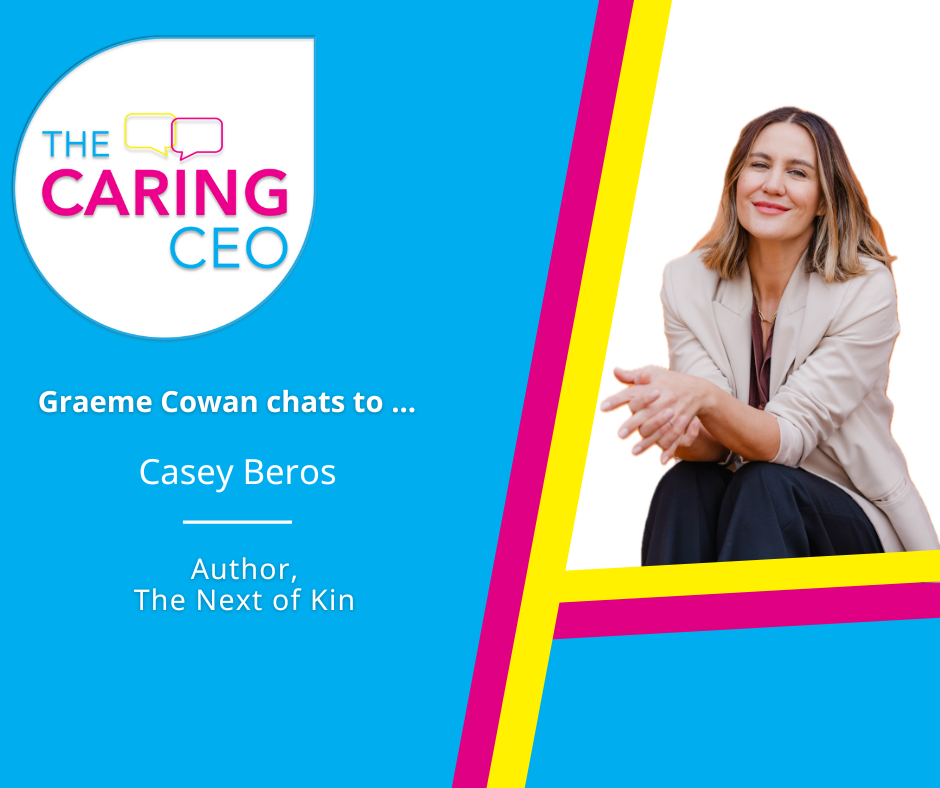
#85 Guiding End of Life Care, Casey Beros


DISCUSSED IN THIS EPISODE
- What caring in the workplace means for Casey.
- Why the best leaders balance compassion with high performance, and the often invisible load carried by carers, particularly those in the sandwich generation.
- A compassionate and practical guide for anyone navigating illness, caregiving, or loss, and invites us to think differently about death, dignity, and the legacy we leave behind.
RESOURCES
Want to learn more about what you can do in workplace mental health training?
Want to to reach out, share a great leader we should interview or learn more about The WeCARE Way, click here to contact us.
Transcript from the interview
Disclaimer: The following transcript was generated using a specific tool. It serves as a convenient method for converting our podcasts into text and allows for easy text searches. However, we kindly ask for your understanding if any typos have inadvertently occurred as a result of the tool’s usage.
SPEAKERS
Graeme Cowan, Casey Beros
Graeme Cowan 00:01
Welcome to the first episode of the caring CEO for 2026 I hope you had a really fantastic break. Took up some good time at the beach or wherever you like. To spend your time on holidays. Today’s guest is a little bit different for the caring CEO. I’m speaking with Casey beros, and she’s the author of a book called The next of kin, and it’s about her journey for the last two years of being her father’s primary carer before he passed away. It’s refreshing to hear how open Casey is about talking about these elements which are often not discussed or acquired taboo. I know I learned a lot from Casey’s experience, and I think you will as well enjoy. Welcome, Casey.
Casey Beros 00:57
Hi. Thanks for having me. Graeme.
Graeme Cowan 01:00
Casey, what does care in the workplace mean to you?
Casey Beros 01:04
For me, care in the workplace is about open lines of communication, about building a culture where not only is it encouraged to share what’s going on in those blurred lines between work and home, but that it’s expected, and which can be really interesting thought experiment, and certainly a really interesting application in the workplace, because people can still be very private when it comes to the things that are going on in their quote, unquote, private lives. And in my experience, the more transparent we can be with our leaders about what is going on for us. I think that really deepens trust and connection. I believe it improves those professional relationships that if we can show up in the workplace with our full humanity and have that be welcomed there. I think that goes a long way towards creating a culture of care.
Graeme Cowan 02:10
And what do you think of the leaders you’ve worked with? What are some of the qualities of a gray one?
Casey Beros 02:18
Oh, I love that question I have had really strong, positive relationships with all of the leaders that I have worked with. I’ve always been a big fan of Modeling the Masters, and so I’m a bit of a sponge. I’m a real people watcher, I suppose. And I am a very analytical person, so I’m forever watching, what do they do that I like that, I love what do they do that I would prefer not to adopt? I think I’d like to think that I have always had really strong personal relationships with my professional leaders that has served me particularly well. They’ve all been fair but firm and deeply, deeply passionate about what they do. I haven’t yet worked under a leader who has been there for the financial gain or for the kudos of being a CEO. Yet, you know, they’ve all been founders and people who have spent a significant portion of their career in corporate and then decided to go out and build something on their own. And I’ve been very fortunate and privileged to be able to be there and build those businesses with them from the ground up. So to be able to have the privilege of being able to watch something, you know, the blood, the sweat, the tears that goes into that has been really a real gift. I think to me, one in particular that I can think of, Dr Norman Swan, who many people listening will be familiar with, who is still a dear friend, a mentor of mine now you know, watching his commitment to evidence based medicine, which is the piece of healthcare that I am most interested in, and always being incredibly generous of spirit with his feedback, with his guidance, I’ve never seen him raise his voice. I’ve never seen him deliver passive aggressive feedback. I’ve only ever seen him be fair and find and generous of spirit, and it’s the reason that I stayed with him for six years of my life, which is kind of unheard of now. But you know, back in my day, she shares, she says, shaking her pain, that that was, you know, more, more so, than norm. But I felt very lucky to have been able to witness that kindness. Don’t think that those two things have to be mutually exclusive. I think that you can be incredibly kind, compassionate, empathic, caring, and be very good at business
Graeme Cowan 04:58
when I think of a great manager, I. Once had it was when I was working with Pfizer, and he really talked about his approach being the golden rule, treat others like you, treat yourself and just sort of not a bad place to start. The other thing I think that also made him a very good leader, is that he treated me one level above what I was, and so I was always stretching. I worked with Johnson, and Johnson before then, it was so bureaucratic, but within about two weeks, he asked me to run a conference in hope art. Never done anything like that, but you sort of, you know, you think, Well, if he thinks I can do it, maybe I can. And they are a great leader when they do treat you and help you to grow and to challenge yourself. It’s not easy, but it is that match of care and high performance. I think that’s very, very rewarding.
Casey Beros 05:54
I agree, and I think you’ve probably just hit the nail on the head of what it was that I’ve experienced in those organizations. It did feel like there was a very horizontal structure. And I understand that that’s much easier to do in a small organization than it is in a larger one. But when I would be building sets for television, they would be right there beside me with the screwdriver building sets for television. Nobody was nobody was above the other and I would like to think that I have brought that not only into my
professional life and my own leadership, but also into the way that I think about healthcare teams. I do believe that we are moving to a much more horizontal model of care, where patients and carers in particular can play a much, much bigger role and be better advocates and better stakeholders in their own care. And perhaps that was inspired by seeing that, by seeing that there
Graeme Cowan 06:47
definitely our listeners will find this episode a little bit different, a little bit unusual. So what I might ask you to do, Casey, is just to explain an overview of your career so far, and then writing the book. Next of kin, sure.
Casey Beros 07:04
So I grew up in little old Perth and I studied journalism, because my only skills coming out of high school were writing and speaking. So I think I got funneled by one of those career days into, oh, we think you’d be great at journalism. So it was not very targeted or strategic, but I did manage to get the grades to get into journalism. And, you know, I really took my time to do that degree. I kept disappearing and going traveling, and then I’d come back and do a little bit more. So I probably did a three year degree in five years, but as soon as I graduated, you know, back in those days in Perth, you were pretty limited in terms of your options. There was, you know, a handful of radio stations, television networks and mastheads. There was no digital it was, it was pretty slim pickings. And then I suppose, the pathway for a journalist was that you would do a cadetship. And I had decided very early in that degree that the only thing that I wanted to write and speak about was health and health care and well being. And so I made the decision to leave Perth and moved to Sydney and work under Dr Norman Swan. So I originally approached him for some work experience, and just got very lucky. He decided to start a production company and communications firm pretty quickly after I had made that request. And so I started part time, very quickly, went full time, and then spent six years working under him, building his business. And so health journalism has always been my game. I spent six years helping build another business as a creative director and general manager in the health content space and on the side, have always been working my way through the health media landscape. So you know, editorial, podcast, video, television, publishing, the full gamut. My goal has always been to give people more time with the people that they love. That’s the mission, and has always been the mission. The medium changes day to day, but the mission is always the same, which is, how do I take all of this knowledge that I have acquired after 20 years of asking questions of our leading experts on how we can all live happier and healthier lives? How do I take that knowledge and deliver it in a way that maybe lands on people a little bit differently. And so I suppose all of those professional skills really helped me greatly when I got a call from my father saying that he had been diagnosed with a terminal, fatal and incredibly rapidly moving cancer called mesothelioma, which is cancer from exposure to asbestos, and I thought I felt very well positioned to actually to navigate him through the healthcare system. That phone call brought me from Sydney back to Perth. I’d built my career in Sydney for 15 years. I’d had my family there. I’d met my husband there. I’d had my children. Been there, but my dad was still back in Perth, where I had grown up, and so that phone call really brought me back to Perth, and I had been a health journalist for 15 years. At that point, I felt very well positioned to navigate him through the healthcare system, and it was quite shocking to me how frequently we fell through the cracks in that an experience to educated, very health, literate, very proactive people who still fell through the cracks of the healthcare system frequently. And I found myself thinking, Gosh, what would it be like if English wasn’t
your first language, or if you couldn’t read or write, or if you had no support system in the way that we had a support system that felt really unfair to me, actually, that I would have all of this knowledge and still find it as difficult as I did, and same for Dad and that others didn’t have that that head start. And so I started writing. I mean, I’ve always written to make sense of the world around me. I started writing and capturing our experience with dad’s blessing, but no idea yet where I would publish it, and he was very private in the beginning of his illness, but about 18 months into that illness, after hours and hours of interviews and conversations about how we could do this thing, this experience, better when it comes to care and healthcare in this country, he started to get a bit bolder about sharing that experience with you know, beyond his immediate network, and I don’t know at what point, but we sort of agreed that we could turn it into a blog on sub stack, and that I would write these articles, and that he would feed in his experience, so that people could get a sense of what this experience had been like, from that first phone call, or from his perspective, from diagnosis through to the point at which we were at then, which clearly dad was getting sicker and everything that was to come. And so I think that was incredibly Jenny, incredibly generous of him to to be willing to open up and to share that with whoever would read it, whoever would find it, whoever would watch and read and listen. And that became the bones of what would become a book called next of kin. And I’m so proud that, you know, I have that experience with him, that I can feel him bouncing off of every single page, and that our experience everything that I wish I’d known before I stepped into the role of becoming his primary carer, but also everything that I learned along the way is is, you know, pummeled into Every word in that book, and I feel grateful and incredibly humbled to get to share that with other people walking the same path.
Graeme Cowan 12:49
I just like to jump back again to when you got that phone call. What did that? What did that feel like?
Casey Beros 12:57
It felt like, you know those moments where you sort of feel the blood trickling from the top of your head down through the bottom of your toes, you almost know intuitively that you are about to be delivered bad news. There’s something about their tone, or perhaps, if you were in person, their body language. I was on the phone with dad, so I only kind of had his tone to go off, but it felt like someone had knocked the life out of me. I remember distinctly. I was in an Airbnb in Wagga, Wagga, my husband had just graduated from his master’s degree. We’d traveled to Wagga, Wagga to celebrate his graduation, and so I was in this sort of completely unfamiliar space, and yet I could explain to you in detail the layout of the room and the color of the carpet and the way that I stood and then sat and then kind of slumped on the floor as I was delivered this news. It’s a moment that I will never, ever forget, but being the true elder millennial that I am, perhaps I immediately put him onto speakerphone and started frantically googling what it was that we were talking about this mesothelioma, but more so the prognosis that we were looking at. And I just remember my eyes kind of frantically jumping from link to link, and you know, I don’t recommend that for anybody who’s listening. But our 15 years as a health journalist, at that point, I knew at a glance which were the sources to pay attention to and which to ignore. But I just wanted to get a quick sense of what it was that he was facing. And I just will never forget my eyes kind of jumping from link to link, seeing six months, eight months, 12 months, fatal, incurable, rapidly progressing. You like I knew that this was perhaps not the worst of news. Maybe the worst of news would be a phone call from somebody else saying, dad had a heart attack today. Or. Got hit by a bus
today, and he’s gone. But it was up there with the worst, the worst phone calls that you want to receive from anybody that you love.
Graeme Cowan 15:08
Yeah, yeah, totally. How was his voice?
Casey Beros 15:13
His voice was steady and robust and hopeful. I mean, my dad, anybody who knew him, knows that he had this great voice. It was very gravelly and full and low and deep, but almost kind of soulful in a way, and so I it was only at the moment that he said to me, I’ve got some bad news that I really tweaked as to what was going on. And it was really interesting, because about 24 hours before that phone call, he had texted me saying, Have you got time for a quick chat? And I, you know, whenever I receive a phone call like that, I’m like, Oh, God, I’m in trouble or something’s wrong. I immediately want to speed dial the source. But I think, because it was my husband’s graduation, I think we were out for dinner with his family, I kind of parked it and text back and said, Can I call you tonight or tomorrow? Whatever it was, and asked, you know, is everything okay? And it was only after I’d had that eventual conversation, and I’d realized that everything was, in fact, not at all okay, that I looked back at that message and realized that he had sort of avoided answering my question, is everything okay with this kind of ninja, like avoidance, he didn’t really say Yes, everything’s okay, but he’d sort of deftly swerved from answering that question, but it didn’t ring any alarm bells at the time. So you know now looking back, I can see things really differently, but in the moment, I just remember I cried all night and then got up and took myself off for a walk the next morning, to try to avoid my small children. I didn’t want them to see me in that state. And I thought, well, if I can just give my thoughts and worries somewhere to go by taking myself off for a walk, I can ground myself or come up for air.
Graeme Cowan 17:25
We have some helpful resources that you can find at WeCARE 360, five.com.au, the first is our mental ill health calculator, which is a quick and simple way to work out what poor mental health costs your organization in lost productivity and employee turnover, you will also find our building a mentally healthy culture checklist, which shows how to launch a great initiative and keep that momentum going. These resources can be found at WeCARE 360, five.com.au, was it a complete surprise to him, or were there hints beforehand that there might be some serious issues?
Casey Beros 18:08
It was a complete surprise to him, although what he called me about, I’m not 100 I’m not crystal clear on the timeline, but I was somewhere between seven and 10 days since he had started this process. And so he had, my dad was one of those annoying people that always looked quite athletic, regardless of how little athletics he actually got. And but he had, he had taken himself down to the swimming pool to start doing some laps. And he had swum very well in the past, but he hadn’t been doing much fitness of late, and he had decided to give up smoking. He had a younger girlfriend, which was pretty on brand for him, and he had decided that he wanted to increase his fitness, so he’d gone down to the swimming pool. And whilst he hadn’t been, you know, training or swimming lately, as I said, he was a pretty athletic dude, six foot three, 100 kilos, pretty strapping sort of lad, and not sort of overweight or anything. He had tried to swim from one end of a 50 meter pool to the other, and he told me afterwards
that he got about halfway, and he was really struggling, which is kind of out of character for him, even at his age, and even though he hadn’t been doing much fitness recently, by the time he got to the end, he said he was gasping for breath and could barely touch the end. And thought that’s really out of the ordinary for me. So he took himself off to the GP. GP sent him off for a scan of his lungs to try to see what was going on, and bearing in mind that this is a man who had smoked for the vast majority of his life, so I suppose it did ring some alarm bells for him. And he told me afterwards that when he went and had his scan, The radiographer said to him, Have you ever come into contact with asbestos? And he knew immediately that something was really wrong. And so. Off the basis of that scan showed that he had acquired 6.5 liters of fluid on his left lung. So you imagine 6.5 liters of milk sitting somewhere in your on your chest, and they immediately admitted him to hospital, where they drained that fluid. And did, I believe, what’s called a talc pleurodesis, as the name would suggest, use kind of a talcum powder situation to essentially plug where the fluid is accumulating from, so that it has nowhere to go and so that it stops doing that. And in the meantime, they send the fluid off to the lab to be tested. And that diagnosis was confirmed as as mesothelioma. So some days later, when the pathology on that comes back is sort of when I received the phone call from him. I am, you know, it breaks my heart thinking about him going through all of that without somebody by his side. And I think it was also incredibly generous of him to not immediately hit the panic button and call someone like me, who was always a big support to him, and sit in the unknowing with him, or make me sit in the unknowing with him. I think that’s incredibly brave and generous to work out what it was that he was dealing with before he picked up the phone.
Graeme Cowan 21:19
To me most of the listeners on the caring CEO between 35 to 60 and so that age more immediately puts parents in the play of potentially having a serious setback. You know, like your dad had, having gone through that two years with him. What did you do? What was your approach? And is there anything you would have done differently in retrospect?
Casey Beros 21:51
There is, there definitely is, I am a doer. I am an Olympic level doer. I would much prefer to do than to be I don’t like sitting around with my feelings. I like to do through the feelings, which a few people listening like, yeah, which I relate to. And, you know, if I had my time again, I I would do a lot the same. In fairness, you know, I really left nothing on the table. I would take a little bit better care of myself. I was very burnt out and depleted. By the end of that experience, I would put my phone down more, you know, I was frequently, you know, when you’re advocating for somebody in this world, you are constantly on the phone, on AIM, on your computer, waiting for results, calling doctors, organizing with services to have somebody come to do something. And I put my phone down a lot to massage his feet and to read to him and to be together. You know, we spent such a lot of time together, which was such a gift, and I wish I had detached from the doing a little bit and sat more in the being with him. And that’s easy to say in retrospect, and much harder to do in the moment. You know, some of that, I think, was a coping mechanism and a really valid one for me. But I think that for people who are ambitious, driven, I don’t know if I would call myself a type A personality, but for people who are really good doers in their professional lives, and for a lot of people listening to this, who might be CEOs or leaders or managers, you’ve reached that level, because you are pretty driven and presumably pretty good at getting the doing done, and it is very difficult to detach from that when it comes to your personal life. So I suppose
my regret, one of my regrets, would be, you know, my dad, my dad’s death in particular, was not a project to be managed, and yet I treated it like the most important project I would ever manage, with a heap of humanity and kindness and compassion, but it still felt like A project, and that’s probably one of the unfair pieces of the current landscape that I think is worthy of exploration for all of us. Because you’re right, a lot of the people listening to this will be in the position whereby they are older, perhaps they’re facing more chronic disease. They’re going to live longer, but that’s not guaranteed to be in good health, and a lot of the people listening to this will be the people that will inevitably care for them, because that is the way that the system is currently structured. So when you are in the position of being a primary carer, as I was, even though I have siblings, they’re at very different stages of their life to me. So I. Am very squarely in that sandwich generation of having two small children and aging parents at the same time. And that is, you know, we’re the first generation to go through that, and so we’re learning as we go. And it is a huge load to care and to carry and to try to maintain some semblance of relationships and your own career and professional development. I don’t know that we’re very good at supporting that yet. I don’t think that we have great policies in place, great, you know, funding programs in place, to be able to fairly and squarely support the people who are doing the doing. And so it is unsurprising to me that that that is where I went, that, you know, my spreadsheets and color coding and, you know, almost military like approach to that experience is unsurprising, and it was effective. And I think it detached me a little bit from the actual experience of losing him. You know, my nickname within our family was drill sergeant Casey, and in the beginning, that sort of hurt my ego a little bit to here, because unfortunately, somebody has to be in charge in those situations. And in the end, I sort of embraced it and said Damn straight, and it’s drill sergeant Casey. It’s Captain, drill sergeant Casey to you, because, as I said, unfortunately in those situations, somebody does tend to have to be in charge, and that’s just the reality of those situations, of moving someone from this world on to the next, and it’s a big argument for consideration with the people that you put into very powerful and very important roles in your estate and in your affairs, being, you know, enduring power of attorney, enduring medical power of attorney, or injuring guardian, depending on which state you live in and your executor, these are very powerful and very labor intensive. Can be very labor intensive roles that I think is worthy of significant consideration for the people who are putting those others that they love and that they care for into those roles.
Graeme Cowan 27:18
Yeah, what did you learn about your dad during that period that you didn’t know before?
Casey Beros 27:25
My dad had this motto that he wanted to live and die with ease and grace. Now I can’t answer for him whether or not he lived with ease and grace. I think only he could answer that. But I can certainly say that while the lead up to dad’s death was pretty rough on him, physically, mentally, spiritually and on me and on the people around him, the actual dying part was incredibly graceful. You know, getting to hold his hand as he left this world. You know, I heard once that a grandparent’s role is to teach their grandchildren how to die. And you know, my children were there when my father died. We were all there where my father died. They weren’t in the room. They were in another room, blissfully and unaware, blissfully unaware and watching a Disney movie. But they came in afterwards and crawled on up there onto the hospital bed and gave him a big hug. And my eldest was desperate to stay and wash the body with us and to be part of that which I didn’t allow. I think I bribed her with chocolate to go home
with her dad, partially because I didn’t really know what I was doing. I was trying to open the experience up to them and protect them, and nobody knows what they’re doing in that situation, so you just do the best that you can. But I suppose what that taught me about Dad was that he was incredibly brave and incredibly generous of spirit, things that I strive to be, that I hope I got from him, that, you know, the impact of somebody’s life is not the culmination of their acquisitions, how much money they make, how many boards they sit on, how many followers they have on Instagram, how quickly they pay off their mortgage. It is fairly and squarely how deeply they loved and how deeply they were loved, and what a gift to teach me and his other children and my children that truly that is all that matters at the end. And you know, I feel so grateful to have learned that I spent months putting together this film for dad. I called it homecoming, because he’s part of a group called the mankind project, which strives to make better men in the world. And much like Men’s Shed, but without the building piece, without the shed, that’s exactly right. And they do this homecoming practice where they take a bunch of men out into the bush, and they go through this process, and then they have some kind of Homecoming as sort of a rites of passage, and their family and friends are there, and they kind of get clapped back into the space with these new learnings. And dad was heavily involved with the mankind project, and so off the back of that, I created this film for him called homecoming, based on the fact that this was, you know, where he was going. Is the ultimate homecoming, whether you’re religious or not. That’s what it felt like to me. I spent months interviewing the most important people in his life and scanning photographs and choosing music and building a narrative to try to show him that whilst our lives are in these teeny, tiny little chapters that perhaps each on their own don’t necessarily make sense when you look at it as a whole, as a movie, as a narrative, what you see is that the chapters absolutely make sense, and that the impact he was able to have on his five children on the planet. He was the head of the Save Ningaloo campaign, so he protected a huge stretch of reef in Western Australia from turning into the Great Barrier Reef and having a big marina built on it with a bunch of others. And the impact that he was able to have on these men in the many, many years that he sat in circle with them, week after week after week, that as an impact of one life, even in 68 years, you know, being cut very short, being able to sit with him on his bed, just the two of us eating ice cream with Maltesers, watching this film, this 40 minute documentary that I had made about him and his life, watching that just the two of us was one of the greatest, most impactful moments of my life, getting to see land on him, the impact that he had had on the world around him was one of the greatest moments of my life, getting to share that with him, and I will never forget him, turning to me afterwards, all teary and saying, You have allowed me to be happy about my life and the impact that I have had on the world, and I couldn’t be more grateful for such a wonderful testimonial. I can still feel in my bones what that felt like, you know, to be able to give him that for somebody who had chronically struggled with low self worth and feeling like you hadn’t managed to have much of an impact on the world around him to be able to gift him. That was one of the greatest moments of mine.
Graeme Cowan 33:12
Yeah, amazing. How do you feel about death now?
Casey Beros 33:18
I feel much more comfortable with death now. As anybody who has been through that incredibly profound experience of getting to hold somebody’s hand as they leave this world and go to the next, I feel much more comfortable with it now, and I would much prefer to not go anywhere. Thank you very
much. I would like to be here for as long as I possibly can, you know, I guess more so from the perspective of, I don’t want to leave my children behind with the hurt that I have experienced in losing my dad. My hope is that I can stay here for as long as humanly possible. All of that said, I think that there are some things that contribute to a good death, if that can exist, and I feel quite passionately about sharing that with audiences now, because I do think that there is still a lot of head in the sand when it comes to death. And I remember Zenith Walker, who is Zenith Virago? Rather, how I got that name mixed up is beyond me. Zenith Virago is an incredibly powerful death Walker. That’s perhaps where it came from in this country. And death educator, I’ll never forget her saying to me that you always set a place for death at the table. You just don’t feed it. Death is a reality for all of us at all times, whether we’re five or 105 whether we’re well or chronically ill, it doesn’t matter. It is always a possibility. So you always set a place for death at the table. And she told me, having walked hundreds, if not 1000s of people to their own deaths, she told me, the people that don’t set a place for death at the table, who refuse to acknowledge its presence, they tend to go worse and they tend to go faster. So if we can set a place for death at the table, and. What that means is just being open to the fact that it’s a possibility that is a really powerful vote, actually, for what is inevitably coming for all of us, and perhaps just not being as afraid of it as most of us are. And I think that you know, spiritually, there can be more openness to what might a good death look like for us? Where would it be? Who would be there? What might it be like? Then also the administrative and practical side of that is, as I alluded to earlier in our conversation, you know, making sure that your affairs are in order in a way that makes you feel comfortable that you’re not burdening people with having to fight for what you’ve built. You know, care is a ripe breeding ground for resentment within families, and I think it’s also really fertile soil for connection and for growth and for more empathy. And so, you know, I think getting your affairs in order for all of us as early as possible, being very considerate of the people that we put into those really powerful roles, and then purely being open to what might that look like. What would I want? And have I communicated that to somebody? You know, we did dad’s death really differently in a number of ways, and it fit him. And I think we inspired some other people, particularly through the book next of kin, to think a bit differently about what they might want at the end of life. You know, I think we don’t need to follow this old, same pathway that we’ve always followed, of death to funeral in a stuffy funeral parlor, I couldn’t imagine my dad going to a funeral, let alone having one. And so, you know, knowing that we have the freedom and flexibility to do with within the confines of the law, to do it our way, I think, is really powerful
Graeme Cowan 36:52
as a health communication person, what is your elevator pitch for next of kin?
Casey Beros 37:01
Next of kin is a What to Expect When You’re Expecting, for the other end of life, for when the life that you are already living goes awry, or somebody that you love from disease or disability or death. It is shocking to me that when we fall pregnant, when there is new life, there is more content than you could consume in a lifetime to walk us through every waking, growing, breathing moment of becoming a parent and then being one. And yet, when it comes to the other end, when I got there with dad, it felt like there was nothing. There was clinical textbooks and there were memoirs, and it felt like there was nothing in between. And so this is a compassionate guide and a practical handhold through what may be one of the toughest periods of your life as a carer, as a patient, it doesn’t have to be in a terminal
illness setting. It could be a chronic disease. It could be that you have a neurodivergent child. It could be that you are struggling with somebody or with yourself, with mental illness or addiction, the two core skills that are required to live better with any of those things remain the same, and that is getting better at navigating the healthcare system and becoming a better advocate for ourselves and the people that we love within it. I believe that those two core skills are lifetime skills that serve us all incredibly well as we prepare to live better lives, hopefully have better deaths, and walk alongside the people that we love through exactly the same
Graeme Cowan 38:36
love that it’s been wonderful catching up today, Casey,
Casey Beros 38:40
it has been talking for four minutes.
Graeme Cowan 38:43
Last question is always knowing what you know now, what advice would you give your 20 year old self? Oh, I love
Casey Beros 38:52
that question. I would say, quit drinking alcohol now. I gave up when I was 40. I wish I’d given up when I was 20, or even I think, look, we go through what we go through because we need to go through it, and better late than never. But I can safely say that giving up drinking alcohol is one of the greatest gifts I’ve ever given myself. And you know, there was many a Campari soda that I had with my dad, and, you know, I probably wouldn’t give those up for anything. So we get there when we need to. The other piece that I wish that I had learned sooner is is some semblance of self compassion. I’ve been pretty awful to myself through much of my life. It’s just something that I actively still have to work on daily now, and I wish that I had cultivated those skills much sooner. You know, I think that life goes as you as you get older, you start to realize that life just goes so quickly. And I’ve spent a lot of my. Life chasing probably the wrong things. I think, had I learned sooner that impact beats income and all of that, any day of the week I may have, I think I would have chased the same things, but with a really different lens, and that’s something that I’m learning in my 40s, learning to actively apply in my 40s or more impact. That’s what I’m after. And if that’s one to one, the ripple effect on that feels really purposeful and meaningful for me. So that’s what I wanted to know earlier.
Graeme Cowan 40:44
I really like that area of self compassion, and Christine neffs has a book on that same topic. And in my new book, great leaders care, part of self care is about psychological well being, and I described self care is an important part of that. And also the growth mindset with Carol Dweck, and also Christy vergotigal and her work the upside of stress, you know that how you think about stress really determines whether it’s good and bad for you. And so they are some, you know, some very, very good, delightful lessons. Thanks so much for being part of the caring CEO Casey and sharing a very personal journey with myself and the listeners.
Casey Beros 41:30
My pleasure. Thank you so much for having me and the wonderful work that you do in the world. I’m all about care. So this has been real, a real treat. Thank you, pleasure.
Graeme Cowan 41:41
Thanks for joining us today. We hope you’re inspired to strive for a culture of care that also leads to great results. If you’ve enjoyed this interview today, please rate us on your favorite podcast platform, and don’t forget to subscribe so that you don’t miss an episode. We also welcome any comments? If you’re interested in seeing details about our scalable we care 365 mental health training programs, please visit us at WeCARE. 360 five.com.au, our goal is to make these programs accessible, practical and ongoing. You can also find me Graeme Cowan on LinkedIn, and I’d love to hear from you. And finally, if you’ve come across a senior leader who has impressed you and you think they’d be a great guest, please email us at support, at we care. 360 five.com.au. Thanks once again for listening today.

Oh, you are inquisitive… getting all the way to the bottom of the page!
Thanks for listening 🙂
From all of us at The Caring CEO, and the WeCARE team, keep listening, keep caring and lead with your heart.
P.S. If you want to reach out, share a great leader we should interview or learn more about The WeCARE Way, click here to contact us.
