
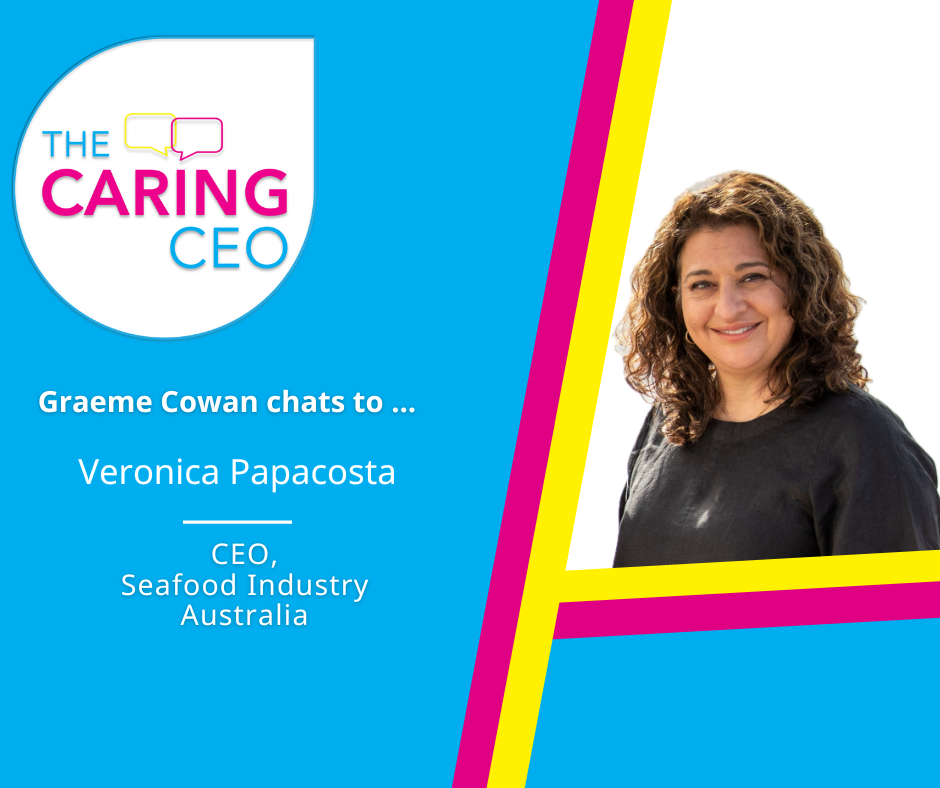
#86 Staying afloat in rough waters, Veronica Papacosta, Former CEO, Seafood Industry Australia


DISCUSSED IN THIS EPISODE
- What caring in the workplace means for Veronica.
- Reflection on how upbringing shapes resilience, accountability, and values — and how different it feels from the way many businesses operate today.
- Addressing mental health issues in the seafood industry, and the importance of peer support.
RESOURCES
Want to learn more about what you can do in workplace mental health training?
Want to to reach out, share a great leader we should interview or learn more about The WeCARE Way, click here to contact us.
Transcript from the interview
Disclaimer: The following transcript was generated using a specific tool. It serves as a convenient method for converting our podcasts into text and allows for easy text searches. However, we kindly ask for your understanding if any typos have inadvertently occurred as a result of the tool’s usage.
SPEAKERS
Graeme Cowan, Veronica Papacosta
Graeme Cowan 00:01
Today’s guest is Veronica Papa Costa, and she’s the CEO of the seafood industry Australia. She comes from a third generation Greek family, and her parents and grandparents have been embedded in the fishing industry their whole lives. She is an incredibly hard working person, and has the experience of being involved in running a family business, but also taking on a big challenge, and that was that the seafood industry had no national body, and she took it on herself to go around to each fishing community around Australia and encourage them to agree to it, but more importantly, to put funds into having this national body. And this got up and achieved some really fantastic results, just in terms of the way that fishing is accepted in Australia, trying to help with getting new workers into Australia, and also having a caught in Australia, element to seafood. Her greatest sense of joy and accomplishment is building a great team. And what’s interesting about her team is that they have always been remote, even before covid. And so she talked about some of the things involved in getting them on one page, embracing a vision, working all together and trusting one another. And these turned out to be really important foundations for a great team and a great result, I think you’ll enjoy Veronica’s very practical and down to earth explanation of what she does and why she does it. Enjoy it’s a real pleasure to welcome Veronica pappacosta, who is the CEO of the seafood industry Australia, to the caring CEO. Welcome Veronica.
Veronica Papacosta 01:52
Thank you. Thanks very much for having me.
Graeme Cowan 01:55
Veronica, what does care in the workplace mean to you?
Veronica Papacosta 01:59
I think that. I think its definition has probably evolved for me, but I used to think it was listening, but I now think it’s more than that. I think it’s ensuring that everybody has the opportunity to thrive in their role and in the workplace. And my learning has been that that’s a much different. It’s very different what
everybody wants to feel, to be like they’re thriving. Get a lot of learning for me around what care really means,
Graeme Cowan 02:25
and how do you go about doing that? You know, when you come into role, there’s people already in place. How do you work out where they should be and what their priority should be, and whether they’re suited or not suited for the role?
Veronica Papacosta 02:39
So I’ve done a lot of recruitment in my my time, and I’ve managed different size teams. I have found that I you advertise a role, people apply for it, saying, I want this role, but what they’re they couldn’t possibly really understand the role until they’re in it and working in it and how they relate. I tend to like to give somebody a role and then sit back and let them have a go. And I would just generally listen and watch for the first few months, but I usually think around three months, I’d set a time to sit down with someone and really have a conversation. And I found that the work or the technical side is one thing, but how somebody’s actually settling into a team, settling into a role, and dealing with their particular stakeholders and relationships is something I like to unpack. And I think it’s really obvious when somebody’s enjoying it and understanding it and feeling energetic, I think you see people give something of themselves into a role by that time. But I also think I’m pretty good at identifying a block, and if there is a block, it’s usually because they didn’t expect the role to look or feel a certain way from the inside, or it needs something from them that they weren’t they are or not willing to give. And I think it’s really just about conversation. So I like to I think most of my team would say I like to provoke in that conversation. I like to give something of my own experience, because I think sometimes people don’t, don’t want to tell you that they’re finding something hard. So I’ll often give something that shows that I have found plenty of things hard in my life to make them feel comfortable, so that they can open up and and we can have a conversation. How do you provoke some it depends on the character. But I do like to point out, I’ll be I’ll always watch, and I have to say that in the last, especially the last 10 years, I’ve 10 to 15 years, I’ve worked remotely. So remote working or hybrid working, wasn’t ever a covid initiation for me, I’ve always, since my eldest child, who’s 18, I’ve worked remotely, and I’ve managed teams remotely. And so I think what happens when you don’t have visual? You know this about the senses. When you don’t have a visual of people every day, you get a very good spidey sense. Your spidey sense develops in listening to how people are speaking. Their tone, their reaction to certain events. So when you don’t see someone every day you you get a sense of how they are from their outputs and their their feeling that their feelings. So I tend to mark a few things over that first three months that I think could have been handled differently or might that were interesting to me. So I’ll mark certain events, and I will usually provoke by presenting them back to them and asking them to explain to me why that particular situation went the way it did have they reflected on it. So I’ll, yeah, I usually sort of hold up a mirror, I suppose, but, but always, I hope, always in a very caring and supportive way. So yeah, it doesn’t always feel like that. I’ve been told before that it can be brutal, even though it it’s ultimately quite successful, very,
Graeme Cowan 05:49
very good. You have very interesting background in the seafood and fishing industry. You mind just explaining to our listeners how you got to this role you’re in at the moment? Wow.
Veronica Papacosta 06:01
So I grew up in the seafood industry. Literally, I tell people that my earliest memory was of drinking a milk bottle under my mother’s fish shop, wrapping bench and watching her legs move around the shop. And I I literally grew up in a fish shop. So everything they now upbringing was centered around that fish shop. And I think the best way to explain it is that experience meant that I went to university and was never going to set foot in a fish shop again. Came out of university with my business degree and went off and worked for some big company, corporates like Land Rover and Optus vision when it launched in Australia, but found that the call of small business really had me hooked, and so about around 2000 came back in to help my brother, who was a very passionate fish monger by this stage, he said, Come and help me. I want to grow and I and I said, Well, I don’t want to work in a fish shop, so I’ll do the growth side, and you do the fish side. And we work together in a family business, which is challenging at best, but we work together really well until around 2015 when I got involved in an industry conversation around the fact that we did not have a national peak body in the Australian seafood industry, so there was an absence of at least 15 years. So that means no coordination nationally, no coordination across the sectors of wild catch, aquaculture and post harvest. So as a retailer, I was saying, Well, it matters to me. The outcomes of the industry really matter, because I need fish to sell, and so I went to a few conversations, and ultimately got involved in establishing Sia, by going around the country and convincing people to get involved and to support financially, as well as their time and and and positions on different issues.
Graeme Cowan 07:39
So and were there many challenges in that? What did people quite a few
Veronica Papacosta 07:44
huge challenges in that. So I was actually given a budget, and I went around and I was the face of the there was a lot of people working in the background, but I was essentially the face of this approach. And I remember doing posters with the support person I had that were like, Let’s get our ship together. So we did like a election style campaign, and I flew around the country on my own, and I met everybody in the industry, and I really just explained to them the direction we were taking, the challenges that we were facing, and that that industry is not guaranteed. We need to protect and defend ourselves and support each other, and that aquaculture was not the enemy of wildcat, that sometimes the challenges were coming from outside our industry, not within hugely complex but over six months, I hit our target, our Go target of half a million dollars. And so we established sia by 2017 and so I was asked at that point, I thought, Oh, great, I can go back and raise my children and go back to my family business do my job, which I put on hold for six months, but I they said, Oh no, no, everyone believes in you now, so you need to stay as the face of this organization. So I took on the chair of the organization. And after 18 months, our inaugural CEO moved on and covid came, and so the board asked me to be the acting CEO, which I took on formally in August of 2020, and I was still here.
Graeme Cowan 09:10
What was the main resistance to setting up this national body?
Veronica Papacosta 09:16
There was a really good point. Industry felt it was very hard to feel that they could be united. So one of the challenges in the industry, and I think this probably happens in a lot of industries, is that everyone sees the difference instead of seeing the similarities. So if I’m in a fisher in Queensland, I’m very different to a fisher in WA. If I’m a fisher, if I’m an aquaculturalist in South Australia, I see myself as in a very different situation to someone in Northern Territory. So identifying the ties that bind were critically important. So sia total mandate was how, how to help industry understand how the consumer and the government see them and being. Retailer. You can imagine I that was all I all I deal in is is seafood, not Queensland wild caught seafood or South Australian aquaculture seafood. All I see is seafood. All the consumer sees is seafood. And all the government wants to know is, what is the seafood industry want. So it was about bringing that together and and helping them understand that there could be some actual impact from what we were going to do.
Graeme Cowan 10:27
How did you manage to get people to understand that you had more in common than you had differently?
Veronica Papacosta 10:34
So I, when I went to a Queensland wild catch Fisher they, I would ask, what? What’s the challenge? What are your concerns, what are you dealing with? I would ask who was supporting them in those challenges now and then I would ask, you know, how they thought it, maybe it could be handled differently. So I would listen to what they wanted first, and then I would tell them stories that I’d been collecting from around the country. And so it was just kind of bringing people together, even if I was the conduit, I couldn’t. It’s very hard to get the entire industry in the room. And when people, some people are on water, and some people are in land, on in, in aquaculture farms, it’s hard to get everyone in one room. So I essentially became the conduit for all of the stories.
Graeme Cowan 11:17
Yep, you’re, you’re the whole room. I
Veronica Papacosta 11:19
wasn’t well in the beginning. I was the whole room and that hence they said, No, you can’t go back to your family business. You need to stay because everyone believes in what you’ve just sold them. And I think that was important for me, too as an individual, to understand that as a retailer, I wasn’t just a trader outside of the industry. I was actually part of the seafood industry, and storytelling is very much connected to retail and trade, and so I got to use the stories. The storytelling skill probably being from a big Greek family as well, but my storytelling skills, what I knew of the industry and its importance to the consumers who love it and the communities who support it and host it, and how to and bringing that all together. So yeah.
Graeme Cowan 12:00
So what’s an example of one of those stories that you told, which you know help to unify people?
Veronica Papacosta 12:07
Well, I think workforce is a really good is a big unifying issue. If I just talk about something quite practically, you can be working out of a fishing vessel in Cairns, and think it’s really hard to find a workforce here. This is something that’s just really tough, because wearing cans, and then I could hold up and say, Well, no, look what’s happening over in WA and actually that was a national issue. So being able to attract workforce is difficult for the Australian seafood industry. I could then go on to explain that actually not just regional communities, but even in the cities, it was difficult. And potentially the challenge for us was not that we couldn’t attract people, but that we maybe didn’t have the reputation that attracted people as an industry. So we could talk about things like, how could we better support your business by by changing the perspective or people’s awareness of what the seafood industry can provide. Fast forwarding that ultimately led to it led to us creating the seafood careers platform, which actually it’s online now, seafood careers.com.au and what that does is talk to kids about what they’re interested in doing, and shows them the vast variety of jobs that the seafood industry provides, and it talks about safety, and it talks about credentials that we have. And I think, you know, whichever issue someone could give me, I found that I could find the same issue having happening somewhere else,
Graeme Cowan 13:33
yeah, and you had, I think, around six or seven years, really building at a very small infant organization. What are your proudest achievements over that period?
Veronica Papacosta 13:48
I would have to say, not by far and away, it would be the team that we built and the influence we’ve been able to have on that shoestring budget that we have. So I would say sia is lean and it is we think about every dollar we spend the team works. They just go above and beyond. Their passion for what they’ve learned and how they connect to members and to government has been fantastic to watch, and we’ve done it completely remotely. So we don’t have amazing we don’t have an office. We started off. I took over in covid. I was already remote working. We didn’t want to spend a single dollar of members money paying for photocopy at repair, so it was very much. Every dollar goes into the work that we do. So I think that’s probably my proudest from a from a work perspective, or a priorities, members priorities perspective, two things. I would say. One was country of origin labeling. So in 2006 the government brought in country of origin labeling in the retail space. So if you go into a supermarket or any retail store, you see where your food is from, they put a caveat on food service. They said, We don’t You don’t need to do that if you run. Food service operation in Australia. 64% of the seafood we consume is imported, and most of that happens in food service. So industry had been campaigning for many years to remove that loophole, and we managed to get that done so on. And I’m really proud of that for sia and for the industry. So the first of July 2025, the legislation changed, and it’ll be enforced from the first of July 2026 so every restaurant, pub club that you go to, if there’s seafood on the menu, will tell you where it’s from. So that’s great, and probably topically for this conversation, the stay afloat program was one of my favorite projects and one of sia proudest achievements,
Graeme Cowan 15:44
and just explain exactly what that is and why you thought there was a really compelling need for it.
Veronica Papacosta 15:53
So before I took on the role of CEO, there had been so dr Tanya King had completed a study that really ripped through industry talking about the the rate of mental health issues in the Australian seafood industry, and that it was twice the national average. So we, we received this study that basically said we had a challenge, that the people in our industry were suffering. There were some indications as to why, and there was discussions. I think the first discussion we had internally was, okay, this is really powerful. And we worked alongside other organizations like the seafood Tasmania and the women in seafood Association. They all stepped in saying, this is a really important space that we need to address and great advocates and so sia our awareness, we needed to understand the space and why we were struggling with mental health issues in the industry. And there were some things that to us that seemed obvious and clear, which is a lot of the people in the industry work alone in remote locations. They don’t really have people to talk to. It’s the kind of industry or wild catch fishing is the kind of place you go to be away from people sometimes. And not only that, but you need to be tough, right? You elements, some of the some of the abalone divers, the the wild catch fishermen, it’s terrifying the work, the environment they work in. So they are naturally quite courageous. And I think we identified pretty quickly that courage doesn’t have to mean not feeling, yeah, but sometimes that’s how it was taken. So we really quickly unpacked a lot of those things. Then also looked at what the government there was a huge government investment into suicide prevention and mental health services, and never enough. Mind you, but there was, there was money going into that space. So why were we not accessing those issues? So the name, stay afloat. We very generously. Seafood Tasmania allowed us to use a name they were already using in their stay afloat program in Tasmania, but so they allowed us to brand ours for consistency, so that we actually people were aware of it. And it was just easier to we didn’t have to explain the name before we got down to work. Yeah, the program was really important because we were supported by the federal government to do a pilot program on a peer to peer engagement process. So we acknowledged that there was beyond blue, there was lifeline, there were services for people who were in trouble. But what about if you didn’t know you’re in trouble? Yeah, and what if you How did you recognize and how do you recognize in your peers within industry that you’re in trouble that was actually a an opportunity that had not been explored enough, and the seafood industry being tight knit, but also like to keep to themselves guide our community. How would we go about that? So the pilot program that we did was called the fishers trial internally in government, but the federal government also ran what they called the farmers trial. The fishers trial for us was that we would train people within the seafood community in and we picked Darwin as our first pilot. Darwin actually Newcastle and Lakes Entrance. So we picked three quite intense fishing communities where we knew there were challenges. There’d been recent government reforms, that been buybacks and things that could create pressure, so we created these pilot programs where we trained people called trusted advocates in those communities. We supported them with materials, funding for barbecues, coffee donut and coffee mornings, and they just got started so they would make sure that they went into communities and connected the industry to each other. So they were people working in the seafood industry. Very early on, we were told, don’t send us white lab coats to try and engage with fishers. And we never did. We trained their friends, we trained their peers, we trained each other and the SIA team. And to start recognizing mental health issue in all its forms and help the people to get to help.
Graeme Cowan 19:50
We have some helpful resources that you can find at WeCARE 360, five.com.au, the first is our mental ill health calculator. Which is a quick and simple way to work out what poor mental health costs your
organization in lost productivity and employee turnover. You will also find our building a mentally healthy culture checklist, which shows how to launch a great initiative and keep that momentum going. These resources can be found at WeCARE, 360, five.com.au, and the pit support is so important, isn’t it so critical for you know, changing culture, for creating a movement, and because being able to speak to people that truly understand your unique challenges, and that sort of thing, I think makes a really, really big difference. And there’s lots, lots of evidence around, you know, peer support programs being very powerful. We work with a group in Canada who’s done called Mental Health Innovations, and, you know, they just specialize in building these peer support programs across the company. Looking back now, is there anything you would have done differently at the start of the stay taking on the stay afloat?
Veronica Papacosta 21:09
I probably would have done my own Mental Health First Aid training course earlier. So when we brought the program on, we hired a woman called Joe Marshall. She was from a company called culture eyes. Had had worked in safety and leadership in South Australia. And look, she was, it was incredible to watch her. So she came in during covid, sat down, got on the phone, and created these pilot communities from the phone. She got people trained online, and so this pilot ran over covid, which we just thought was destined to fail because we couldn’t get on the ground. Yeah, what I what, what I absolutely did right is we picked the right people to run that program. It was beautiful to watch. What I think, but I think my involvement in the beginning was probably I saw it as a project that, as a CEO, I had to run, and I had to make sure it was delivered well, and I always understood the value of it. But I think once I did my own Mental Health First Aid training, yeah, it completely changed my view of the value of that project. So yeah, that’s probably I’ve if I’d done that earlier, I don’t think I would have changed anything. I think Joe did a perfect job in delivering that project. I just think I would have appreciated its impact more. I’d done that, yeah.
Graeme Cowan 22:24
What were the, I guess, the steps you took to roll it out, yeah.
Veronica Papacosta 22:30
So first thing we did was we contacted so and hired Joe, and she was fantastic, and she had this energy and passion about the space that was infectious, and she got straight on to the in those three communities. So I should say that we later then rolled this out nationally, across more than 50 seafood communities across the country. But first thing we did was these three pilot programs. Joe got onto the local, state body and sector bodies, so the associations that were on the ground in those three communities worked with them to identify people that might make good trusted advocates. Yeah, he secured our our goal was to have three trusted advocates per community, and she secured them pretty quickly and got them trained. So went through that training program, helped them understand what they should do, but also what they shouldn’t do. Yeah, they were not clinical support officers. They were there to connect people. Yep, that took a while to sort of help, because when it’s human nature that when you see someone in need, it’s very hard, very hard to not try and do everything you can to help. But there was a very clear peer to peer support service that had to be provided to get them to help but not feel, not feel that you could offer the actual help that they needed. So there were frustrations around time of supports and whether they’d done enough. Pretty soon into the program, we realized that our trusted advocates needed their own clinical support. So yeah, you brought someone in to do that as
well. So getting the trusted advocates up and then supporting them in organizing events and getting people together on the ground, and then we just kind of got a momentum around those events, and then we got some reporting and evaluation that happened alongside, which means we were able to get the pilot program to launch into a national program.
Graeme Cowan 24:16
Yeah, fantastic, fantastic. And you mentioned that you got the people really right? What was it you were looking for in those people? What were the qualities that you thought were absolutely essential?
Veronica Papacosta 24:29
When we interviewed a whole range of amazing people who had great experience in safety and mental health, and we looked across safety and mental health because we were very conscious of the the influence of physical safety and mental health, right? The industries had these physical safety outcomes, which we didn’t realize at the time, how much were sometimes driven by the state of someone’s mental health, the fatigue, the distraction these things. So going into the interviews, what struck me about Joe was that energy and passion, and I think you need that in this industry. Tree, because you need to keep delivering the same message until people trust you. Yeah. So I think getting Joe on board felt very easy, because I knew that she would have the tenacity to wear people down. You absolutely needed it. And so, you know time she spent so much time on the phone, triaging and finding the right people and those trusted advocates. I think one of the things that is fair to say is they also had a lot of care about mental health generally, because they were exposed to it either in their own experience or somebody else in their family, or in their or close to them, in their in their network. So their experience of the tragedy that can befall you know that it can lead to or their experience of how actually you can get through things really help them self identify as a trusted advocate. Yeah, and it just took then, it just took us to train them and give them a way to report and be supported themselves. And it just rolled from there, fantastic.
Graeme Cowan 26:02
I want to jump back to something you mentioned before, and that was being really proud of the team you built up around you. What were the building blocks of that, you know? What was, did you have a process? Did you start with something, or have a few things on the go? What do you think led to that, you know, really committed, focused, engaged team.
Veronica Papacosta 26:24
Well, everyone’s kind of come to their role. If I think about the current team, they’ve all come to their role in different ways, some through recruitment processes, some through word of mouth. They’ve all had an interest in the space that they’ve they’re working in. I think that being in a remote being a remote setting, the only thing I really think I bring to it is that ability to manage people remotely, and knowing that you work well in a remote setting. Sometimes, a lot of people said, I want to work remotely because I want to work from home, but a remote setting, it comes down to your character and what you what you like. Some people want to work remotely, but really like working in in a team in person environment. So what I needed to bring to it was helping them understand what a remote environment look like, making sure they had enough connections. So we have regular meetings. We talk outside of that, but we have a lot of sort of online face to face. But just I think, what I what I people need to feel a
couple of things. In my mind. They need to, obviously be paid. They need and they need to be satisfied. I would put remote working into that remuneration bucket, because remote working, or in person working, is kind of connected to salary in terms it’s the things that that your your role, can give you the opportunity to work flexibly is as important as salary to some people, yeah, and then you’ve got sort of the status, you know, the satisfaction of working and the impact that you can have. And I think impact is through that technical ability, so making sure I support them enough to be have impact, and just guiding them from behind to from the back to help them maybe get more out of what they’re doing. Ultimately, I think it’s about understanding who the person is, and I think in this team, we have a very good understanding of each other. And as a remote worker, I am not a micro manager in the slightest. I don’t know when they clock on or when they clock off or when they get their actual work done, but I have a really good sense of their outcomes and when they’re thriving, and that that is something that that means a lot to me, because I know that great productivity and great outcomes comes from someone who’s feeling happy and content and supported. So yeah, so cool, right? Because keeps going around and around
Graeme Cowan 28:39
you mentioned, you know, the importance of meetings and that sort of thing. But it’s more than that, isn’t it? That like, it’s really also about building emotional connection and belonging. And were there any, were there any things that you did to try and foster that, trying to, you know, to really help people be their authentic selves, talk about what was really important to them, any any steps you did to take them on that journey? Yeah, look at the meeting.
Veronica Papacosta 29:05
The meetings are important. And I think, I think it was Joe Marshall, again, who rang me one day and said, Let’s start the meeting with the team share. Because you know, people in the space that you’re in when you’re talking about you always have fantastic ideas, and so we, we now always start our Monday meeting with a share of what’s going on for you, what’s an interesting story, what happened on the weekend, if that’s if that was overwhelming. So we always start a meeting with establishing where you’re at and who How you feeling, yeah, but I think the trust in our current team has probably built more from those moments where things are going really badly. We’ve had situations with health, with children and family, where they’ve things have been really tough and stat and just getting on with it isn’t, isn’t going to work today. And I think, for a leader and for when you’re leading a team in those moments, that response and how you take care of your team in those moments. Just sets the scene, it builds the trust, or it completely erodes the trust. So I think one thing we’ve done well is responding to those moments very well and offering support even when work’s just not going to get done this week, but investing in the people and making sure everyone’s safe, I think is is the most important thing.
Graeme Cowan 30:19
How do you create an environment where people feel comfortable suggesting ideas, suggesting new ways to do things, and also comfortable challenging ideas that they have reservations about?
Veronica Papacosta 30:32
Yeah, it’s an interesting question, I think, by making mistakes. So I sort of talk to my i There are things in our team where I just know for sure. There are so many things that I just know for sure. I’ve done this
for many years. Please trust me. I asked for trust in certain areas, and say, I know this sounds crazy, but please trust me and and you hope that that that works, but also acknowledging, as a leader, what I don’t know and what I don’t know is vast and extensive and understanding sort of, you know, we’ve got a team member, Julie petty, who is one of the best brains I’ve ever seen. And she reads everything, and she understands everything she reads when she first reads it, and understanding her technical ability and relying on it and trusting it builds trust. And she will come to me with things that I’ll go, You know what? Fine, okay, you’re the expert. You know that? I’ll take that. Jasmine Kelly is our stakeholder engagement manager. Can read a room and a vibe like nobody else, instantly trusting that you know, looking at her and saying, Okay, I get that. Taking that instruction really quickly builds trust between us. So knowing who you are in your team, what you bring, and not having a leader that thinks they have to be the best at everything. Yeah, it gives really important.
Graeme Cowan 31:50
Yeah. What about your self care? You know, being a leader has lots of responsibilities. You also a mother with children. How? What do you do to keep yourself in a good place in the green zone?
Veronica Papacosta 32:05
I would say to you that now my day is completely different to how it was, say, 10 years ago, even five years ago, I, I don’t think I had much of a concept of self care, but I and I don’t think I understood boundaries. There was, there came a time where I was really burnt out, feeling really exhausted, and I remember one of my kids said to their friends, we’re all working from home. And you know, they were home doing their homework. A friend was over, and they said, oh, oh, my mum works here. She works at home. And they the they were having a little conversation about it, and my son was like, Oh no, no, that’s all. All she does is work. And it really struck me, I thought. And I thought in that moment, I realized that my sense that my children are my my main priority was not clear to them, so they thought work was the main priority. And look, I’ve always I’ve never stood back from the fact that I really enjoy what I do. I’m passionate about the people I work with and what we do, but my children are my main priority. So I re I made it. I realized that I needed to to redefine the way they experienced my time. And once you take that piece of time out and give them that, then actually I need to figure out how to work smarter and harder. So I would say the first thing I did was identify the time with children, which then meant that I couldn’t work around the clock. I had to have boundaries on my work time, but I was still as effective as before. I just seemed to be doing things smarter, more efficiently, and delegating and sharing more with the team. And then I would say, after that, self care came in. So I took very I realized that actually, if I got up and just walked the dogs in the morning before everything got started, even if I lost half an hour of sleep, it put me in a better frame of mind. I am really addicted to my night routine now, so I I step away from even the kids now, and I just have this sort of one hour before I go to bed to really just wind down and make myself feel like I’m about to have a great sleep. So yeah, and what are the things you do in that hour? I really enjoy reading. I like business books. Really. I, you know, I wish I read fantasy and things that were more but I really just enjoy business books and investing books. So I’ll take some time to read. Really enjoy my shower and, you know, my red light therapy and some skin care therapy, and it just winds me down and lets me sort of wash everything off from the day, because sleep is the place where I’ve probably had to spend the most work maximizing my sleep, but actually making it good quality as well.
Graeme Cowan 34:38
What were the things that you learned about leadership from your mother and your grandparents?
Veronica Papacosta 34:44
Wow, that’s huge. I I think they Well, their form of leadership was lead from the front and the best and the toughest and. And watching that, I did that for the longest time, and this is going to sound terrible, but I think what I learned was that there were other ways of doing that. So watching that approach means you You are the tiredest as well, and sometimes a tired leader is not the most effective leader. So I think actually my mother’s it’s really interesting that you raise her, because we still, she still works in the family business, and we talk about this a lot. Yeah, she’s 71 still work every day to work ethic. Okay, that’s right. So and look, I am so grateful for the work ethic that I’ve been given, but I’m actually we do a lot of talking around self care and boundaries, and so I think what I did was I went away and learned those things in the mainstream workshops, and was able to come back and share those learnings with my grandparents and my mum and and we, you know, we’ve we’ve developed, I think we’ve improved each other together.
Graeme Cowan 35:56
I can’t believe how quickly our time’s gone. Veronica, but I always finish with the same question, is, you know, knowing what you know now? What advice would you give to your 20 year old self?
Veronica Papacosta 36:09
Wow, but So as someone who’s probably someone who’s probably suffered from a little bit of an imposter syndrome, I would say, focus on, don’t focus on the degree or the the PhD or the experience. What you give to people is enough. What what you you know, your energy, your passion and your interest matters just as much as the PhD. Fabulous.
Graeme Cowan 36:36
That’s a great message for us all. Veronica, and thank you so much for being part of the caring sea. I’ve really, you know, enjoyed, I must admit, I haven’t really had exposure to the fishing industry, and so, you know, it’s just very, very interesting to look at other places. But, but also, the other thing is, is the really, really nice, how much each industry has in common I work, I work for a long time in in recruitment and consulting and consulting and that sort of thing. And used to go to an industry and say, our place, you know, our industry is really different. You know, it’s hard to get good people. People are trying to get stuff cheaper, and, you know, you can’t, you can’t make any money. Yeah, so there is more in common, isn’t there with different industries than there are different
Veronica Papacosta 37:20
so much I spend a bit of time working across agriculture, particularly when you’re in seafood. And whenever someone says something, you say, Yeah, same, same. I mean, there are, there are peculiarities, a very variant of every industry, and there are different personalities but them, yeah, everything’s the same. We’re all in the same boat.
Graeme Cowan 37:40
Thanks for being part of the caring CEO Veronica.
Veronica Papacosta 37:44
thank you so much. Graeme. Appreciate it.
Graeme Cowan 37:46
Thanks for joining us today. We hope you’re inspired to strive for a culture of care that also leads to great results. If you’ve enjoyed this interview today, please rate us on your favorite podcast platform, and don’t forget to subscribe so that you don’t miss an episode. We also welcome any comments. If you’re interested in seeing details about our scalable WeCARE365 mental health training programs, please visit us at WeCARE365.com.au, our goal is to make these programs accessible, practical and ongoing. You can also find me, Graeme Cowan, on LinkedIn, and I’d love to hear from you. And finally, if you’ve come across a senior leader who has impressed you and you think they’d be a great guest, please email us at support, at WeCARE365.com.au, or AU, thanks once again for listening today.

Oh, you are inquisitive… getting all the way to the bottom of the page!
Thanks for listening 🙂
From all of us at The Caring CEO, and the WeCARE team, keep listening, keep caring and lead with your heart.
P.S. If you want to reach out, share a great leader we should interview or learn more about The WeCARE Way, click here to contact us.
