
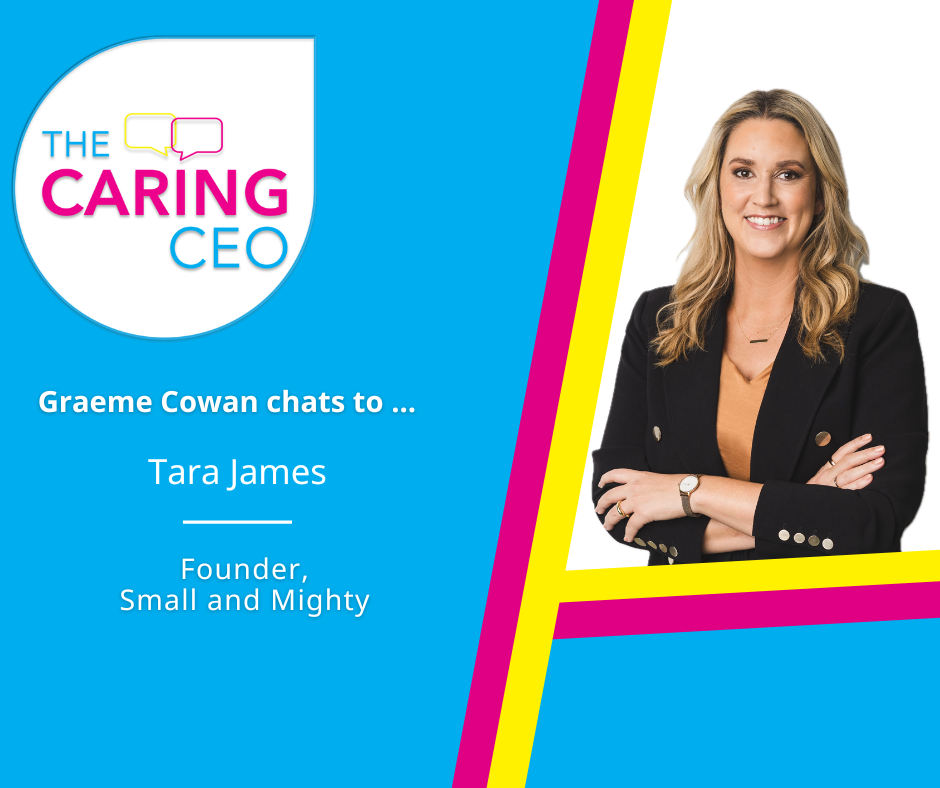
#87 Clarity counts most, Tara James, Founder, Small and Mighty


DISCUSSED IN THIS EPISODE
- What caring in the workplace means for Tara.
- How leadership starts with psychological safety.
- Self-care and emotional intelligence to feedback, humility, and “human first, human last” in the age of AI.
RESOURCES
Want to learn more about what you can do in workplace mental health training?
Want to to reach out, share a great leader we should interview or learn more about The WeCARE Way, click here to contact us.
Transcript from the interview
Disclaimer: The following transcript was generated using a specific tool. It serves as a convenient method for converting our podcasts into text and allows for easy text searches. However, we kindly ask for your understanding if any typos have inadvertently occurred as a result of the tool’s usage.
SPEAKERS
Graeme Cowan, Tara James
Graeme Cowan 00:00
Today’s guest is Tara James, and she has a very interesting background. I used to be in recruitment, and it’s fascinating to see the twists and turns she’s taken. She started working at the Intercontinental group in the Kakadu National Park, and so had experience with some large multinational organizations, but then made the decision to start her own business, which was called small and mighty. And right from the start, she encouraged remote working, and so she was able to work all over the world. This was pre covid. Since starting that, she’s worked with a huge range of organizations, everyone from Specsavers to a biotech company called Tech cycle, Southern green gas, an energy company. And what’s interesting is that she talked about, which I’ve discussed in the past, is that we often think our industries are quite different, but the one common element is the people and the people we lead. So you know, building psychological safety, having a culture of care, encouraging people to challenge your ideas and encourage them to suggest things that they make sense of is really the difference between success and failure in this world. She wrote an interesting article for the CEO global magazine, which was called Clarity, not urgency, will define global leadership. And that was published in January 2026, and when we dug into that, it was really about having greater clarity around job descriptions, around success and failure, around boundaries to have She is a wonderful, insightful thinker. She loves to travel with her work, and she describes that as one of her real joys that rejuvenates her while she’s away. There’s a lot to learn from Tara and joy, it’s a pleasure to welcome Tara, James to the caring CEO. Welcome Tara, thank you for having me. Tara. What does care in the workplace mean to you?
Tara James 02:24
Well, for me, care in the workplace is about creating an environment where people essentially feel safe and valued, and it’s really the foundation for well being and performance. So care, I think, is shown through consideration and consciousness, and that relates to the actions and outcomes. So it’s really how we interact with our team, the impact we have on the environment around us and broader society. And of course, a big part of that is about creating psychological safety.
Graeme Cowan 02:53
Yeah, and how do you go about doing that? Do you have any particular method, or is it intuitive? How do you how do you make people feel safe.
Tara James 03:02
Oh, well, I think there’s a few parts to that. Creating the space I think is important. So psychological safety as a leader, particularly so myself, and also the leaders I work with, a big part of that is demonstrating the safe and inclusive environment. So with psychological safety, encouraging people to speak up, so if there is a problem, they feel safe to be able to speak up and raise their voice. And maybe it may not be the opinion of everybody, but that’s often, sometimes the those brave ones to speak up is important, and that’s where coming back to performance, that’s how we can improve as as a team, as a company, and make that impact.
Graeme Cowan 03:42
Yes, no one has all the information and all the knowledge these days, and we really need to tap into the wisdom and knowledge the team. And people don’t feel comfortable do that if they’re quickly dismissed, or people roll their eyes, or they don’t accept an opinion. And you know, there’s many, examples of big physical disasters when that has happened, plane crash. This is issues with, you know, sea petroleum extraction, you know, really physical ones, but also lots, lots of ones from a psychological perspective as well.
04:16
Exactly who did you learn
Graeme Cowan 04:19
to do that from do you think, or is something you just picked up intuitively?
Tara James 04:24
I’d love to say it was all intuitive, but I definitely can’t claim that. I’m very fortunate to work alongside an organizational psychologist and leadership specialist at small armady so Tobin Thomson is definitely has taught me a lot over the last 10 years, and being fortunate enough to pass that on to a lot of clients as well. Some of the things I’ve learned, one of the key things that sort of sticks to my mind is he says, you if you can’t take care of yourself, you can’t be anything for others. And I think as leaders, that’s really important, because there tends to be a high focus on team, well being and care. However, if. Leaders who are essentially leading those teams, if they can’t take care of themselves, if they’re not looking after their own well being, things start to fall apart. So I would love it if, if that sort of conversation was a bit more bit more balanced, and that conversation at, for example, board levels, in leadership meetings, it was made a bit more, bit more comfortable, bit more open to be able to share, share these challenges.
Graeme Cowan 05:23
Yeah, my new book, great leaders care, which is coming out in April, the first excuse the plug but, but it talks about three elements of care, what I call a great leaders care mindset. And the first aspect is self care, you know, making sure we have fuel in our own tank, which you just described. Yeah, crew care, which is about building psychologically safe and engaged teams, and red zone care, which is being
able to identify and support those that are struggling. And there is a lot of struggling going on right now. You know that recently, Wiley, just in December 2025, found that there was 37% of employees severely stressed, but it was 46% of managers severely stressed. And you know, it can be incredibly hard as a manager or leader, trying to keep things going, but making sure you take time for yourself, which you know you’ve just really spoken very eloquently about.
Tara James 06:27
Yeah, exactly. You’re exactly right. And I see that a lot in the work that I do, that managers, CEOs, it’s correct when they say it’s tough at the top, because it is quite can often be quite isolating, and it’s that’s why it’s important to to build a network around you and establish it early so you can have that aspiring partner and understand what you need as an individual to to become resilient, which is absolutely, very key to this. Yeah.
Graeme Cowan 06:54
What do you do for your self care?
Tara James 06:56
Life says very individual. So the things that I look to do when I need to have a bit more balance is simply break up the day with going for a walk, getting outside, getting some fresh air, being around people that I feel comfortable is talking because as leaders, you obviously can’t often talk about the challenges you’re facing at work with your team. So being able to surround yourself with that support network is definitely important. Yeah, actually,
Graeme Cowan 07:23
just speaking with my wife earlier on. She’s a professor in cancer epidemiology, and they’ve got an overseas delegation visiting them today, and it’s been rock solid. And she called me about 30 minutes ago, said, I’ve just got to walk outside around the oval. I’m going to get some fresh air. Because Exactly, yeah, I really, I’m really feeling it. And, you know, even those small breaks can make a difference, can’t they absolutely.
Tara James 07:47
And I think also recognizing when you need to take those breaks so early, when you’re talking about your book and the elements within that, think a big part of that is emotional intelligence, so as as a leader, understanding and having that self insight and self awareness is probably two of the most valuable tools you could have, and especially if you can then teach your team how to have to develop emotional intelligence, then you know, you can spot the cue before it becomes a big issue, and then we end up with what we’re seeing a lot out there is burnout and fatigue, and obviously that has a lot of impact, not just on the team, but on the companies. So it affects performance. Mistakes happen and yeah, some terrible consequences can occur, like you mentioned.
Graeme Cowan 08:29
Yeah, I interviewed Bob Borstein in my previous book back from the brink, and he lives with bipolar, but he also was the Director of Public Policy with Google based in Washington, and he said that you have to learn to be your own therapist. And he wasn’t dismissing, you know, the need for professional help,
far from it, but he just said that you know, you have to learn to catch yourself early, know your own early warning signs and take corrective action. And I’ve had some, you know, severe bouts of depression in my life, and I know how important it is to catch it early. Now take corrective action. And for me, you know, that includes a lot of regular exercise, catching up with, you know, good friends, and I guess, also feeling a sense of purpose. And, you know, in a very fast moving world, purpose is important, isn’t it?
Tara James 09:27
Absolutely it is. It’s a big part of of well functioning teams. So it’s been quite a lot of research around that that topic, and having that common sense of purpose can create, I guess, a more harmonious team, but a much more enthusiastic. There’s research being done where reduced absenteeism. People become more creative, thinking. They feel safe to speak, speak up, like we’re just discussing. So there are multiple benefits of that for sure. Yeah.
Graeme Cowan 09:55
Very much. So I saw, I looked through your LinkedIn profile. And so you had just written an article about 2026 clarity, not urgency, will define global
10:08
leadership. Yes,
Tara James 10:11
yes. I think for the last many years, there’s been a focus on on growth. So seems to be growth for the sake of growth sake. But that, of course, burns out people, culture and purpose. So what I believe now we need more than ever to navigate sort of this time of uncertainty, rapid change. And of course, it’s not all bad. There’s a lot of technology adoption, AI adoption, there’s there’s lots of exciting things happening, but the pace is fast. So what effective leadership requires is clarity, and a term I often use is Hurry up slowly. What I mean by that is move decisively, but never faster than your own thinking. So take pause before rushing and going. I’ve often seen people afraid like, oh, quickly, smash this out. Or I’m so busy, busy, or those sorts of phrases. It’s just encouraging people just to take a moment. Because often when you do get caught up in the speed and rushing, it obviously causes a lot of stress, anxiety, and that has a ripple effect through the through the whole organization, and often it does end up costing the organization. So Mistakes happen or reruns need people don’t listen as carefully with that clarity, and then we will need to have free runs and repeat, of course,
Graeme Cowan 11:28
yeah, I think that’s so true, and I often, when I do keynote presentations or workshops, you know, run live polls and regular at the top now, about The most, biggest stressor is uncertainty, you know, and that can come from all sorts of different areas. You know, come from your home life, your finances, but it also work plays a really important role there, doesn’t it?
Tara James 11:52
Definitely, yeah, and that is, that is a cool a key feature of effective leadership is, is keeping calm under pressure, obviously, sharing that that kind of gets clear vision of where we’re going and what we’re
looking to achieve. I think it’s also important to remember that we aren’t perfect as CEOs and leaders. We make mistakes, so part of that is also sharing when you make those mistakes and and that we’re only human. Because I think sometimes like, we like say, referring to being our own therapist. While I agree with that, but I also think that we were only one person. We’re not superheroes, and we also need time to to recharge our own batteries in however ways that that looks for an individual.
Graeme Cowan 12:35
Yeah, and humility goes a long way, doesn’t it? When you’ve been you don’t know everything, but you need other people to be part of it. People step up, don’t they?
Tara James 12:44
Yeah, that’s right. And it can be challenging, I think, because it isn’t really the traditional approach to say, I made a mistake in front of a large group of people, when often you as the leader. They’re they’re looking to you for all the answers. But as as you say, if you admit that, while despite your best judgment, this ended up not being the right decision, I think you then that humility generates a lot more respect, and then people are more likely to work with you, to follow you and yeah, and achieve
Graeme Cowan 13:13
with you. I come across some really interesting research from Gallup over the last six years, and they found that even in the first year of covid, people were more sure about what they had to do, you know, I guess people thought maybe they’re over communicating or, you know, doing all these sorts of things, but they had a better idea, and there is less clarity now than there was in the first year, quite a bit less than the first year
Tara James 13:41
of does that makes a lot of sense to me. Yeah, because we were, we were forced to slow down when we were forced to reflect and and look inwards, I suppose so that self reflection and insight was was something we were all made to do, which wasn’t natural for a lot of people. So makes a lot of sense.
Graeme Cowan 14:00
How would you suggest that leaders improve their clarity?
Tara James 14:06
There’s a few things, I think, like obviously, growing up slowly is one core thing, but also not admitting we you may not know all the answers, so ask your teams something we also potentially don’t do enough of is asking for feedback, so setting time aside after a major project or after an event or a crisis, and and looking at what worked well, what didn’t, what could potentially be done differently, and how next time and be open to receiving that that feedback. Because if you you receive that constructive feedback, it will open up mutual respect and understanding. The communication will become stronger between you and you can become a better leader.
Graeme Cowan 14:49
I heard one of my previous interviews David. He was the APAC CEO for Pearson, the publishing company, and he talks about how he would. Regularly ask in his one on ones, what are three things I
do that frustrate me and but he said, you know, takes a bit of courage to do it, but you really learn some really significant insight on how best to work with someone. Have you had, have you thought of other ways that you can sort of tap into people and help them to be really honest, and sometimes brutally honest.
Tara James 15:25
I think like asking the question is absolutely the right step, but again, creating that environment where they feel safe to speak up to say so that would be probably the two big things, making it, I guess, embedding it as a normal process. That’s probably the other other parties, rather than formalizing it as a review or a performance review or a formal structure, make it part of your everyday conversation. So that reduces the fear potentially, to speak up to your leader, because it’s obviously more difficult to tell your CEO you don’t like what they’re thinking than opposed to your peer. So normalizing it and demonstrating it. So that’s that’s the other part. And once you’ve received that feedback, actually act upon it. So we’ve all been in that situation where we’ve been asked to share feedback and then nothing happens. So showing that you’ve actually listened and and taken it on board in some way, shape or form.
16:21
Yeah, that’s great.
Graeme Cowan 16:22
Great. A great tip. We were speaking before we came on air, and I mentioned I’m Executive Search, and I was fascinated by the number of different industries they’d been in. Would you mind giving our listeners an overview of the things that of your career and your career progression?
Tara James 16:42
Yeah, for sure. So it was about 10 years ago. I had been working in management for quite some time across different sectors, and felt like I had more to give, essentially. So founding small and mighty group established a platform to work with leaders and companies around the world. It was also at the time where remote working wasn’t normal, and that, I guess, is part of my my approach, my personality, is to to look potentially of unconventional ways of doing things, if it makes sense to do so. But over that time, I’ve had been fortunate to work with industry spanning medtech biotech. Worked a lot with engineers and scientists, but right through to manufacturing, retail, finance industry. So it’s a real broad range of industries, size of companies, from startups right through to multinational companies from Northern Europe to cafeteria. So I’ve definitely had the pleasure of working in lots of different diverse environments, working with lots of different leaders, but something we were just touched on before we went on to air, was that despite all the differences, there’s still those common threads in terms of what makes a good leader and what creates a caring culture, and the direct impact with performance in relation to that,
Graeme Cowan 17:56
we have some helpful resources that you can find at WeCARE 360, five.com.au, five.com.au, the first is our mental ill health calculator, which is a quick and simple way to work out what poor mental health costs your organization in lost productivity and employee turnover. You will also find our building a
mentally healthy culture checklist, which shows how to launch a great initiative and keep that momentum going. These resources can be found at WeCARE 360, five.com.au, you’ve worked a lot with scientists and engineers. What do you see as their strengths and weaknesses is, is is it a con one across the group, or is there some nuance there?
Tara James 18:47
I think it’d be unfair to put them all in one bucket, because, as we know, some the stereotypes were probably quite different to the reality of some. Some were quite introverted. Some are extroverts. So but the what I personally enjoy working with these more technical, complex industries is the knowledge. So learning different nuances on or opportunities or technology that could potentially save lives, which has experienced with technology, which is life saving, has huge impact on on planning and reaching net zero, so the technical aspects of that is really interesting. And then what I have had the privilege to do is to be able to absorb that and then translate that into a way that we can actually take to market, commercialize it help translate to investors or customers, to take that further. Yeah, that’s that’s been very, very, very interesting.
Graeme Cowan 19:45
Yeah, often it’s very important to be able to simplify things, isn’t it? I guess it comes back exactly right your clarity point. Because, as I said, My wife’s a professor, and she has a very high bar for research. She says, show me the details. Show me the details. Else, but, but, to be fair, you know, she has always strived to be able to simplify the message, and I think that’s been very helpful.
Tara James 20:11
That’s right, yeah, candidates get lost in the noise. That’s essentially, there’s, there’s a lot of ambition out there, but ambition without clarity, exactly, that’s just noise that that is probably sometimes working in these in these industries, that can be the their undoing of not progressing and not actually taking it to market, is getting lost in the detail. So clarity in that instance is is crucial, and that’s obviously what I help them do.
Graeme Cowan 20:36
I’ve also found AI to be very, very good for clarity as well. I can put a whole page on there, but ask to simplify it to one sentence or simplify it to three words, and it does it incredibly well. You know, I think there’s, there’s big potential in simplifying things using AI, whichever mode that you
Tara James 21:01
use, yeah, absolutely use. Well, it can be extremely powerful. Something which was mentioned to me years ago, which really stuck with AI is, is it’s really important to have human first, human last, because with the the huge rise in AI adoption, I think there’s a a large group of people, they’re very keen to use the tool, but really haven’t quite articulated how, and so that’s when we fall back in the noise and the lack of clarity. So understanding what problem it is this is looking to solve is very much important to get that clarity and also making sure it’s, you know, obviously facts checking, so you still need that human last look over things to go is this, is this correct? Have we lost the meaning somewhere in, in the mix?
Graeme Cowan 21:46
Yeah, yeah. That’s a very good point. I’ve never heard that said before, human first, human last, but I’ve sort of it should reuse that, because I, you know, might have something summarized and what have you brought it down to, you know, 200 words, but then I tend to read it and say, Does this sound like me? And many cases, it doesn’t. So you know, sometimes, sometimes just different words. But you know, sometimes, not often. These days there can be something completely wrong,
Tara James 22:18
that’s right. And again, it’s taking that moment, that couple of moments to pause and go. Does this make sense? And we’ve all heard about some, some high profile consultancy firms which which have got caught out by using AI incorrectly, and there’s been mistakes and whatnot in that. So it’s just those few moments, or, you know, even an hour to check can save you a lot of it later. Exactly, exactly right and reputational damage, exactly, I think
Graeme Cowan 22:44
the example you talked about, you know, the bill was for 400,000 that’ll reduce it to 130,000 something. So, yeah, just, just by not properly checking the back page and the references, yeah, it’s a wake up call for all of us, right? Yeah, we can’t accept anything there,
Tara James 23:03
yeah, but it’s part of our that’s what we’re just gonna say. It’s a part of our life now, really, is digital transformation, and the tools we get presented to years ago was when social media came on the stage that was groundbreaking. We weren’t really sure how to navigate that. So we’re definitely on a learning and adoption curve, and it’s good to have these conversations around
23:22
- Yeah,
Graeme Cowan 23:24
have you ever had any you know, severe setbacks in your career?
Tara James 23:29
Don’t think I’d necessarily call them setbacks. There was times where, actually, it’s something I often do, which is stop and pause and and reflect, kind of calibrate things, things on track, and then it’s something I’ve spoken with with others about, is when you have that feeling, or you might be feeling like having a bit of a crisis, is it’s actually a good sign, because it’s telling it’s your internal compass saying something’s not quite right, something probably needs to change. So probably that time was when, before I established smaller mighty group, was when it didn’t really feel like I was maybe making the Mark I was wanting to on the world, so to speak. But that was a good opportunity to pause and and again, use that self insight and reflection and and challenge it a little bit to help get you back on on track.
Graeme Cowan 24:15
It’s always a big move to go from, you know, an employer situation, to self employed, which you know you’ve gone through, was that a hard transition to make?
Tara James 24:25
I think retrospectively, there was a lot of challenges, and they, as you say, You know what you know now. You’d probably do things a little differently, but it’s also exciting. So it’s not, I’m not someone who would take the normal path, as they say, The Road Less Traveled is a lot more windy, but often I find a more exciting one. So yeah, it was. There’s definitely been challenges about lots of awards, and very happy to have learned what I have along the way, and people I’ve met, and it’s been very valuable.
Graeme Cowan 24:54
Yeah, I saw in one of your roles previously may well have been a consulting role as a. Political capability group for spec savers in in Europe. Yeah. How did you come to get that position, and what were some of the changes you had to make when you’re on that path?
Tara James 25:14
Well, I guess over the years, as most organizations do, we grow and we scale. So in the beginning year one, obviously it was, it was just myself, and there’s one other person, and then we grew to a team of bit over 25 people. So as as we we sort of our capability grew, our market awareness grew, and gratefully, attracted some really interesting clients, like step savers in Northern Europe. So we adapted one obvious, big one is time zone differences. So working across time zones, and that really forced us to think about our way of working. So we’re already working remotely, but then working outside the normal nine to five and and how to do that without burning ourselves out was, was one thing we really had to look at. So yeah, those types of types of roles, it’s been really great because I’ve been able to, been fortunate to be able to take on interim CEO roles, like with tech site recently, and similar ones like you mentioned with spec savers, where we can really get in and rather than just creating the strategy rapidly getting and implement and execute.
Graeme Cowan 26:20
Yeah, the time zone one is a really significant challenge. What, how do you find the best way to to work that it
Tara James 26:28
depends, obviously, where in the world you are. Sorry, I remember having a meeting in in Iceland at close to midnight with a client in, you know, Adelaide. So I think the key is to remember again, you’re in the human so you need to make time to rest and restore and as I mentioned, we don’t have auto recharge batteries as leaders. So making that time, but also a key part of it is setting boundaries and and communicating those with your team, with your clients, so so they they understand and sticking to it so often we can set boundaries. For example, I’m not looking at my emails. I’m not taking meetings between these times because I need some sleep. Quite reasonable, the dashes sticking to them. So those are things that I think are important to do. It’s really interesting.
Graeme Cowan 27:16
You say that because there was a well publicized case last year, and it was a workers compensation case. The company was Cowan mining, and they had two accountants in Australia that reported to a finance head in Switzerland, and it became incredibly challenging for them. They complained to their
boss, and, you know, they virtually said, we’ll just sort it out. You know, you should be able to manage time anyway, it ended up leading to them, you know, complaining about it with the some of the outside bodies. And then it was fully investigated, and what they found was it wasn’t just surprise, surprise about just two people in the organization. It was about not having clear roles, you know, clearly to find roles, clearly to find things you could say no to not say that to. But the company ended up having to spend, or was committed to spending, a million dollars to fix it, to sort it out. And that was, you know, doing some of the basic things, like having proper position descriptions, having people go through assessment to see if they’re using their strength and those sort of roles. So we know intuitively that it’s bad with time zones, if we if we don’t manage it properly. But you know, this actually led to a legal case, which led to a very big payout, yeah, yeah.
Tara James 28:48
And I’m not sure if it was that exact one, but I’ve also heard of similar so it’s often the simple things, like you mentioned, position descriptions, that get missed. And to be a caring CEO, these are fundamental things so that in terms of causing stress and burnout among staff, having that clarity is a great way to help prevent that. I recall being working in in a team, and talking with one of the staff members that they and they felt that that they were expected to work all the time because they had an office in South America, so they just hadn’t had the manager, hadn’t had the opportunity to talk to them say, actually, no, that’s not what we’re expecting from you. So just having the communication open to be able to explain what the expectations are can also go a really long way.
Graeme Cowan 29:37
Yeah, you mentioned text height and you became a co CEO there. How did you sort out who does what when you’re a co CEO?
Tara James 29:48
Yeah, it was a bit of a non traditional approach we took. So I’d actually been working with the company through small, mighty group for about five years prior to that. So it was a bit of a natural evolution. And we. Where the team had got to is there was quite a strong, lot of skills in research and obviously science based technical skills. But where there was a gap was commercialization and the more strategic focus. So it reached a point where the technology was ready to be taken further and taken to market, essentially. So that’s where having clear roles, clear areas as a co CEO, worked really well. So my co CEO was the scientist, had a very strong technical background, which was very complimentary for mine, which was much more business and commercial focused. So that that worked really
30:35
well. It’s a win. Win, exactly right?
Tara James 30:38
And there’s, there’s been quite a few, actually, I’ve heard over the years, it obviously doesn’t work for everyone. Meat requires a lot more, probably, self inside and emotional challenges potentially, than if you were just on your own. But even I was just reading a book recently conscious capitalism by looking at it here. John Mackay, John McKay and Raj de hope, I said that, right? And he’s co CEO of Whole
Foods Market. So that is obviously a huge American organization. So there’s definitely some examples out there that work really well,
Graeme Cowan 31:10
yeah, what do you do when you’re not working? What’s something that you love doing? Recharges your batteries. Got nothing to do with work?
Tara James 31:19
Well, the good thing with the way I do work is I can blend two of my passions, and that is travel. So that’s and it’s probably a way that, as we’ve moved from being very, I think years ago, was very focused on having work life and personal life was separate. More and more, I think today that they’re blended, so, which is not necessarily a bad thing. So what I’ve learned to do is learn how to integrate the two, but have a focus on each one they need to be because if you’re in the you’re multitasking, or if you’re trying to focus on both, you’re not really presently there. So while we are going, like, say, go to Europe, for example. For work, it’s taking the time to go see some sites. Yeah, that’s definitely part of what I enjoy doing. Or even if it’s just it’s too Adelaide or to Melbourne in seeing what’s around and going to a gallery or something like that.
Graeme Cowan 32:17
Yeah, I love to travel as well, and I really don’t like the term work life balance, because it implies that life is good. Work is bad, exactly. But for many people, and I’m certainly one of those like you are as well. You know, works something that is really important to us. You know, we get a sense of purpose, right? We use our strengths and hopefully make a difference. And I wish you know that was more widely embraced, and maybe it will be as time goes on, because I think it is just a very, very healthy way to do things. And you know, my wife, Karen, who conferences, has gone all over the world, so we often do something, you know, following a conference. You know, there was one in Lisbon about five years ago. So we decided to do the the Portuguese Camino, which starts in Porto and finishes up in Santiago. And it was such, such a such a contrast for her, because she was presenting at the conference in a scientific forum, and paranoid about it, everything is correct and not correct. But then, just to be able to switch off, not even have a phone during the day, a total, you know, total relief. And we’re both lucky like that. We do both work hard, but, you know, we do it in a, I think,
Tara James 33:35
yeah, the way that works, yeah, that’s right. And when you, when you enjoy what you do, when you, when you feel that purpose in your work, that’s it’s obviously not, doesn’t, doesn’t feel like work when you’re enjoying what you’re doing. So creating team, creating a culture in your organization where it does feel nice to be there, then you obviously you’re not going to burn out as quickly and and need those resets and recharges as much potentially,
Graeme Cowan 34:00
if I asked three people that know you well, what your strengths are, what would they say?
Tara James 34:06
Three people to get these people in my mind now, one would probably be, well, that I genuinely care. So that’s I genuinely care about my clients, the people we work with, my team and what we do. So that’s that’s core to my purpose, my personal purpose, and also the work that I do, and also I am open to being challenged, and particularly my biases. But we’ve all got biases. It’s important to recognize these and understand these and and I think people would also say, I’m I’m happy to be challenged, and reflecting on that
Graeme Cowan 34:41
fantastic, and it is interesting. The care thing, you know, often I ask people to reflect on, you know, what’s been about their best team? You know, whether it’s this team or previous team when they worked at McDonald’s or or even for a sporting club, a sporting team, and what made it different? And generally, three things come through, you know, we have people vote for it. One is, we cared about each other. We had each other’s back, you know, and that’s, I guess come you know, we can be frank and honest and challenge each other, and that’s well, and we encouraged each other. And, yeah, those three areas, and you know, what you describe is very closely aligned to that. There’s also the Gallup research, the Q 12 engagement survey, and one of the statements is my supervisor, or some of that work seems to care about me as a person, not even does, seems to care about me as a person. But the more people that strongly agree with that statement, the higher the productivity, profit, customer service levels, and the longer people stay in the organization. So it’s not a soft skill anymore, is it? It’s absolutely not, sincerely a strong skill. And you know, that’s what we have to keep championing that cause
Tara James 35:57
exactly like you’re you’re dead, right? It’s not a soft skill, and I would say it’s actually an essential business skill, because if people feel that the manager, the CEO, the team, cares, they will feel that sense of belonging and purpose, as we were discussing earlier, which has enormous memorable effects.
Graeme Cowan 36:15
If you had the opportunity to teach something to the world in a simple way, in a clear way. What would you like to teach the world?
Tara James 36:26
Probably returning back to what we were discussing earlier, would be the importance of and how to hurry up slowly and really helping people understand that, and probably early on in their careers. So if when you’re first starting out, you feel a lot of pressure to perform and do things at speed, that understanding that he doesn’t always equal success. I originally when I was when I was younger, actually watching my growing up, and watched my dad build and restore cars and race cars. So I watched him racing. And when I got a little bit older, he actually taught me. He actually said, Maybe you should have a go at being behind the wheel. Tara, so I said, Okay, let’s, let’s give it a go. And what I learned from that was actually how to be strategic and and under pressure, how to take calculated risks, and also how to rep slowly, essentially. So to speed doesn’t always get you there, but it’s how you you take the corners and the challenges that gets you there.
Graeme Cowan 37:25
So true. Long Walk on Sunday, and I thought I knew what I was going to went in a different entrance to the National Park, and I thought I should be able to figure it out. Yeah, I just worked walking this way and got tougher and tougher and tougher and bigger cliffs and all this sort of stuff. Why didn’t I look at the map rather just why did I hasten slowly?
Tara James 37:53
That’s it. Yeah, that’s it. Sometimes the ambition and the enthusiasm gets the better of us, and I think we’re all guilty of that. That’s yeah, we’re not perfect, that’s for sure, but yeah, part of the journey, isn’t it, and sometimes you find different things you wouldn’t expect along the way.
Graeme Cowan 38:08
That’s right, that’s right. And I even wrote that down as a reflection. I didn’t use the word to hasten slowly, but it was something like that, check it regularly, or something like it, I think it
Tara James 38:19
was, or take your phone, it’s
Graeme Cowan 38:22
been real pleasure catching up. Kara, our time’s gone so quickly, and I love how succinct you are in your answers and the things that you found have really, really worked for you. But I always finish with the same question, and you alluded to it earlier, and that is knowing what you know now. What advice would you give your 20 year old self?
Tara James 38:47
I would say you’re on the right track. It’s not a it’s not a sprint, it’s a marathon. So make sure you keep some fuel in the tank for yourself and and enjoy the journey.
Graeme Cowan 39:00
What great advice. Thanks so much for being part of the caring CEO,
Tara James 39:03
Tara. Thank you very much for having me.
Graeme Cowan 39:07
Thanks for joining us today. We hope you’re inspired to strive for a culture of care that also leads to great results. If you’ve enjoyed this interview today, please rate us on your favorite podcast platform, and don’t forget to subscribe so that you don’t miss an episode. We also welcome any comments. If you’re interested in seeing details about our scalable we care 365 mental health training programs, please visit us at WeCARE365.com.au, our goal is to make these programs accessible, practical and ongoing. You can also find me, Graeme Cowan, on LinkedIn, and I’d love to hear from you. And finally, if you’ve come across a senior leader who has impressed you and you think they’d be a great guest, please email us at support, at WeCARE.365.com.au. Thanks once again for listening today.

Oh, you are inquisitive… getting all the way to the bottom of the page!
Thanks for listening 🙂
From all of us at The Caring CEO, and the WeCARE team, keep listening, keep caring and lead with your heart.
P.S. If you want to reach out, share a great leader we should interview or learn more about The WeCARE Way, click here to contact us.
