
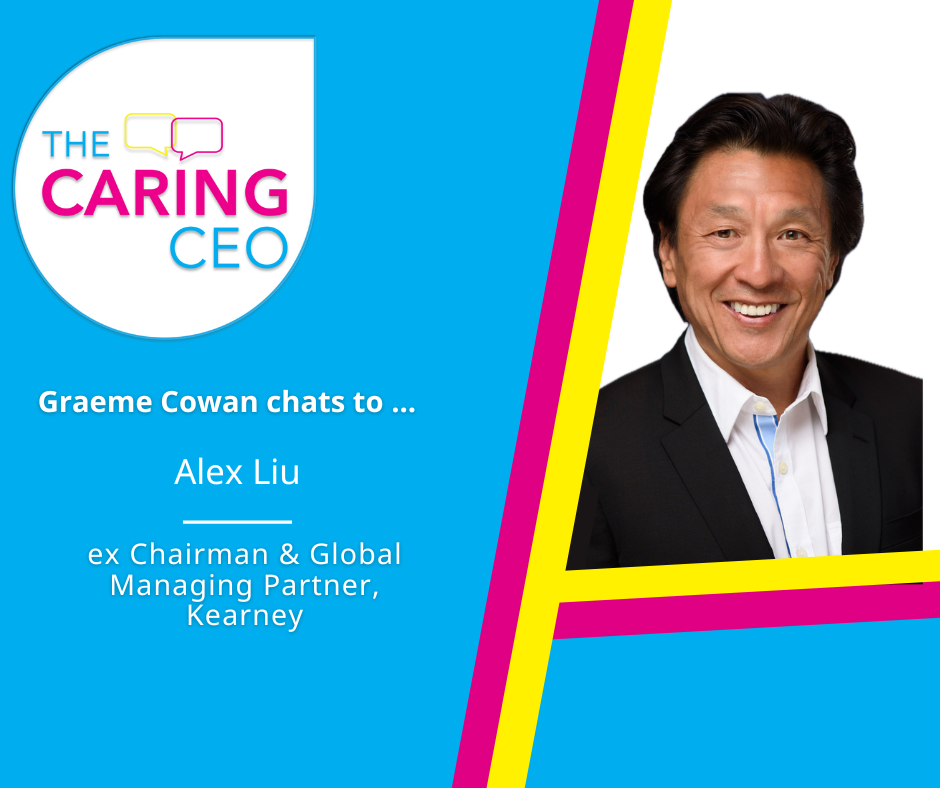
#88 Joy at work, Alex Liu, ex Chairman & Global Managing Partner, Kearney


DISCUSSED IN THIS EPISODE
- What caring in the workplace means for Alex.
- How to with care, competence, and confidence.
- How building psychologically safe, successful teams is key to long-term success.
RESOURCES
Want to learn more about what you can do in workplace mental health training?
Want to to reach out, share a great leader we should interview or learn more about The WeCARE Way, click here to contact us.
Transcript from the interview
Disclaimer: The following transcript was generated using a specific tool. It serves as a convenient method for converting our podcasts into text and allows for easy text searches. However, we kindly ask for your understanding if any typos have inadvertently occurred as a result of the tool’s usage.
SPEAKERS
Graeme Cowan, Alex Liu
Graeme Cowan 00:02
I just had a great chat with Alex Liu, who is the former Chairman and Managing Partner at the global management consulting company Kearney. And funnily enough, I worked for Kearney earlier in my career. It’s a remarkable story, because Alex was born the son of a peasant. His father came from very humble origins in Taiwan, and was the only person in his family to go to university. They migrated to the US, to the southern part, and it was very difficult period for him as a new Asian American, but he strived to do the best he could, both in terms of his learning and approach to life. It’s a remarkable career. He started first of all with the Boston Consulting Group, then became a partner with Kearney, and worked his way up to remarkable success, and he really believes in the importance of coherent, caring and success oriented team. It led to him writing his recent book, which is called Joy works, empowering teams in a new era of work. I could have talked to Alex for another hour, but you’ll find many gold nuggets in there about how to be a good leader, how to be a good follower, and how to build the best teams possible. Enjoy. It’s a real pleasure to welcome Alex Liu, to the caring CEO, welcome, Alex.
Alex Liu 01:44
It’s great to be here. Thanks for having me. Graeme.
Graeme Cowan 01:47
Alex, what does care in the workplace mean to you?
Alex Liu 01:51
I mean, care is a key part of the success formula of any culture, and it has to be two way, right? We talk about employees, staff, colleagues, our teammates, who need to be there. They need to feel they belong. They need to be committed to the cause, the team, purpose. They need to show commitment, at least for the time being, while they’re there. And I think from a leadership perspective, they need to create a culture that sort of engenders that capability, that feeling, that sense of belonging, being seen, as you say, being resilient and together, it’s a nice multiplicative factor. Care from the top, care from the bottom, care for each other.
Graeme Cowan 02:35
Yeah, we have a fundamental human need to feel like we belong, don’t we? And what sort of things. Have you talked a little bit about your career in a moment, but what sort of things can be done each day to really nurture that sense of belonging and safety in a team? Yeah.
Alex Liu 02:52
I mean, again, it’s two way. I think, you know, from a from a leadership perspective, obviously creating a sense that every person needs to find joy. They need to find the role. They need to, obviously, be in a place where they love the work and they and the work loves them. In some sense, they get reinforcement. So there are many levers that a leadership team or a leader needs to communicate and reinforce, the practices, the policies, the role modeling, the visible communications, etc. But I think also from a colleague’s perspective, from a human perspective, we also need to make sure that we have a sense of identity. We shouldn’t work in a place where we don’t feel like we belong. It’s again, you’ve heard the adage, it’s not what you are, it’s who you are. Look at the example from Top Gun Maverick, one of my favorite movies, right? He’s a fighter pilot. He’s not he doesn’t come consider himself an educator or a trainer or a teacher, but you can’t fight who you are. And I think the more that we as employees, colleagues, staff members, teammates, feel that we need to contribute our own identity and bring our best selves to work if we know who we are, right, and that’s a key part of the discovery in the workplace.
Graeme Cowan 04:05
You have a remarkable migrant family story. Would you mind just sharing with our listeners a little bit about your background and coming to the US and your career, how it evolved from there?
Alex Liu 04:19
Well, sure, I’m from an immigrant family from I was born in Taiwan. My parents were both born in in China, and my dad was a son of a peasant family, and his whole family didn’t have any formal education, but he was the one to get education past eighth grade, worked in Taiwan, became a PhD professor in the United States, and he and my mom decided to bring me. I was the first born over when I was just a little kid, I had no choice in the matter, and we immigrated to the southeast United States, and my dad taught in historically black colleges and universities for his whole career. These are great universities, but they were under resourced and the like. So I grew up as an outsider, if you will. And I was always the outsider in sports in the community. Were we black? Were we white? Why were we excluded from both? So it was important to me to represent the sense of finding belonging even though you are an outsider, because everyone’s an outsider to some group and and my parents obviously inculcated me and my brothers, and now my children and hopefully their grandchildren, a sense of the importance of education. So I grew up in a family of educators, teachers, mentors, students, my son, my my daughters, my daughters and my two sons are all in that profession, in some sense, and I chose a profession, management consulting, which in some sense is it’s about mentorship. It’s about teaching. It’s about coaching companies, executives, even countries, to their full potential. So it’s been a full circle. You’re starting out from, you know, no education, to actually being a key part of my life coming from another country, to trying to be successful in an upwardly mobile and free society like United States.
Graeme Cowan 06:02
Yeah, and why did you think that management consulting could be a good place for you to work?
Alex Liu 06:09
Well, I discovered it. I to be honest to our earlier conversation. I went back to business school because I wanted to play rugby. So I picked the best school that had a good rugby team, and I was president of the club, and I played practice twice a week. But during those practices, I met these folks who happened to it was in Boston, and they were working for consulting firms that were based there. At that time, it was a very big hotbed for consulting. It still is, I guess. And they were telling me, oh, it’s a great industry. You get to fly around the world, work on secret projects, expenses paid, and you still get and you still get the paid if you’re smart enough, and you do the job in time, you can still make practices and games on weekends. So I said, Wow, that’s pretty cool. But then when I discovered it, it was very much what I liked, solving tough problems in a team environment, having a global perspective, not only on the topic, but also you have clients and the situations that bring you around the world, which is another part of my, my love affair with the industry, which is, you know, the global aspect and learning in multiple scenarios. So that’s how I discovered consulting. And, you know, every couple years, you reinvent yourself, find a new challenge, a new geography, a new client, a new practice, a new role. And, you know, it’s kept me in it sort of as a unicorn. I’m one of the very few, probably less than a handful of people from my business school class, which is many moons now, that are still in the same profession and not fully retired, not there yet.
Graeme Cowan 07:33
And you’ve had a remarkable career. You mentioned you started with, I think, BCG Boston Consulting Group, and then joined Kearney and had a very long career with Kearney. Can you share with the listeners a little bit about your career there and how you progressed and got promoted and made really a global impact?
Alex Liu 07:56
Yes, no. Well, I’ve been, I guess, almost 40 years in consulting. So I spent 11 years and was a partner at BCG in Boston, and then helped start their practice in Asia Pacific. It was a new practice, new clients, no clients. Actually, no staff, no offices. This is the area outside of Japan where it was the number two office. So I found in that world that my career in consulting was really everything I look for, you know, pioneering new adventures, solving problems in new geographies. And I discovered technology. And so I did a tech company startup for about a year and a half, and then I came back to Kearney, where I’ve spent almost 30 years focusing definitely on on Telecom, technology, media type of client situations, which is my professional love. And so I worked on clients and situations around the world, including your native Australia. I spent four or five years almost consecutively, month by month there on some large assignments. Have worked and have a great deal of respect for the clients and executives down there. And so, you know, I spent a fair amount of time just being a regular partner, leading practices, leading the global CMT practice. We call it communications, media and technology. And then, you know, we have an elected managing partner and Chairman. And I was elected well to the board before that, but then elected as basically our CEO and chairman in 2018 and I served two elected terms till the end, till the middle of 2024 and, you know, basically now chairman emeritus over the last year and a half. So I’m still back to active duty. I’m still doing what I love. I’m still working with clients. I’ll be traveling to Europe next week to to help lead a leadership summit on the future of XYZ in Europe. So I’m still in the game, and you never lose energy if you love what you’re doing. Yeah.
Graeme Cowan 09:48
So that’s a remarkable progression. What do you think was the key to because it’s very hierarchical management consulting. You know, there’s lots of levels. What do you think was the key to? To getting the part of it, then expanding that to, you know, country, regional, global responsibility.
Alex Liu 10:08
Well actually, I mean, consulting is actually because it’s basically focused on problem solving. It’s actually very flat. I mean, you have people that more experience than you, maybe some cases, six days of experience, six weeks, six years, maybe a dozen years or more, but together, you’re solving a problem. So if you’re a curious person, you can learn at all levels. You know, if you’re the most senior person, you learn from the junior level, and vice versa. So, you know, I think in that sense, it’s if you are solving problems, effectively communicating them, getting them to real results. Clients recognize you, your teams recognize you, your partners and your fellow teammates recognize you, and they ask you to do more responsibility. They want you to lead them, you know. Help drive more client growth. Help build more partners over time. Help develop training programs. Help lead practices, help lead regions. So it’s a natural outgrowth Graeme, of just doing your job well and you, yes, there are promotions, you have more responsibility, but it’s, it’s very natural, because you’re always challenging yourself. Your grasp always has to be a little bit less than your reach, right? You should be reaching for more and learning more and then expanding yourself along the way,
Graeme Cowan 11:19
yeah, having focused in the, you know, digital technology type area, it must be staggered by what’s happened in the last year in terms of the rate of change. How has that changed from when you started in technology to what it is today?
Alex Liu 11:39
Well, I mean, clearly the rate of change has accelerated, and when I started in the Jurassic Park era of consulting, we didn’t have we didn’t have FedEx we didn’t have fax machines, we didn’t have cell phones. If I wanted to travel internationally, I had to type out a telex machine, which we had in our office. But the nature of consulting and solving problems is still the same. You still need what is the problem we’re trying to solve? What’s the relevant data? How do we cleanse it, graphicize it, interpret it, apply it. And the fact that we have technology now at our fingertips as consultants, but also in our clients hands, just makes the outcomes come with more clarity, speed, some uncertainty, right? You know, the cost of errors can be much greater when you’re getting a lot of information coming at you at the same time. But we’ve migrated through the laptop revolution, the PC revolution, the mobile revolution, social media, cloud. Now we have advanced analytics and generative consulting, generative AI, all these new technologies and the amount of data, again, the quality of data. Is it proprietary? Who owns it? How do you cleanse it same issues? You need to apply it to business problems and deliver outcomes that make sense. And we can be the conduit. You know, we as humans in the loop, consultants also in the loop to help interpret, navigate the problem, with the data, with the solution, with the client situation. So it is a challenging environment, but that’s good for problem solvers. Yeah, and that’s why it’s been a growth industry management consulting, at least for the last for every year that I’ve been in it, it’s growing faster than GDP everywhere.
Graeme Cowan 13:23
How do you what’s the process that you think is important for the team to come up with the best decision?
Alex Liu 13:31
Well, I think we need to put our egos aside and the hierarchy aside and focus on the roles like and focus on listening. So if I’m the senior leader of the team, I need to respect the teammates gathering the data. Help them understand that the quality of the representation, the quality and sourcing of the information, is very important, the confidentiality of it, etc. And people that are putting together problem solutions and scenarios and judgment, they need to contribute their role. So I think it’s important for each to know their role in the broader team, and each one can be a superhero in that role, whatever it may be, the brand new analyst, the agent that’s working alongside the team, the AI agent, or the more, the project leader who might be part time working with other projects, the partner who’s even more part time or maybe devoted, depending on the client situation. And I think it’s also important within, within the momentum and the rhythm of a problem solving case project assignment, you need to have a great deal of mutual respect, not only for the problem, the severity of the problem, these are the toughest problems that clients will ever face, and they’re asking us to help solve it with them, and they may only have two of those in their whole career, and that’s all we do. So I always tell my junior consultants, those that. Are less experienced and less tenured, to treat each opportunity like a craftsman, a crafts woman, you know, treat it with ultimate respect that this is like a stewardship of a problem. And when you do that, you will listen more intently, you’ll take greater care of the data. You’ll put that extra effort in putting together the communications and the logic of the storyline, the documentation supporting the persuasive argument that you’re putting together. So a lot of it is curiosity plus seriousness and egalitarianism as well, that those are kind of the magic ingredients for a high performing project structure,
Graeme Cowan 15:42
yeah, I’ve interviewed Amy Edwards, and, you know, the real pioneer in psychological safety and at Harvard Business School. And one of the things that she talks about, she, you know, I think the latest book is called the right kind of wrong is encouraging people to make intelligent risk taking, you know, which is based on the best information you have. And it’s solving a problem that’s really important, but it’s not taking a, you know, a company threatening risk. When you think about, you know, the various teams that you’ve worked with. How do you get people to, you know, just grab it and not say, we need a whole more analysis, but you know, we’ve got enough to to know that we’re 70% right. How do you get people to, then go for it and to, you know, commit to taking that intelligent risk? Yes.
Alex Liu 16:41
I mean, well, Amy’s great, and I saw her. She gave a lecture at my recent business school reunion, and she talked about exactly that the difference between mistakes and failures, and you can learn from both, but obviously one is immediately correctable, the other is much more introspective, right? Well, I
mean, I think it’s important for us as leaders to encourage, maybe not risk taking, to take risks, but to think beyond the box, right, to think bolder. One of the one of the disciplines I used to teach my younger consultants was when we’re asked for the client, probably, you know, what would you do if you own the whole industry? What would you do if you were the client. What would you do if you had all the resources in the world and all the time? So work more expansively, and then go back to the constraints that the problem set has given you. You know, we don’t have all the money in the world. You know, we were only the number three player, not the number one player. We don’t have the talent or the technology to do that. So I always try to get people to push their boundaries of what is a risk. Because if we had a resource constrained problem, that’s one thing. If we have emboldened our thinking to think beyond resources and the immediate constraints, then we might get a bolder strategic scenario, a different angle that the client may never have seen before, or maybe the industry had never seen before, a part of the psychological safety that you mentioned is making sure that people are not penalized or stigmatized for being too bold. I mean, obviously, be careful about what you say and think through. Have a logic, but everyone should be safe in problem solving mode, and as consultants who are basically hired to solve problems, you know, we can’t put too much of a break on the problem solving calculus, and then it’s up to the more experienced folks to understand, are we overdoing and overcooking this one? Is it too bold? Is it not practical enough? And it always has to come down to outcomes and results. So the ultimate test is, does this insight? Does this idea? Does this boldness lead to impact, effectiveness, productivity, revenue, profits, cost, improvement, etc. So there has to be discipline along with the risk taking, but there does need to be boldness in the ideation phases.
Graeme Cowan 18:58
You’ve just written a great book, which I’ve had the chance to read, called Joy works, empowering teams in the new era of work. Why do you write that book?
Alex Liu 19:09
Well, I mean, Joy is a human phenomenon, right? It? You know, we should not settle for anything less than joy in our personal life, in our family life and in our work life. I mean, at the end of our lives, we only have our family and our memories. So work should be an important part of that. Do what you love. Love what you do. And when I took over and was elected as the CEO of Kearney, you know, I wanted to sort of help espouse that that was kind of part of my platform, that culture is important, self belief, self identity, strategic identity. Brand identity is very important for any winning team, and that comes from being a part of a joyful purpose led energetic culture. So I wrote a I wrote an HBR article in July of 2019, before covid. On this making Joy a priority at work. And I think the editors looked at me sideways. And said, this is kind of unusual. Most people don’t go to work for joy, right? They go they get their joy elsewhere. And we did some research and showed that, no, I mean, it’s actually correlated with a lot of things, you know, purpose, satisfaction, loyalty, retention, business success. And that led to four seasons of podcasts and eventually the book, which I didn’t really want to write, but like yourself, Wiley came and said, is a good concept. There seems to be a little bit of following for this. It links to purpose. It links to justice, which is another topic which happened over the last several years with wars and race riots and anti semitism, etc. And so this topic built some momentum, and I was very happy to put together the thoughts in an organized way. I didn’t do a lot myself. I had some help with the podcast, and the other contributors that, like you, use on your podcast, you know, using the content of people that are smarter than me and seeing other experiences to leverage that into the book.
Graeme Cowan 20:53
And you talk about a three part framework in the book, can you just explain what that is for our listeners?
Alex Liu 20:59
Yeah, very simple people, purpose and praise, right? It starts with the people. They need to be safe, seen, supported, connected and inspired. So I tell leaders, you need to inspire individuals, but in part, empower teams. And that all comes down to people, and the people. Energy is the most renewable energy resource every day, every day. In the morning, when you wake up, you have to renew your energy. Why am I here? You know, do I belong where I belong? Am I doing what I love? Am I the naval aviator in Top Gun, or am I the educator or the consultant in XYZ? So that’s the people side. And again, it’s, as I said before, it’s a two way street, right? You have to choose the profession that you want to belong in, and also the place needs to give you a culture that that delivers that. On the purpose side, that’s a little bit of the intersection between individual energy and corporate energy. And I think it’s the role of the leadership to submit the strategic identity of the firm. What is its mission? What do we define as success? What do we want to be in XYZ timeframe? What do we want to represent? What is our legacy? And I think people have to choose the firm and the company, and the company needs to be a beacon and a lighthouse for what it stands for. So I think having a broader purpose is important and also reinforcing the purpose of you in the in the individual role in the firm I mentioned, everyone can be a super, a superhero in their role. They need to know their role. They need to love that role, and they need to grow and develop it. But the company leaders who craft the culture and the teams and the business units and the regions and the product development teams, etc, they need to be very careful in designing and being disciplined, in structuring that world, that workplace, you know, how are we going to measure each other? Are we going to have followership scores? Are we going to promote people on merit? Are we going to have a sense of inclusion? Are we going to look at different types of measures for defining are we on track for purpose? And the third piece is Praise, praise, which is, and I this is one thing I learned from the podcast. It’s not so much. You know, Team A did a great job. Isn’t it great that we won the championship? Yes, you need to have that praise. But people respond to individual praise when you single out Graeme, well, that was a great job on that presentation. That really made the difference when we were fumbling on how to answer that very important provocation from the client. Or Alex, boy, we know you work hard this weekend to pull that together, but it really made it you know, singling people out individually for what they do versus just that is something that really energizes people. Just think about when anyone calls your name, you’re going to pay more attention if you actually associate praise for a role that you provided in purpose, you know, alongside other teammates, wow, that I’m part of a championship team, and I got acknowledged. So if you look at all the championship teams, you pick your sport, basketball, football, footy, rugby, they have those same ingredients. And why not? In a corporate culture, you know, gotta have the right people’s role clarity. You got to give it a purpose every day reinforced. We have habits. We have cultures that we respect and that we acknowledge and reinforce, and we have praise we acknowledge what we do. So that’s basically the three part framework in a bit of a nutshell.
Graeme Cowan 24:25
Graeme, we have some helpful resources that you can find at WeCARE 360, five.com.au, the first is our mental ill health calculator, which is a quick and simple way to work out what poor mental health costs your organization in lost productivity and employee turnover, you will also find our building a mentally healthy culture checklist, which shows how to launch a great initiative and keep that momentum going. These resources can be found at WeCARE 365, Dot com.au, makes a lot of sense. Therese umberlay from Harvard, and her book The Progress principle really reinforces what you’re saying. You know, she did this assessment of workers across a whole range of whole range of different industries, and she found that the one thing that motivated people the most was recognition for meaningful progress. And it wasn’t, you know, winning the championship, or it wasn’t, you know, it was everyday recognition, which is exactly what you’ve just outlined. We can never hear too much encouragement, can we? No, that’s true.
Alex Liu 25:41
It’s human. If everyone wants to be seen, yeah? And if they’re seen, they have a higher chance of feeling that they belong, which will, like you said, energize them even more and get even more recognition for their contributions later. Yeah.
Graeme Cowan 25:56
In my book great leaders care, I talk about a great leaders care mindset, which involves three things. Firstly, it’s about self care, keeping yourself resilient and energetic. Secondly, it’s about crew care, building engaged and psychologically safe teams. And then, thirdly, red zone care, which is identifying and supporting someone who may be struggling. You may be aware or may not have been. Some research came out from Wiley in December, which found that 46% of managers said that they were severely stressed, severely stressed. So there’s obviously some real issues in organizations. And I love that, you know you have this vision for joy at work. I also really believe that work is good. And I hate the term work life balance, because it implies that life is good, work is bad. And for many people, a lot of people work can be incredibly meaningful. But jumping back to the first one, self care. What do you do to keep energy in your own tank?
Alex Liu 27:12
Well, the big choices need to be right. You need to be in the right profession. Pick the right company, you know, choose the right friends, etc. And then a lot of it is on autopilot after that. But you need to have, you need to have a regular routine. So I find that I do the same thing every morning to sort of indicate to myself and my body and my mind that it’s a new day, a new agenda. So I’ll regardless of where I am, what time zone, if I landed at 10 o’clock the night before, or had a late night, I’ll get up and do 15 minutes outside jogging. I don’t like being on the treadmill, so that’s my self care. I’ll get up I have a routine. I will purposely pick hotels where they have a sauna. I always find that it’s not just meditation, but actually the physical reassurance of quietness and helping your body heal a little bit. So I think health is very important. It’s the mind body integration. It’s the cleansing and detoxifying of bad ideas and bad, you know, bad mojo when you wake up. So I think the self care has to be your responsibility. You know, work on the big stuff, but also work on the daily stuff. And don’t just skimp on it, like make sure you do it every day, because if you schedule con calls at six in the morning, you’re not going to be able to do either the self care, yeah, finding find an excuse to make it at eight o’clock. Yeah, whatever.
Graeme Cowan 28:35
And obviously, another huge part of self care is having supportive and peering relationships around us. You know that Harvard adult development study showed that having those relationships were the number one predictor of a long life, happy life, most affluent life, in a really intensive environment of Kearney and management consulting, I take it you would develop very good relationships with those you’re working with. But do you also consciously nurture relationships outside the company that were very, very important to your good mental health?
Alex Liu 29:10
Yeah. I mean you, you have to find your friends, where you spend your time. Obviously, you need to have respect and affection for the people that you work with that you build lifelong friendships, shared journey, shared adventures. But also, I found many, many of my clients are friends. There’s no reason to, you know, have a bridge that you can’t cross there in terms of feeling close, helping them reach their full potential as people also understanding their family struggles. I mean, for every consultant that’s stressed out. There’s definitely a couple of clients who are even more stressed out. So you can help alleviate each other’s stress and pressure in any number of ways outside of the work relationship being friendship and fellowship, sharing knowledge and the like and of course, everyone needs to have a family support structure that works for them. Yeah, right? Whatever their family environment is, whether you have children or not, whether you have a significant other and partner or not. I think it’s important for all of us to have multiple sources of self esteem and reinforcement, not just your work, not just your sauna routine, not just your career progression. And I think having that integration. It’s work life integration and friendship. Work integration, support system integration that defines people that are less stressed versus those that can’t seem to get it right more the time than they should.
Graeme Cowan 30:35
Yeah, we’re certainly singing from the same hymn sheet. I believe very much in that integration as well. And, you know, working is an important part of that, but also being able to de stress is a very important part of that. We’ve talked a lot about crew care already, and psychological safety. And your book goes very much into the depths of creating, you know, a joyful team, a joyful environment. What about red zone care? You know, as I said, while he researched December 2025 in the US, found that 47% of managers were severely stressed. Does that surprise you? And what do you think might be the root cause of that?
Alex Liu 31:20
That statistic does not surprise me. I think we ask a lot of our people these days. We ask them to change their roles on the fly with the advent of new technology, yeah, we’re asking them to change global supply chains because of the geopolitical unrest. We’re asking them to promote people that don’t look like them. We’re asking them to do things that makes them say, well, it’s just too hard. Yeah, you know, I’m just going to say no, and that’s the real power of the organization. GRAEME is the middle of the company because they have the power to say no, it’s too much. So it doesn’t surprise me with the rate of change, the rate of displacement of psychological uncertainty and stress from all of a number of dimensions, the 47% figure, the 57% whatever the number is that doesn’t that doesn’t surprise me. I think your question about how to overcome that, how do you obviously, corporates and leaders need to have any number of vehicles, anonymous and or otherwise, the mentorship program, the Ombudsman
Program, mental health lifelines, communication about the importance of taking care of yourself, sympathizing around shared concerns for the population that are in represented in your company. But that’s a very tough challenge for for all leaders, you know how to deal with that red I use it. Red Zone care individually on your executive team, you have close friends that you work with that you might even be a part of creating that stress and acknowledging that and finding ways to alleviate it, decompress and ultimately solve as much as you can without the with, in addition to compassion, help solve the root causes of the stress. Is it workload? Is it the wrong role? Is it toxic behavior by colleagues and or superiors or subordinates?
Graeme Cowan 33:13
Yeah, there are getting more and more sophisticated ways of identifying the root causes of stress. Monitoring it and taking action and looking at progress. You know, it’s referred to as psychosocial hazards, which really and psychosocial risks, and those risks are harmful work stress. So as you know, some stress is really good for us and good for our performance, but it can go too far when it starts to affect sleep and motivation and energy. Are you aware with the companies that you work with, of any that are taking real progress in that area? You know, actually surveying, looking at data, EAP data, insurance data, and really monitoring that very closely. Have you seen firms do that well?
Alex Liu 34:05
Well, I like to say that we try to apply some of those best principles to ourselves. I mean, we are a people led company. I mean, all the only assets we have are laptops and leases. The rest is people energy. So we have made in our firm, and I know there are many other services firms that do this have made a commitment to wellness and not just physical wellness, and you have allocated budgets, time, days, programs to make sure that people feel like they are connected right to something more than just their work or their laptop or their particular task. So there are programs around mental wellness, like, again, the whole spectrum of sort of the periodic or episodic stress to something that’s very structural and needs to be fixed and corrected in a in a very urgent type of way. But it’s not just about the programs and the money either around this. Just saying, well, we. A program to do that. It’s I think leaders need to show by example, I mean, and they need to be evaluated. In our profession, a lot of the stress comes from the work itself and the specific manager that you’re working with exactly. So we have very clear upward feedback mechanisms, anonymous, anonymized, across a portfolio to give feedback to the managers and people that are leading teammates to make sure that they’re on their best behavior and are raising their game. And also evaluating people based on that. We evaluate our partners based on upward feedback metrics. So I think having metrics on people care will reduce a lot of the stress. You can’t always fix the workload that you have, but you do need to manage it in a reasonable and humane way. And one source of psychos psychological stress these days, and you alluded to this in the technology discussion. A lot of people in the middle of the companies are feeling that they could be obsolete in this new world. They don’t have the right tools. They didn’t grow up with mobile phones, much less social media and the latest AI tools. Now they’re being told to write job descriptions for people that may replace them or have or train on agents that technology that are four or five steps away from what they’re used to in the old way. So I think that’s creating an extra level of psychosocial in the workplace, stress, the technology disruption that’s happening at an astounding pace right now. On top of everything else that we talked about.
Graeme Cowan 36:34
yeah, yeah, you mentioned Top Gun, as you know, significantly influenced you. Has there been a leadership book that you found particularly great?
Alex Liu 36:48
Well, I grew up in North Carolina, and as a young kid, I love to watch college basketball, and University of North Carolina in the United States has a really good basketball team, but more importantly, they had a really good coach, Dean Smith, who coached Michael Jordan, you know, Hall of Fame, all these kind of things. He also was a pioneer for social justice. He integrated the University of North Carolina basketball team and the campus in many ways. And my my my dad taught in the University of North Carolina system, so I had a natural affinity for the coach, but he wrote a book called a coach’s life, and it’s not a book that you will have read necessarily or many people, but those principles about mutual respect, treating the character of who you lead, very importantly, as the outcome that you’re trying to achieve. Sorry, you know, leading educating people in a broader sense, how do you conduct yourself in terms of being a good sportsman on the court of competition, as well as in life. That was a very motivational and at the time, as a 1012, year old, it guided me a lot, the principles, and he’s very well revered. You should look him up if you if for the your audience, if they don’t know Him, Dean Smith. But he was a great coach, but more importantly, a great person and teacher, and his lessons are codified in a number of books, but that was the one I remember a coach’s life.
Graeme Cowan 38:09
Yeah, just on the topic of sport is, you know, as you would know, in Australia, Australian rules is a huge sport, especially if you go to Melbourne, yep, it’s a huge thing. And there’s a very interesting story there about one of the big clubs called Richmond, and back in about 2016 they came last. Oh no, they came 13 out of 16 in the comp, and it was a disaster. And the coach was Damien Hardwick, and he was really depressed by the end of the year, but his father said, you know, this doesn’t define you go on a journey and, you know, check out things. So went across the US, and he went to and it was down the south. It was a basketball team, but that coach champions, something called the three H’s. And the 3h were highlights, hardships, heroes. So he came back the next year, and he started the session with the 4045, people in the playing staff, and went through his own highlights, hardships and heroes and highlights were getting married kids. Hardships were last year, which was really tough. Heroes for him was his dad basically saying, This doesn’t define you. So after that, every single person coached junior players all had that session where they went that and some of them reveal very sensitive, embarrassing stuff, like being in such a poor family that you didn’t feel right inviting friends home to school afterwards. Anyway, over that year, they just built up this incredible interpersonal trust. Yes, and they won the competition one year after becoming 13. And that was building psychological safety. It was building mutual respect and support. But it can be so powerful, kind of when it works.
Alex Liu 40:14
Well, absolutely the well, you know, authenticity and vulnerability are great superpowers. It, like you said, in a trust based world, or one where we need more trust, that’s important for any team right to succeed, they need to put their arms and hearts in each other’s way. That is a great story. I like that highlights hardships and heroes. I think Dean Smith’s version of that was play hard, play smart, play together. Yeah, right. And I do remember, you know, the first grand final I went to in Melbourne at the
MCG, was in 2010 and the result of that was, as you remember the grand tie, right? St Kilda in Hollywood. I was like, This is crazy. You just had a tie, and you’re gonna come back next week and play, play it again. I was like, wow, that’s not what we have in the other parts, at least in North America. Of course, I think they changed the rules after that, but that was my introduction into the crazy world of AFL
Graeme Cowan 41:12
why has rugby been a lifelong passion of yours? Well, I
Alex Liu 41:17
picked it up in freshman year in college. I mean, I was never going to be a division one athlete. And I know I did stuff, but I met the again. I met a bunch of folks who said, Let’s try rugby out. It’s kind of cool. It’s more interesting than lacrosse, and we have great parties. And so I joined and then I just I played ever since then, you know, I played in college. I played in club sides. After graduating, I did pretty well. I remember playing against the under 23 Eagles when I was 21 or two. I got, I got killed, pretty badly, but I can say I did play against the US national team at that time, and played in business school. I was president of the club. We did. We were really good team in New England and and then the Alumni Club is a we call them old boys, but they’re also old girls. There’s a female team as well. But we tour around the world, you know, we go to Six Nations. We’ll watch the Wallabies play, you know, the All Blacks here and there. You know, we’ll have the Rugby World Cup in 27 down in Australia. So I plan to be there for five or six weeks, doing work, but also attending, you know, the knockouts rounds and maybe some of the pool games all the way up to the final. So it’s just a lifelong passion, and it’s the best sport in the world. Everyone can do anything. It’s unpredictable. It’s based on a lot of the principles we talk about. You know, everyone has a role, and rather your size or skill and you contribute, it’s got to be a culture of trust. You know, you have your role. You got to do it with enthusiasm. Don’t miss that tackle, don’t miss that role and do it with gusto. Yeah, so it’s a great sport. Unfortunately, it’s mostly New South Wales and Queensland. You play a little bit in very little bit in Victoria,
Graeme Cowan 42:51
that’s right, very little. It’s been absolute pleasure catching up, Alex. I’ve really enjoyed our discussion. And you know, just the insights and, you know, the remarkable success story. And you know, there’s a lot of talk around immigrants now in all countries, but boy, like Australia, just has so many examples of amazing immigrants. And you know, they make the world a better place. My original descendants came from Ireland, and they had to leave in 1854 because of the potato famine, and there was no food. And that led to Irish descent going to the US and Canada and to Australia and to England, and they made fantastic contributions there. So I hope this, you know, current, unhelpful discussion about immigrants certainly passes. Alex, I always finish the same way and ask this question, well, first of all, do you have any response to that? You know, I think being an immigrant and seeing what’s happening now, yeah.
Alex Liu 43:59
I mean, it’s a challenge and an opportunity, and I always use it as an extra motor for me to prove myself, to make myself better, to move up the ladder of respectability, education, what have you. But it’s also key, no matter your beginnings, to also have the right ending. To give back, you know, to give back to your culture, to represent and honor your parents, honor what they the principles they stood for,
honor the teachers and coaches that saw and believed in you along the way. So I’ve tried to do that as well. It’s not just about my achievement or what I did, but also trying to honor the people that helped spur me along and believed in me along the way. And I think that’s a human that’s a human need, and we need to respect people from wherever they come, because they all have a story, and, more importantly, they want to have a good ending. So let’s find ways to encourage that.
Graeme Cowan 44:51
Definitely, the main motivation is to, you know, spread the message of, yeah, good work. You know, very much like joy at work. It’s to. Show that, you know, the very best workplaces have a culture of care and high performance. You know, they go for both those things, and it’s that balance that you talked about before. You know one’s not better than the other. In fact, one informs the other.
Alex Liu 45:14
You know, you’re right. It’s not it’s not an either or. I like to tell people like young youngsters in our profession, I said, when a client evaluates a consultant, they obviously look for confidence. They can see that pretty quickly, and it usually takes them five or 10 minutes to understand that you’re competent. So there’s confidence and competence, but what really makes a difference is if that you can communicate and they feel that you really care about them. You’re not just a bookings number or a project that you need to get through, that you and that takes a little bit of time to develop. But care is a key ingredient to certainly management consulting the successful firms and individuals in it, versus those that are just confident and competent. That’s not enough to be successful.
Graeme Cowan 46:04
My final question is, what do you know now that you wish you could have told your 20 year old self knowing what you know now? What advice would you give your 20
Alex Liu 46:15
year old self? Well, I think I would tell I mean, I look at pictures of myself, and I was really happy when I was 21 with, actually no degree as yet, no job. I was in debt, but I had my health, I had my friends, and I had full potential. And I would say, Stay hungry, but also humble, like you know. I mean, again, live don’t look too much in the rear view mirror or the side view mirror, live in the moment, and I think I did that, so I look back and cut. Was reassured that I probably had some good principles starting out, but when I strayed along the way since then, it was probably because I was not hungry enough, I wasn’t curious enough, or I wasn’t humble enough. I was too arrogant or too proud. So I would just say go. My advice to myself at that age would be to stay myself at that age. Don’t get polluted by your press releases or whatever you know. Yeah.
Graeme Cowan 47:09
And what a great message to leave everyone to stay humble and stay hungry. So thanks for being part of the caring CEO, Alex.
Alex Liu 47:17
Thank you so much for having me. Graeme. All the best to you.
Graeme Cowan 47:21
Thanks for joining us today. We hope you’re inspired to strive for a culture of care that also leads to great results. If you’ve enjoyed this interview today, please rate us on your favorite podcast platform, and don’t forget to subscribe so that you don’t miss an episode. We also welcome any comments. If you’re interested in seeing details about our scalable we care 365 mental health training programs, please visit us at WeCARE365.com.au, our goal is to make these programs accessible, practical and ongoing. You can also find me, Graeme Cowan, on LinkedIn, and I’d love to hear from you. And finally, if you’ve come across a senior leader who has impressed you and you think they’d be a great guest, please email us at support, at WeCARE.365.com.au. Thanks once again for listening today.

Oh, you are inquisitive… getting all the way to the bottom of the page!
Thanks for listening 🙂
From all of us at The Caring CEO, and the WeCARE team, keep listening, keep caring and lead with your heart.
P.S. If you want to reach out, share a great leader we should interview or learn more about The WeCARE Way, click here to contact us.
