
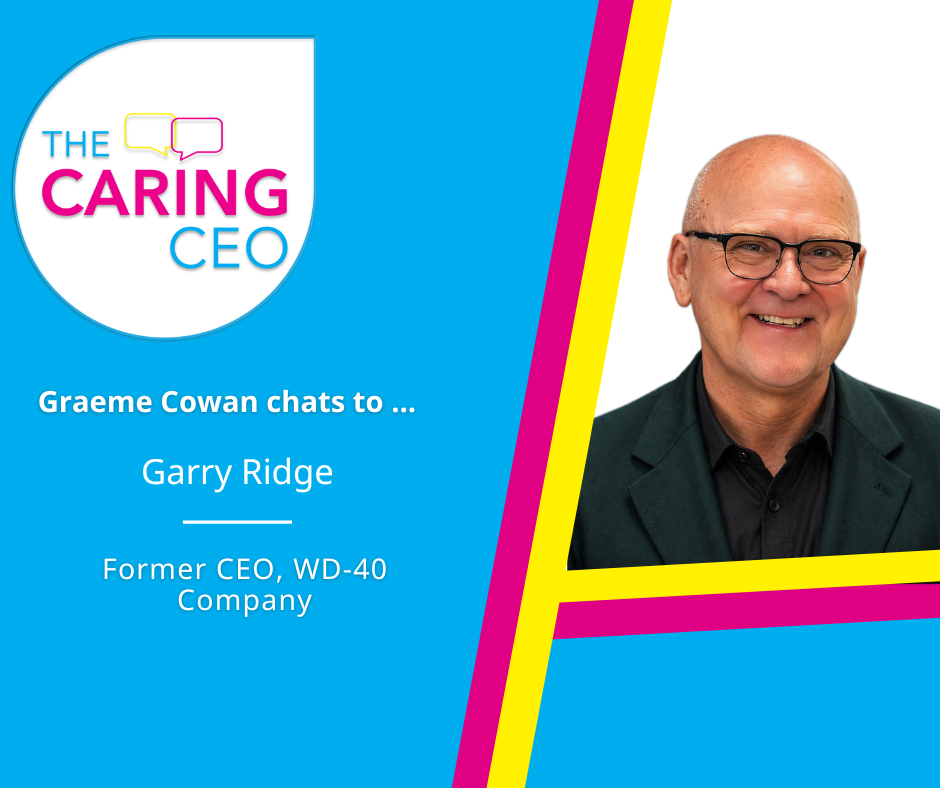
#93 Building a 10x WD40 culture, Garry Ridge, former CEO, WD-40 Company


DISCUSSED IN THIS EPISODE
- What caring in the workplace means for Garry Ridge.
- Principles that help make a brand one of the world’s most trusted brands.
- Practical leadership lessons and thought-provoking insights for anyone looking to create a more caring, engaged, and successful workplace.
RESOURCES
Want to learn more about what you can do in workplace mental health training?
Want to to reach out, share a great leader we should interview or learn more about The WeCARE Way, click here to contact us.
Transcript from the interview
Disclaimer: The following transcript was generated using a specific tool. It serves as a convenient method for converting our podcasts into text and allows for easy text searches. However, we kindly ask for your understanding if any typos have inadvertently occurred as a result of the tool’s usage.
SPEAKERS
Graeme Cowan, Garry Ridge
Graeme Cowan: It’s a real pleasure to welcome Garry Ridge to The Caring CEO. Welcome, Garry.
Garry Ridge: G’day, Graeme. It’s great to be with you. Thanks for inviting me along.
Graeme Cowan: My pleasure. Garry, what does care in the workplace mean to you?
Garry Ridge: I think care starts with a simple but profound belief: people are not resources to be managed—they’re human beings to be valued and coached.
To me, care means showing up every day genuinely interested in the growth, wellbeing and success of the people around you.
And actually, Graeme, it’s not a soft concept. It’s a leadership discipline that we learned along the way at WD-40 Company. We didn’t talk about employee satisfaction; we talked about belonging.
There’s a difference between satisfaction, which is transactional, and belonging, which is emotional. Care creates belonging.
It’s about seeing the whole person. It’s about candour with kindness. It’s about learning and coaching rather than judging. And it’s about consistency.
At the heart of it, it’s all about who you are as a person and what you’re going to do to help those you have the privilege to lead become a better version of themselves.
Graeme Cowan: I love that.
When you think about your long career at WD-40, could you give our listeners a bit of an overview?
Garry Ridge: Sure.
I actually started with WD-40 in Australia in 1987—with a fax machine under my bed.
Before joining WD-40, I’d worked for the company’s Australian licensee. During the 1980s, the US-based public company was becoming serious about global expansion. The question was: how do we take that iconic blue-and-yellow can with the little red top to countries all around the world?
Australia was one of the markets where the brand already had good awareness, so I got to know the team in the US. As the licensing agreement was coming to an end, I was having a conversation with the company’s president when he asked, “Would you like to join us and help build our Asia-Pacific business?”
I thought, That sounds interesting.
I remember asking my dad what he thought. He’d worked for the same company for 50 years, from the age of 15 until he retired at 65. He started as a fitter and turner and eventually became an engineer.
I said, “Dad, what do you think about working for WD-40?”
He smiled and said, “You can’t go wrong with that stuff, son.”
So the first lesson was: listen to Dad.
I joined the company in 1987 and worked from our Sydney office until 1994, spending a great deal of time throughout Asia building our distribution network.
Then, in 1994, I was talking with the president again and asked if there was anything else he’d like me to do.
He replied, “Would you like to move to the US?”
I said, “To do what?”
He said, “Come over here and help me take the brand to the world.”
It wasn’t a simple decision. Moving from Australia to the United States is a big step. But we packed up our lives and made the move.
In 1997, he retired and, for my sins, I became the CEO. I spent the next 25 years leading a US public company, learning an enormous amount and having a lot of fun along the way.
Graeme Cowan: You’ve developed a unique approach to building culture. What are the foundations of that approach?
Garry Ridge: I think they’re actually quite simple.
First, do people know they belong?
One of the strongest human desires is to belong—to feel that we matter to someone. Everyone listening to us today has probably left a workplace, a relationship or even a social gathering because they didn’t feel they belonged.
So the first question is: Are we creating a place where people truly belong?
Second, do people know that the work they do matters? Do they understand that they’re contributing to something bigger than themselves? And are they recognised for that contribution?
Third, are we creating an organisation with a high level of psychological safety—or, as I like to say, a reduction in fear?
At WD-40 Company, we stopped talking about mistakes. Instead, we talked about learning moments because we wanted to become a genuine learning organisation.
Finally—and I think this is just as important as the other three—we’re not there to manage people.
You manage your bank account.
You manage inventory.
Our role as leaders is to coach.
A coach’s responsibility is to help the people they have the privilege to lead continue to grow, thrive and do great work.
Graeme Cowan: There’s so much overlap between what you’ve described and the work of Bob Chapman from Barry-Wehmiller. I’m sure you’re familiar with him and his book Everybody Matters. I was fortunate enough to interview Bob twice before he passed away, and many of the themes are remarkably similar.
Garry Ridge: Bob was a wonderful human being.
I spent quite a bit of time with him over the years. Simon Sinek is also a good friend of Bob’s, so our paths crossed often.
Bob created an organisation where people genuinely felt they mattered. That’s what great leadership does.
Graeme Cowan: I understand there was an Aristotle quote that had a profound influence on your thinking about leadership. Could you share that story?
Garry Ridge: Absolutely.
When I became CEO in 1997, I knew how to market the product. What I didn’t know was how to build a culture where people all over the world felt empowered, felt they belonged and knew they mattered.
In 1999, I was flying from Los Angeles to Sydney on a Qantas 747. We were about 38,000 feet above the South Pacific, a couple of hours from landing at Kingsford Smith Airport.
As you do on long flights, I had plenty to read.
The first quote I came across was from the Dalai Lama:
“Our purpose in life is to make people happy. If we can’t make them happy, at least don’t hurt them.”
I thought, What a wonderful way to think about leadership.
The very next quote was from Aristotle:
“Pleasure in the job puts perfection in the work.”
I remember thinking, Well… of course.
How had it taken us more than two thousand years to really understand that?
He was right.
The challenge was that I still didn’t know how to create that kind of culture.
A week or so after returning to San Diego, I was reading the local newspaper and saw an advertisement for a Master’s Degree in Leadership at the University of San Diego.
The program had been developed with Dr Ken Blanchard, one of the pioneers of servant leadership.
So I decided to attend an information session…
Garry Ridge: I enrolled in the Master’s program because I realised I needed to become a student of leadership.
Up until then, I’d been a student of marketing. I understood brands, channels and customers, but I didn’t really understand people and culture.
That course changed my life.
It introduced me to servant leadership, emotional intelligence and the importance of creating an environment where people could flourish.
One of the biggest lessons I learned was that leadership isn’t something you do to people. It’s something you do with people.
That completely shifted my perspective.
Graeme Cowan: Was there a particular moment when you realised the culture at WD-40 had become something truly special?
Garry Ridge: It didn’t happen overnight.
Culture is never built by a single speech or initiative. It’s built one conversation at a time.
One of the things we became very intentional about was our values. But values only matter if they’re lived every day.
We wanted people to experience our values, not just read them on a wall.
So we talked constantly about learning.
We talked constantly about belonging.
We talked constantly about coaching.
Over time, those conversations became habits, and those habits became our culture.
People started to describe WD-40 as a place where they could be themselves, where they could grow and where they knew someone genuinely cared about them.
When you begin hearing that consistently from people all around the world, you know you’re heading in the right direction.
Graeme Cowan: One thing I’ve always admired is your decision to replace the word failure with learning moment. That’s become one of your trademarks.
Where did that idea come from?
Garry Ridge: It came from asking a very simple question.
If we say we want people to innovate, experiment and take initiative, what happens when something doesn’t go as planned?
If our response is blame or punishment, then people quickly learn that it’s safer not to take risks.
Eventually they stop bringing ideas forward.
So I asked myself, “What if there really is no such thing as failure? What if every outcome is simply a learning moment?”
If we achieve the outcome we wanted, we celebrate.
If we don’t achieve the outcome, we learn.
Either way, we’ve gained something valuable.
That small change in language had a profound impact on our culture because people stopped fearing mistakes.
Instead, they became curious.
The question changed from, “Who made the mistake?” to, “What have we learned?”
That’s a far more productive conversation.
Graeme Cowan: I imagine that creates a much greater sense of psychological safety.
Garry Ridge: It certainly does.
People often misunderstand psychological safety.
They think it means lowering standards or making excuses.
It doesn’t.
Psychological safety means people feel safe enough to tell the truth.
They can admit they don’t know something.
They can ask for help.
They can challenge an idea respectfully.
They can acknowledge a mistake without fearing humiliation.
Ironically, when people feel psychologically safe, accountability actually increases because people are far more willing to own their actions.
Fear causes people to hide.
Safety encourages people to learn.
And if you’re trying to build a high-performing organisation, learning will always outperform fear.
Graeme Cowan: That’s such an important distinction.
People often think care and accountability are opposites, but you’ve shown they actually strengthen one another.
Garry Ridge: Absolutely.
The highest form of caring is helping another person become the very best version of themselves.
Sometimes that involves encouragement.
Sometimes it involves difficult conversations.
But if those conversations come from genuine care rather than judgement, people experience them very differently.
That’s why I’ve always believed leaders should see themselves as coaches rather than managers.
A coach’s job isn’t to catch people doing something wrong.
A coach’s job is to help people improve.
Graeme Cowan: One thing that strikes me is that many leaders genuinely want to build a caring culture, but they feel under enormous pressure themselves. They worry they simply don’t have the time.
What would you say to them?
Garry Ridge: I’d say you don’t have time not to.
People often think caring leadership is something extra they have to add to their workload.
It isn’t.
It’s how you choose to have every conversation.
You can ask someone how they’re going—and genuinely listen to the answer.
You can thank someone for their contribution.
You can ask, “How can I help?”
Those aren’t big, time-consuming activities. They’re small moments that build trust over time.
The reality is that organisations spend an extraordinary amount of time dealing with the consequences of poor leadership—conflict, disengagement, turnover and poor communication.
When you invest in people upfront, you avoid many of those problems later.
Graeme Cowan: I often say that people don’t leave organisations—they leave leaders.
Garry Ridge: That’s certainly been my experience.
Most people join organisations because they’re excited about the opportunity.
They leave because of the experience.
Leadership shapes that experience every day.
One of the questions I used to ask myself regularly was, “When people go home tonight, will they feel better because they came to work today?”
Think about that.
If leaders asked themselves that question every day, we’d create very different workplaces.
Because people spend such a significant part of their lives at work, we have both an opportunity and a responsibility to make that experience meaningful.
Graeme Cowan: That’s a wonderful question.
Another phrase I’ve heard you use is that leaders should create a place where people can “learn, contribute and belong.”
Garry Ridge: Yes, because those three things are deeply connected.
People want to learn.
They want to know they’re growing.
They want to contribute to something worthwhile.
And they want to belong.
When those three needs are met, people don’t just perform better—they enjoy coming to work.
Too many organisations focus almost exclusively on financial outcomes.
Financial outcomes matter, of course, but they’re the result of people doing extraordinary work together.
Culture is the environment that makes those results possible.
If we neglect the environment, eventually the results suffer as well.
Graeme Cowan: Throughout your career you’ve spoken about creating organisations where people leave “happy.”
Some leaders hear that word and worry it sounds a little simplistic.
What do you mean by happiness?
Garry Ridge: Happiness isn’t about walking around smiling all day.
It’s about fulfilment.
It’s about knowing your work matters.
It’s about feeling respected.
It’s about having opportunities to grow.
It’s about working with people you trust.
That’s a much deeper form of happiness than simply feeling good in the moment.
The Dalai Lama’s quote has always stayed with me:
“Our purpose in life is to make people happy. If we can’t make them happy, at least don’t hurt them.”
As leaders, we have the opportunity to influence people’s lives every single day.
Why wouldn’t we want that influence to be positive?
Graeme Cowan: It really is a privilege, isn’t it?
Garry Ridge: It is.
Leadership isn’t about status.
It’s about stewardship.
People give us a tremendous amount of trust.
The question is: what are we going to do with that trust?
For me, the answer has always been to help people become more than they thought they could become.
That’s what coaching is all about.
And that’s what caring leadership looks like in practice.
Graeme Cowan: Something I’ve always appreciated about your leadership philosophy is that it’s incredibly practical. None of this feels theoretical.
If a leader listening today wanted to start building a more caring culture tomorrow morning, where would you tell them to begin?
Garry Ridge: I’d begin with curiosity.
Become genuinely interested in the people you lead.
Ask questions instead of giving answers.
Listen more than you speak.
One of the biggest mistakes leaders make is believing they’re supposed to have all the answers.
They’re not.
Their role is to create an environment where the best answers can emerge.
That’s why I believe coaching is such an important leadership skill.
Instead of telling someone what to do, ask, “What do you think?”
“What options have you considered?”
“How can I help?”
Those kinds of questions help people develop confidence and capability.
Over time, they become better decision-makers themselves.
Graeme Cowan: That’s a very different mindset from traditional command-and-control leadership.
Garry Ridge: It is.
Command and control might achieve compliance, but it rarely creates commitment.
People want to contribute.
They want to think.
They want to solve problems.
As leaders, our responsibility is to create the conditions where that can happen.
That’s why I’ve always believed people are incredibly capable when they’re given trust and support.
If you continually tell people exactly what to do, they’ll become dependent on you.
If you coach them well, they’ll become increasingly independent.
That’s a much healthier organisation.
Graeme Cowan: You’ve often described leadership as a privilege rather than a position.
Garry Ridge: I genuinely believe that.
Leadership isn’t something we’re entitled to.
It’s a privilege that’s entrusted to us.
People give us their time, their energy and a significant part of their lives.
The least we can do is create an environment where they feel respected, valued and able to grow.
One of the questions I often ask leaders is:
“When the people on your team think about you, do they think about someone who helped them become better?”
That’s the legacy I’d encourage every leader to pursue.
Not titles.
Not awards.
Not financial results alone.
But people who look back and say, “Working with that leader made me a better person.”
To me, that’s success.
Graeme Cowan: It reminds me of something Maya Angelou famously said: People will forget what you said, they’ll forget what you did, but they’ll never forget how you made them feel.
Garry Ridge: Exactly.
That’s leadership.
People remember how leaders made them feel.
Did they feel safe?
Did they feel encouraged?
Did they feel respected?
Did they feel they mattered?
Those experiences stay with people for years—sometimes for the rest of their careers.
That’s why leadership is such an incredible responsibility.
Every conversation leaves an imprint.
The question is whether that imprint helps people grow or causes them to withdraw.
I think every leader should reflect on that.
Graeme Cowan: Looking back over your career, is there anything you would do differently?
Garry Ridge: I think I’d become a student of leadership much earlier.
I spent the first part of my career learning about products, brands and business. They’re all important, but I eventually realised that organisations succeed because of people.
Once I understood that, my focus changed.
I became fascinated by what helps people flourish.
What creates trust?
What creates belonging?
How do people learn?
How do you create an environment where people are willing to bring their best selves to work every day?
Those questions became far more important than simply asking how to improve quarterly results.
Ironically, when we focused on people, the business results improved as well.
Graeme Cowan: That’s an important point because some people see caring leadership and commercial success as competing priorities.
Garry Ridge: I never saw them that way.
In fact, I’d argue they’re deeply connected.
When people feel trusted, valued and safe to contribute, they become more engaged.
They collaborate more effectively.
They’re more innovative.
They solve problems faster.
They care more about customers.
All of those things ultimately improve business performance.
So caring isn’t separate from performance.
It’s one of the drivers of performance.
Graeme Cowan: Throughout your career you’ve met and learned from some remarkable leadership thinkers.
Were there any who particularly shaped your philosophy?
Garry Ridge: Many.
Ken Blanchard had an enormous influence on me through servant leadership.
The Dalai Lama influenced the way I think about compassion.
Aristotle gave me one of the simplest but most profound insights I’ve ever encountered:
“Pleasure in the job puts perfection in the work.”
And then there are countless people I’ve worked alongside over the years.
One thing I’ve learned is that leadership is a lifelong learning journey.
The moment you think you’ve mastered it is probably the moment you stop growing.
That’s why curiosity is so important.
Graeme Cowan: You often describe yourself as a learner first.
Garry Ridge: Absolutely.
I still consider myself a student.
Every conversation teaches me something.
Every experience teaches me something.
Every mistake teaches me something.
That’s why I don’t believe in failure.
I believe in learning.
If you’re willing to learn, almost every experience has value.
The challenge is to stay humble enough to recognise that.
Graeme Cowan: Humility seems to come up again and again when people talk about great leadership.
Garry Ridge: I think humility and curiosity go hand in hand.
When you’re humble, you don’t feel you have to prove you’re the smartest person in the room.
You’re comfortable asking questions.
You’re comfortable saying, “I don’t know.”
You’re comfortable inviting other people to contribute.
Ironically, that’s when people are most likely to trust you.
Leaders don’t build credibility by pretending they’re perfect.
They build credibility by being authentic, by continuing to learn and by helping others succeed.
That’s what creates lasting trust.
Graeme Cowan: It’s a refreshing perspective, particularly in a world where many leaders feel they have to project certainty all the time.
Garry Ridge: Certainty has its place.
People want confidence from their leaders.
But confidence isn’t pretending you know everything.
Confidence is being clear about your purpose and your values while remaining open to learning.
Those two things aren’t contradictory.
In fact, they reinforce one another.
Graeme Cowan: One of the stories in your book that really resonated with me was about listening to the alarm bells.
Garry Ridge: Yes. What really struck me was asking myself, “Am I listening to the alarm bells?”
There are always alarm bells going off around us.
The question is: are we paying attention to them, or are we choosing to ignore them?
Too often, the warning signs are there long before something goes wrong. We simply don’t notice them—or we choose not to.
That became a personal practice for me.
I’d regularly stop and ask myself:
“What alarm bells are ringing around me right now?”
“Which of those could have a negative impact if I ignore them?”
It’s a simple discipline, but it encourages you to stay curious, stay aware and take action before small issues become big ones.
There’s a chapter in the book called “Listen to the Alarm Bells”, and that idea has stayed with me throughout my leadership journey.
Graeme Cowan: It’s been such an engaging and fascinating conversation, Garry.
I always finish by asking the same question.
Knowing what you know now—with all your experience, everything you’ve learned and all the people you’ve met—what advice would you give your 20-year-old self?
Garry Ridge: I’d simply say this:
It’s not about you, Garry.
It’s about the privilege you have in life to help other people step into a better version of themselves.
If I’d understood that lesson at 20, I think I would have become a better leader much earlier.
Ultimately, leadership isn’t about building yourself.
It’s about helping other people grow.
Graeme Cowan: What a beautiful message to finish on.
Garry, thank you so much for joining me on The Caring CEO. It’s been an absolute pleasure.
Garry Ridge: Thanks, Graeme. The pleasure’s been mine.
Thanks for joining us today. We hope you’re inspired to strive for a culture of care that also leads to great results. If you’ve enjoyed this interview today, please rate us on your favorite podcast platform, and don’t forget to subscribe so that you don’t miss an episode. We also welcome any comments. If you’re interested in seeing details about our scalable WeCare365 mental health training programs, please visit us at WeCARE365.com.au, our goal is to make these programs accessible, practical and ongoing. You can also find me, Graeme Cowan, on LinkedIn, and I’d love to hear from you. And finally, if you’ve come across a senior leader who has impressed you and you think they’d be a great guest, please email us at support at WeCARE365.com.au, thanks. Once again for listening today.

Oh, you are inquisitive… getting all the way to the bottom of the page!
Thanks for listening 🙂
From all of us at The Caring CEO, and the WeCARE team, keep listening, keep caring and lead with your heart.
P.S. If you want to reach out, share a great leader we should interview or learn more about The WeCARE Way, click here to contact us.
