
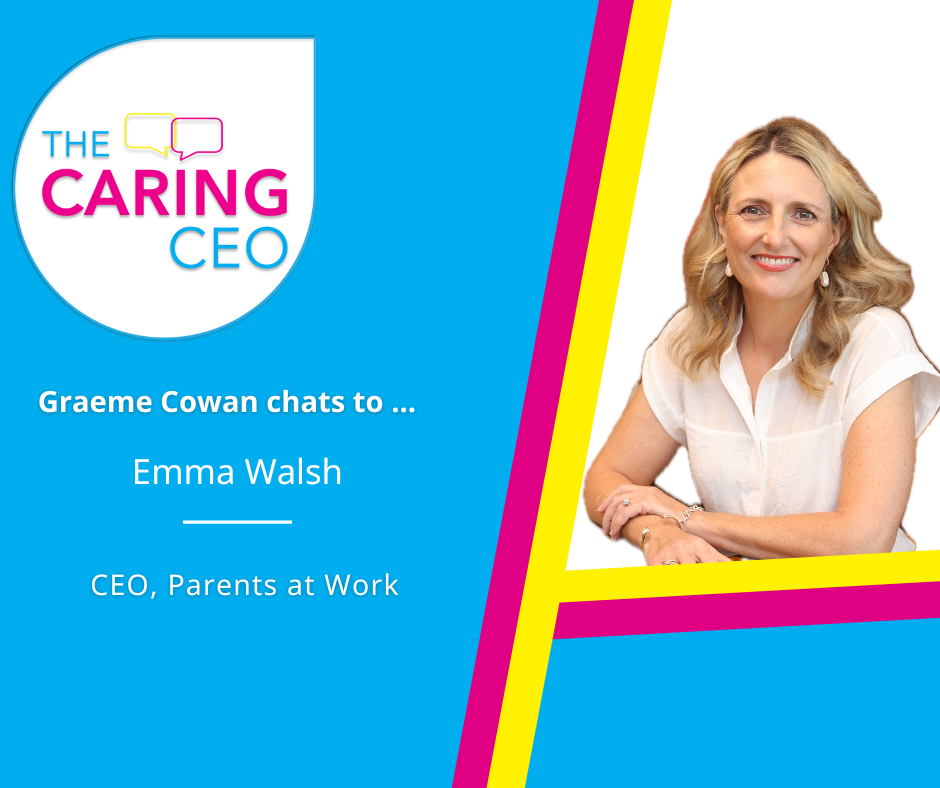
#94 Family friendly workplaces, Emma Walsh, CEO, Parents at Work


DISCUSSED IN THIS EPISODE
- What caring in the workplace means for Emma Walsh.
- Practical strategies for creating family friendly workplaces where people can thrive at every stage of life.
- How inclusive leadership, flexible work, and supportive workplace cultures improve wellbeing.
- Simple, actionable ideas leaders can implement today.
RESOURCES
Want to learn more about what you can do in workplace mental health training?
Want to to reach out, share a great leader we should interview or learn more about The WeCARE Way, click here to contact us.
Transcript from the interview
Disclaimer: The following transcript was generated using a specific tool. It serves as a convenient method for converting our podcasts into text and allows for easy text searches. However, we kindly ask for your understanding if any typos have inadvertently occurred as a result of the tool’s usage.
SPEAKERS
Graeme Cowan, Emma Walsh
Graeme Cowan 00:00
Hi, today’s guest is Emma Walsh, who spent the last 20 years really encouraging companies to develop family-friendly workplaces. Her career started in HR with groups like KPMG and also Zurich, and then she had twins and realized how difficult it was to juggle home life and work life. She began her business to make it easier for the mothers and fathers involved, but also the companies to retain really good people. As you will hear, she has also worked a lot in career development and in leadership development programs and shares what she believes are the core qualities of great leaders. She also describes her small business of 10 people and how it’s driven by care, care for the clients, care for each other, and care for the community, so she really is a great leader’s care. She really shows that dramatically. She’s very articulate and enthusiastic, and I know you’ll enjoy listening to some of Emma’s insights. Enjoy. It’s a real pleasure to welcome Emma Walsh, CEO of Parents at Work. Welcome, Emma.
Emma Walsh 01:26
Thanks, Graeme. It’s great to be here.
Graeme Cowan 01:28
Emma, what does care in the workplace mean to you?
Emma Walsh 01:32
Well, first of all, can I just say I love that is your first question on this podcast, because so often we don’t put care and workplace in the same sentence, so I just love this question, and it goes really deep to the heart of my why, actually, but that’s well, I’m sure we’ll get into that, but just put simply, care in the workplace for me is about creating an environment where people can thrive professionally and personally, and that’s just about how do we help people thrive at work and at home. It’s about recognizing that, you know, employees don’t leave their caring responsibilities, their health concerns, their life challenges, their life dreams at the door when they come to work. You know, carers about designing workplaces where you know we acknowledge that people live whole lives, and it’s about supporting them to succeed. So, but I know that can seem really.. oh, isn’t that lovely? And I get that, you know, but I think care isn’t about simply being nice or offering occasional wellbeing initiative. It’s about culture, it’s about leadership, it’s about ways of working, it’s about ensuring policies, practice, leadership behaviors really genuinely enable people to balance work, family wellbeing without fear, really, is so much of what comes through that you know flexibility and caring responsibilities aren’t going to damage their, the way they judge their career prospects, their pay opportunities, and you know, you know, deeply believe that family-friendly, caring workplaces aren’t just good for individuals, it’s good for business, and when people feel supported and included, they’re more engaged, they’re more productive, they’re more likely to stay, and you know, care creates conditions where people can bring, well, their best selves to work, and I just, when I look at the future of work, and I look at what’s coming down, you know, on the bullet train that’s heading towards us all, you know, globally this huge aging workforce, you know, every nation on earth is aging, we’re having less babies, and there are more and more aging people, and so the more of us are going to do over our lifetime need care, or we’ll be giving it to somebody else, and how are we going to manage that? How our workplace is going to rise to meet that challenges? How are governments going to rise to meet those challenges, and you know, and the other big one is obviously AI, you know, and how are we going to imagine, you know, I think probably every job will have a human machine do it, and so, how do we think of care as the real essence of humanity? Of you know, AI can’t emotionally feel care, humans do that, you know. So, anyway, great place to start. Thank you for asking.
Graeme Cowan 04:39
Yeah, fantastic. So, your mission now is, you know, helping organizations build family-friendly workplaces, but for our listeners, it’d be great to get a little bit of a background about how you ended up with this mission.
Emma Walsh 04:54
Well, as I said to you, obviously in prep, for this is that I feel like really all. Ordinary person with actually an ordinary story, and I think because of why is that. Well, because I like many young women left school in the 90s, and anyone who was part of that era will remember it was a period in time where globalization was on the rise, the women were more and more empowered to take on careers, and it was all about you can do anything, you can be anyone, you can work anywhere, you can do anything. And I set off in the world with that wonderful backdrop, and thought about, right, well, what am I going to do in this world? And I really enjoy people, what am I going to do with that? And it was my father who said to me, actually, Emma, I think you’d be great at human resources, and I thought, what’s that? I’ve never heard of that term. And actually, my dad was quite really advanced now. I think about it back then, because really, 90s was not even, you know, I don’t think human resources as a term was really even coined that much, it was still personnel, if you remember,
Graeme Cowan 06:08
or payroll,
Emma Walsh 06:09
not payroll, and you know, recruitment, and, and I said, about thinking, okay, well, that, that sounds good, because I’m going to need to have a career, and I’m going to need to earn money, and I’m going to want to do that with a family, and how is that? So I’m going to go about doing that in my 20s, because I know in my 30s I’m going to want a baby, and so off I went, and true to form, about 29 years old, I’d had this amazing career in HR, and I was lucky enough to do that internationally as well, and I’d worked in lots of large organizations, big names that we would know internationally, and I loved my career, but one thing that I had noticed was working in HR, you obviously get every employee dispute come across your table, and one of the things that I’d started to notice was that a lot of those disputes and complications were about women having babies, taking parental leave, wanting to come back and negotiate part time, being sidelined, being told not to give them any pay rises or pay reviews, clawing back paid parental leave, if we were offering it at all. It seemed that I just saw penalty after penalty, and I found the one particular incident at work time where I was negotiating a return to work with a particular employee with a difficult leader, and that leader screamed down the phone to me, over my dead body, is she coming back part time, get rid of her, and that was one of the turn points for me, where I went, wow, you know, I feel like I’m staring down the barrel of my future, this is going to happen to me, but I also felt so complicit and powerless at that moment to really do anything about it, and I decided I was done, actually not long after that, and age of 29 I left the corporate world quite young, still thinking, right, I have great HR skills and consulting skills, I’m going to just build my own, I’ll just do my own HR consulting work, and that will work really well for me, because I will be able to get the flexibility I need, because I know that I’m going to want to be a great mum, and I’m going to want to continue to have a great career, and not long after that, I did set up an HR consulting business for about 12 months, 12 months in, I fell pregnant with twins, and I thought, right now I know why I’ve been so obsessed with how I was going to balance work and family, and I thought, right, wow, well, now’s my time, and I thought, you know what, I can continue this HR consulting work, I do know how to do it, I’ve done it before, you know, it’s easy money, so to speak. It, you know, I could do it with my eyes closed, and I thought, no, I really deeply care about the fact that other women are being sidelined, other women are being pushed out of the workforce. I want to create something that gives people a chance, like I had, and to keep them connected to their workplace, and so our organization was born when my twins were about six months old.
Graeme Cowan 09:29
Wow,
Emma Walsh 09:29
and I, we just didn’t.. there was no real business plan. We just decided to see how we could help people stay connected to their workplace, do return to work programs for mums that needed it, and very much a not for profit, free reviews of their resumes, anything we could do, because back then, Graeme, no one would have paid me any money for doing that work, so it was 100% about wanting to give back to try and use my HR contacts next. Expertise to push organizations to think about running return to work programs, so that was really early on in, you know, the infancy of what we know to be, we’re talking 20 years ago, so a lot has changed in that time, but a lot hasn’t, and you know, really the 20 year journey, you know, year on year, I thought, you know, have I done enough? Should I give up on this? This is really hard, you know, really hard, because I’m pushing society change, I’m pushing, you know, employers to do something they don’t want to do, I’m trying to lobby government to do something they don’t want to invest in, you know, that was just.. it felt like there was just so many roadblocks, and I was putting my personal, you know, well-being, my financial well-being, my.. you know, our family’s wellbeing on the line for this, and there were so many times that I wanted to give up and pack it all in, but there’s something burning in me, like, no, gotta keep doing it, and yeah, anyway, so here we are.
Graeme Cowan 11:07
I’m good friends with Avril Henry, who I’m sure you’ve
Emma Walsh 11:10
met. Yes, I remember Avril. She was one of the women I spoke to in the early days.
Graeme Cowan 11:15
She, you know, was pretty heavily involved in Westpac being the first organization to, or large first bank, and I think probably first large organization to offer maternity leave, and once there was that precedence, it made a massive difference. And it is great to see how it’s evolved, and it’s interesting. Now I have friends who have sons that have had kids, and they’ve had paternity leave, and I thought, boy, I wish I had that when I was my kids were growing up, but so what percentage would offer paternity leave these days of organizations?
Emma Walsh 11:52
Oh, that’s a great question. I think paid parental leave has got to be one of the most controversial, complex, convoluted policies that organizations have in place, including government, that when you think of leave any kind of other leave provision policy that exists in organization, they’re actually pretty straightforward, but it’s not uncommon for me to get a 20 page document covering parental leave policy for an organization, you almost need to be a lawyer to interpret it, and that’s because we use all sorts of different terms, often try and put in all sorts of different caveats, so there are lots of different terms that we use to describe parental leave, one of them is obviously maternity leave, paternity leave, primary care, secondary care, and they’re all designed to put men and women in a box around how they care and how much they should get based on that caring, and so in Australia, actually, paternity leave is not a label that the government use anymore to describe leave taken by men, Australia has introduced one paid parental leave scheme, which allows families from the first of July up to 26 weeks to share. There is a proportion that is ring fenced for men to use, but that doesn’t preclude them from using more, should their partner also want to take that leave. Organizations some have followed suit with the government and have removed those labels, and there’s just one parental leave policy in their organization, and they allow men and women to fully use it and access the same leave provisions, regardless of gender. And then we’ve got some organizations that only allow women to take parental leave, they don’t permit men to take parental leave, and that’s so there’s that group of companies, then there’s a whole lot that don’t pay anything at all and don’t contribute at all, so it’s very difficult to get your head around a number of people taking paternity leave or men taking parental leave, but we do know certainly it’s on the rise, because more organizations are making sure that you know they’re opening up access, trying to, as part of their gender equality progress, make it easier for men and women to share care, which is super important if we want to close the gender equality gap, and we do know that Wajir, the Workplace Gender Equality Agency, is asking organizations to report on and measure and put improvement plans in place for men accessing parental leave, so it’s one to watch, but a difficult one to get a perfect stat on as to how many, and even that is an issue that we can’t, as a nation, really get some accurate, easy figures on that, but it is on the rise.
Graeme Cowan 14:52
I just want to take a bit of a slight tangent now, and I saw in your background that you’ve been in a leadership position with career development. Australia, and you had also managed a leadership development program for a large organization, and very interested, I guess, in the knowledge you gain on both those things about what were the things, the parts of the role that really led to people becoming good leaders, and then great leaders. Was we ever identify the elements that most contributed to that?
Emma Walsh 15:30
Oh, yeah. Great question. I think you know a really obvious answer to that, and maybe not a necessarily sexy answer to that question, is emotional intelligence. So much of great leadership comes down to emotional intelligence, the ability to read a room, read an individual sense, what might be going on underneath there, and thinking using critical thinking skills in that moment to go, what might be needed of me right now.
Graeme Cowan 16:05
Yeah
Emma Walsh 16:05
Based on what I’m seeing in front of me and what I’m hearing, and being able to be really deliberate around how we respond to those things. So great emotional intelligence is about self awareness, and it’s about, yeah, and it’s about self management, and I think great leaders deeply understand that, and they practice that so well, and it’s that that they reflect on a daily basis. You know, how did I show up today? Did I, was I the person I wanted to be? And you know, what did I notice today about what was going on for other people, and how did I respond to that, and trying to put yourself in the shoes of other people, because leadership is all about people, isn’t it? And once heard a brilliant article, very long time ago from Harvard Business Review, and it was something like, is it a requirement, or do all new leaders, or do all new leaders in general need to have a psychology degree? Question mark, and I thought, yeah, probably might be a good idea, will really help them enormously. Yeah, but it was like really telling, isn’t it? Because if you don’t, and often would talk about this as a facilitator of leadership programs, if you don’t really like people, enjoy interacting with people, don’t get a kick out of people, you absolutely shouldn’t be doing leadership, and yet there are plenty of people who do take on leadership roles, they’re not really people, they do know that, and yet they put themselves in the lion’s den, and I go, why would you do that to yourself? Because leadership is all about people, and how well you can communicate with people, connect with people, engage with people, influence people, you know, inspire people, you know, all of those things, and you almost don’t need to know anything else other than really understanding people.
Graeme Cowan 18:12
It is, you know, we were talking before we came on air about, you know, a book, my new book, Great Letters Care, and in the crew care section, which is the leadership and team optimization, and it’s broken into three bits, about caring about belonging, building a sense of belonging, and where there is so much uncertainty and disruption in the workplace, feeling that you belong is pretty important, isn’t it. And I just wanted to also extend that to people that may be on maternity leave or paternity leave. How do you help them belong when they’re at home and you’re not coming into the office as much, not having the face-to-face contact as much?
Emma Walsh 18:56
Yeah and I think this goes for so many people now, doesn’t it? That not in the office regularly? I mean, this is what employers get whipped up around, because it’s like, oh, how can I manage them or engage with them? How do I know what they’re doing, and how do I know that they’re deeply caring about the work the way that I need them to, and blah blah blah blah blah. I think this is one of the most difficult modern workplace challenges for any leader today, is this, you know, managing hybrid flexible work arrangements and people’s wellbeing needs, because often leaders feel an intense pressure if they’ve got to do the right thing by leadership. Then I’ve got to care about every individual need that every individual in my team has, and they get very stressed very quickly, and I do think that leads to a lot of leader burnout, because there are some really great leaders out there that genuinely care, and then they get caring fatigue, and they crash
Graeme Cowan 19:52
Well they forget about, they forget about self care, they do, and they
Emma Walsh 19:57
Yeah,
Graeme Cowan 19:57
you know, as everyone thinks. Knowledge is, you can’t assist or support others if you don’t have fuel on your own tank. It’s impossible. It’s impossible.
Emma Walsh 20:05
No, that’s right. It is really difficult. And I think this whole.. and I have definitely fallen in this trap. I mean, I wrote an article years ago now, and about caring fatigue, going.. it’s real, you know? I don’t think we talk about it enough. I think. We, when we think about caring fatigue, probably our minds go to, oh, someone who’s having to deal with, you know, a relative with high dependent needs that can’t be left alone. You know, we take our mind to someone, yeah, we get deep caring responsibilities who can’t in any way get out of them, they’re shackled to them, but actually all of us feel caring fatigue. You don’t have to have a family to feel caring fatigue. It is totally about your attachment, your emotional attachment to what you’re doing and the people around you, and how well you learn to manage your emotional attachment in a way that serves you and them, and I think that’s just the greatest leadership challenge of all time, really. And something I still try to practice each week, and never think I’m quite nail, because it’s really hard, like, you know, I don’t want to sit here and say that this is super easy stuff, because it isn’t, and you know, I think about, I don’t think anyone leaves the house really with this idea that, you know, what I’m going to have a really bad day today, it’s all going to go pear shaped, I’m going to miss my bus, I’m going to, you know, get into an argument with my partner or my colleague, I’m going to, you know, not deliver on something, and I’m going to be a really bad performer, and yet by the end of the day, that’s exactly what they think about themselves, and that’s because life didn’t go to plan that day. They didn’t leave the house intending for any of those things to happen, but they walked home from work, and that’s what was on their shoulders,
Graeme Cowan 22:03
yeah, yeah,
Emma Walsh 22:04
and life is messy,
Graeme Cowan 22:07
yeah, yeah,
Emma Walsh 22:08
and often unpredictable, and rarely goes to plan, and I think for many people, when you have a genuine, you know, positive outlook, and you know, and a hope for something, and a set of expectations around how something’s going to go, whether it’s an interaction with your boss, or you know, a way you’re going to get to work, or an interaction with your child, or whatever, and it doesn’t go that way, and it gets messed up. Yeah, then I think for people who have that just happening to them over and over and over again every single day, and yet they’re pouring in deep care, trying to prevent all these things from happening. Caring fatigue is just envelops them, it’s very difficult in that moment. So, caring fatigue is real. We don’t talk about it enough, and it particularly is hard for young parents, and not just mothers, you know, fathers too. There was so much pressure, the sleep deprivation, you know, the sense of needing to, for the fathers often go back to work and provide a really, and quickly get home as well, if they’ve had to go to an office or a work site because they don’t want to leave their partner for too long, because they know that they’ve probably had a really tough day, and they come in with all the work pressures and all the stress that happened at work, and they hit the wall with everything stressful that happened at home. No one’s happy in that story, and then they go and do it all again tomorrow, and the next day, and the next day, and the next day, and we wonder why families feel broken from that. You know, the strain gets to them. How can anyone feel like they’re going to turn up and be their best self? Is that the relentlessness of what people are dealing with? And it is. That’s just true, Graeme. That’s what most households are dealing with young families.
Graeme Cowan 24:02
We have some helpful resources that you can find at We Care 360 five.com.au The first is our mental ill health calculator, which is a quick and simple way to work out what poor mental health costs your organization in lost productivity and employee turnover. You’ll also find our Building a Mentally Healthy Culture checklist, which shows how to launch a great initiative and keep that momentum going. These resources can be found at We Care 360 five.com.au What do you think you know the benefits to family, you know, having a family-friendly workplace is obviously good for them, and should be. But what you say to those about, you know, what does it do for the business? What’s the evidence for a CFO about
Graeme Cowan 24:57
Why we should do this? You mentioned. Before that, you had a boss that said that I’m not doing this, get them out here. What do you present to them to challenge that assumption that it’s too much hassle to try and make it happen?
Emma Walsh 25:14
Yeah, well, I mean, it just.. I’ve often thought about that moment where the manager spoke to me like that, and I went, “I’m done, Graeme. I never went back to the corporate workplace. I started, I thought it was going to be easier to start my own business than re-enter an employer. Now that’s extreme, because I think most people would know it is not easy on starting a small business. I didn’t happen to know that at the time, but no, I think of my loss to employers, you know, where I could have gone on to be a huge asset to employers, but they lost me, you know, and they lost me to their organization, and how many more people like me were lost to their organization, and what was the cost of that? You know, and I think that one of the biggest misconceptions in business is that care and performance are somehow competing priorities, you know, that I think in my experience the highest performing organizations are often the ones that care the most about their people,
Graeme Cowan 26:24
appreciate to the converted. Always bring up every episode the evidence from Gallup that you know they’ve got one statement: my supervisor or someone at work seems to care about me as a person, and they just show amazing business outcome from that high productivity, health profit, longer people stay there, and the better the loyalty, and the loyalty, all that sort of,
Emma Walsh 26:49
yeah, it’s priceless.
Graeme Cowan 26:50
Yeah, I think
Emma Walsh 26:51
employee loyalty is priceless, and I think that we undervalue care is undervalued and underrated in organizations. I would say
Graeme Cowan 27:00
another element, which probably isn’t spoken about, but is around, you know, friendship at work, and
Emma Walsh 27:06
yeah, the
Graeme Cowan 27:06
Gallup organization also have a statement in their Q 12, which is I have a best friend at work, and people that strongly agree to that are seven times more engaged than someone that says I disagree with that, seven times more engaged, and you know that’s discretionary effort, that’s loyalty, that’s going beyond what’s expected. So one of my, you know, as you may recall, one of my things in the book is that, you know, care isn’t a soft skill, it’s a strong skill, and quite frankly, it will differentiate between a good and great team and a good and great organization, especially when there’s uncertainty, when people aren’t, you know, feeling vulnerable or whatever.
Emma Walsh 27:48
Yeah, yeah, I mean, I think, gosh, I’m Australian employers chasing productivity, aren’t they obsessed with it? And I go, wow, you know, it’s over here,
Graeme Cowan 27:59
but it’s not happening, you know. All this technology is coming in, but the needle isn’t moving on productivity, so something
Emma Walsh 28:07
is exactly.. and I get.. I just go, “Wow, you know. Do you know what? When I look at my team, and we have such a small team, we 10 people, but we do global work, and when people, new people start our organization, or when new clients come on board, they’re like, “Oh my goodness, had no idea you were doing all of this.
Emma Walsh 28:31
And I go, “Oh yeah, oh, I guess I guess we just do it. I don’t know, you know, like, you know. And you know, so much of many of my team members have been with me a very long time. We’ve been through so many highs and lows, we’ve learned so much together. There’s deep friendship, and occasionally, from time to time, we’ve thought, well, maybe we’re all too close, you know. But we really identify with being, even though we can irritate, you know, each other, of course, it’s normal in a small team that have worked together for a long time, like family members, but ultimately underneath it all, we deeply care about the work we’re doing. We’re so proud of it, and we, you know, with every adversity or every challenge that we get, we go right, really annoying. How are we going to overcome that? You know, and so I don’t think. I think a culture of care, it’s not about lowering standards, it’s not about letting people have more days off, it’s not about, you know, avoiding accountability or just being really nice. It’s not a.. it’s really about creating the conditions that people feel enabled to perform at their best. I just want my people to be able to perform at their best
Emma Walsh 29:41
And if that means they need to deal with stuff that’s going on at home, so they need to sort that out to be great at work. Then they should do that. I don’t want to get in the way with that, and I want to help them with that, because I know that’s good for them, and it’s good for me too, and it’s in our best interests to support each other. So I just. As an employer, I just go, what’s wrong with all these other employers? They can’t see that, that if they.. that’s the magic to productivity. And I often think, as these talk about what makes a great organization comes down to 3c’s1 is care for customers, the other is care for community, and the other is care for their people. Well, that’s a P, not a C, but yeah, care for colleagues. When you get those three things right, that’s when that’s the golden triangle. That’s when you become a great organization, a legacy building organization, and not many have got that right.
Graeme Cowan 30:42
Just want to jump to, I guess, something more personal, and that’s around, you know, you as an individual, you as a leader. How do you switch off?
Emma Walsh 30:51
Oh, good question. I am pretty good at jumping from things, you know, and what do I mean by that? I can switch from thing to thing quite easily. I can be doing this podcast with you, and then in about 10 minutes be walking the dog, and I’ve changed sets from where I am. So my transition zone between doing something and then moving to something else is quick, and I think that serves me super, super well. It isn’t something that necessarily I mean, I do think part of it, I’ve got that it’s a natural strength of mine, but I’ve also come to learn to use it to my advantage much more. And so, being able to switch from one thing to the next, and maybe that’s having to do with twins, I don’t know, maybe that helped me deal with that, you know, having to do two things at once, the 10 to two people, multiple things at any one time, and I think the other thing is recognizing when I find myself doing a couple of things at once, or even in something, one thing that I’m doing specifically, I’ve tried to get better at going. Is this the best use of my time right now? As if I was like my mum had come and tapped my shoulder and said, Emma, should you really be doing that right now? And that little voice goes in my head, and when it does, I pay attention, because I usually know it’s popped in, because it probably shouldn’t be, and I have to at that moment stop and go, no, you probably shouldn’t. Time to make a decision whether you’re going to continue or you’re going to put it down and go to the next thing that needs your attention. So, I’ve had to get so self-talk, I think, is really valuable, and learning to when to switch it and listen to it, and that’s because I think I’m an intuitive person, generally, and so I guess I try to really be in touch with my intuition, and that also includes if I can see it happening over there, like often my team know I have a bit of a sixth sense about things, and so I try. I’ve tried to listen to that, you know, and to tap into intuition is a really great thing, and that’s often about your subconscious trying to tell you something, or you just can’t quite get your finger on, and trying to just stop in those moments and just pay some quick attention to something. So, I think I mean, so that’s about thinking habits. I am quite a creative person, and I like to have a fulsome life. So I was saying to you before this, I, you know, a lot of people know me as a bit chaotic. That’s because I’m trying to pack as many things into my day as possible, because I’m energized by that, and I do tend, my mum often used to say to me, when you know, I just was wanting to constantly, I was, my daughter is a bit like it, so I actually see, I now see myself through my mother’s eyes, actually in my daughter, of just wanting to make the most of every day, and so sometimes I try, and really young, I need to stop, and I’m not great at that, and I’m the first to admit it.
Graeme Cowan 34:08
Yeah our time has gone very quickly, and I always finish with the same question as well, which is basically knowing what you know now, what advice would you give to your younger self when you’re so, for example, where your father suggested going into HR, what knowledge would you give that person starting a career down that track?
Emma Walsh 34:36
Yeah, do you know what it’s pretty simple. I mean, I think there’s two things, one hang in there, you know, and I think that phrase is such a really important thing. The reason I’m still here today, 20 years in business, doing this work is because I’ve hung in there, just one day at a time, you know. You don’t need to have all the answers, you don’t need to. To you know, have it all plotted out, and that actually the beauty of life is letting things unfold, actually, and being open to what comes next, trusting in the universe, you know that things will unfold as they should, and being open and ready to respond to things that come, and that probably you can handle way more than you think you can.
Emma Walsh 35:25
Yeah, you know, and you don’t need all the answers. I just, so don’t need all the answers
Graeme Cowan 35:30
I think that’s a great message, because sometimes easy to overthink things, isn’t it? Just Raja and just start and learn by doing, and you know, particularly in this world, there was so much evidence that learning by doing is a bloody would go good way to do it. Having a good coach also helps, but learning by doing is a good way to approach it. I’ve really enjoyed our chat. Thank you, Emma. Thank you so much for being part of the caring CEO,
Emma Walsh 35:56
Graeme. Thank you, and kick off the amazing work. We need you, definitely more of you, please, in the world.
Graeme Cowan 36:05
Thanks for joining us today. We hope you’re inspired to strive for a culture of care that also leads to great results. If you’ve enjoyed this interview today, please rate us on your favorite podcast platform, and don’t forget to subscribe so that you don’t miss an episode. We also welcome any comments. If you’re interested in seeing details about our scalable WeCare \365 mental health training programs, please visit us at WeCARE365.com.au, our goal is to make these programs accessible, practical and ongoing. You can also find me, Graeme Cowan, on LinkedIn, and I’d love to hear from you. And finally, if you’ve come across a senior leader who has impressed you and you think they’d be a great guest, please email us at support at WeCARE365.com.au, thanks. Once again for listening today.

Oh, you are inquisitive… getting all the way to the bottom of the page!
Thanks for listening 🙂
From all of us at The Caring CEO, and the WeCARE team, keep listening, keep caring and lead with your heart.
P.S. If you want to reach out, share a great leader we should interview or learn more about The WeCARE Way, click here to contact us.
