
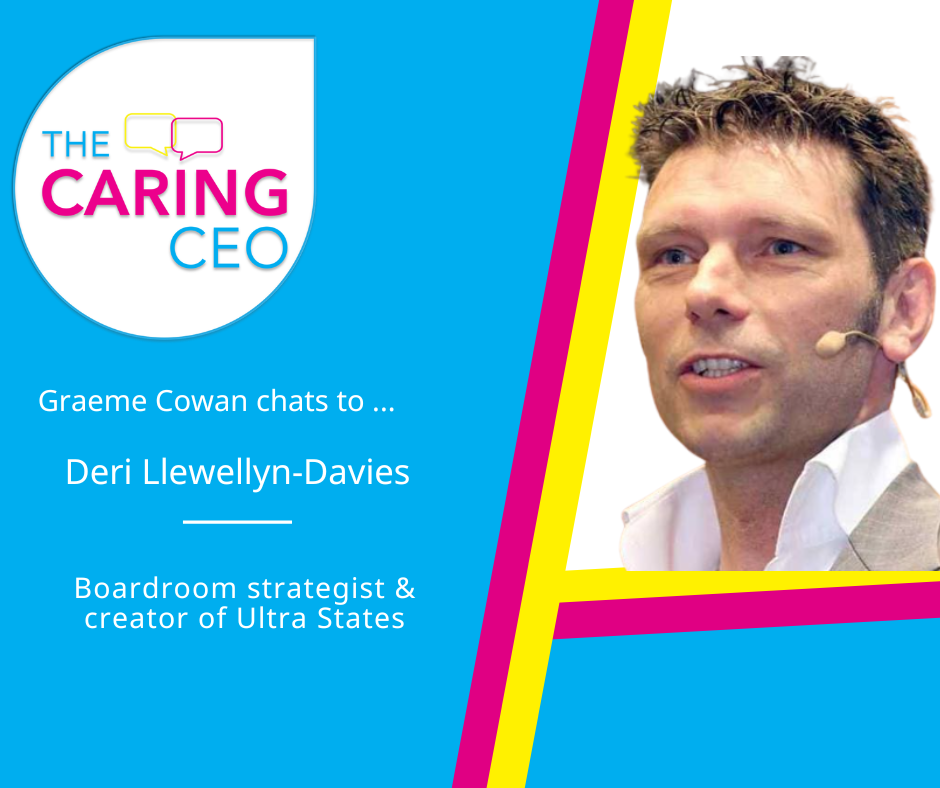
#95 No regrets leadership, Deri Llewellyn-Davies, Boardroom strategist & creator of Ultra States


DISCUSSED IN THIS EPISODE
- What caring in the workplace means for Deri Llewellyn-Davies.
- Leading with clarity, resilience, and purpose in high-pressure environments.
- Why sustainable high performance isn’t about constant intensity.
RESOURCES
Want to learn more about what you can do in workplace mental health training?
Want to to reach out, share a great leader we should interview or learn more about The WeCARE Way, click here to contact us.
Transcript from the interview
Disclaimer: The following transcript was generated using a specific tool. It serves as a convenient method for converting our podcasts into text and allows for easy text searches. However, we kindly ask for your understanding if any typos have inadvertently occurred as a result of the tool’s usage.
SPEAKERS
Graeme Cowan, Deri Llewellyn-Davies
Graeme Cowan 00:02
Today’s guest is Deri Llewellyn-Davies, who’s had an extraordinary life. Over the last 25 years, he’s advised lots of boards and senior executive teams, but he came from a very humble life in a small village in Wales. And something happened there when he was very young, that had a lasting impact on his life. In the last couple of days of his father’s life, he told him that he’d had lots of regrets in life. This had a huge impact on Deri, and he decided to live a life with no regrets. That included running six marathons in the Sahara Desert, climbing some of the highest mountains around the world, and pushing himself on lots and lots of fronts. He’s had two TED talks, one which is the habit of flow, and the second one is about how to push through fear and achieve great things. As you hear, Deri has lots of passion for his work, and his advice to his younger self would be to discover his purpose earlier. That’s how important he considers that to be to a good life, to an ultra-state life. There’s a lot to learn from Deri. Enjoy. It’s a real pleasure to welcome Deri Llewellyn-Davies to the Caring CEO. Welcome, Deri.
Deri Llewellyn-Davies 01:29
It’s great to be here, Graeme. Looking forward to this conversation.
Graeme Cowan 01:32
Deri, what does care in the workplace mean to you?
Deri Llewellyn-Davies 01:32
Do you know this is? I was really when I got the invite to come on your show. That’s what jumped out at me was the word care that you’ve used, and I was like, “That’s a really interesting word to be using, isn’t it, in the workplace? This is why I love your work because it’s not one that we talk about. You saying that question, I don’t have ever been asked that question before in 30 years. Now that’s insightful, I think. But I’ll cut straight to it because I’m a pretty direct person, which is for me, it’s like you actually need to give a shit. That’s right. It’s like cutting through all the noise and no fluff. It’s you actually have to give a shit, and I mean that’s giving a shit about the company and also giving a shit
about the employees, right? And I mean really, and this is word caring, right? And I think we have to. If I use that word caring, some boards would resist against that, but then there’s like we’ve got to unpack what that word means, which I’m sure we’re going to do a little bit today, right? But it’s, and I think a lot of leaders, I think the world’s rife with narcissism, it’s rife with bullying, and they don’t give a shit, and that is the truth. I won’t work with those companies, by the way, because it’s culturally toxic and it doesn’t work, right? Yeah, yeah. I think you just got to care, right? You’ve got to give a shit. That’s that’s my my my view of it. But I’m I’m I want to know more about your view on that in a minute, Graeme.
Graeme Cowan 02:41
Well, there’s some very robust research that confirms how good it is. Gallup Organization have been researching engagement discretionary effort for 40 odd years, and now down to just 12 statements. And one of those statements is, “My supervisor or someone at work seems to care about me as a person, and it’s been asked over a million times, 100 different countries. The more people that strongly agree with that, the higher the productivity, profit, customer service levels, and longer people stay in an organization. So, and you know, part of my work with the Caring CEO was just not to say this is theory. You are my 90-first person to interview on this show, and there’s lots and lots of examples of very senior leaders that are doing amazing stuff that really strive for both those things: a culture of care and a culture of high performance.
Deri Llewellyn-Davies 03:37
Well, I come from the high performance side of things, so this is what we’ll be delving into, but I really want to get that Gallup study because I haven’t seen that piece of detail of it, which I think is fascinating. Because I’ve been looking at various Gallup polls for decades, and the one that jumps out the most is engagement, right? You know, and I can’t remember what the I’ve been watching that number. It’s been moving from 70% to 80% plus for years of disengagement in the workplace.
Graeme Cowan 04:00
Exactly. It’s now that there’s only 14% actively engaged now. One four.
Deri Llewellyn-Davies 04:06
That’s just like that’s. I’ve been quoting this for 25 years. This this and it’s got worse. And it’s the and it’s the you the actively disengaged is the worrying statistic, right? Because so for those listening to those actively disengaged means you have a terrorist in the building and they are purposely taking you down and that statistics going up, right? And it has been so. It’s like that engagement, but then then the next question behind that, because I love engagement indices and everything else, right? What constitutes engagement? And it always comes back to the leadership, and it comes back to the leadership caring, right? Also about development. There’s a few other things going around that. So this actually, the leader actually feeling like you give a shit is critical. It sounds so obvious, doesn’t it? Right when you say it, but I’m so glad you got the science behind it because now I will. I’ll be singing from the rooftop for you now, Graeme. So it’s amazing.
Graeme Cowan 05:00
Right, you grew up in a small Welsh village. How was that, Deri?
Deri Llewellyn-Davies 05:05
Small and Welsh. So I always say that because I think it’s important. I think our heritage informs us, and I we we as humanity. When we look at ultra states, you know, I’ll be talking about performance and states at some point today. Right, states is I think our God-given gift. You know the ability to get an access flow state, etc. Right, but a lot of this comes back to ancient origins, and I’m always looking back to us. And we were we came from villages. That’s the point. We had tribes. That’s where we originated, and the tribes had rules, and there were certain things around that of which our biology and our brain hasn’t fully evolved out of. I mention the village thing because it’s relevant. So what? And and also when I look at it from a corporation perspective, a business perspective, this is culture. If you and this is culture was formed in a village. When you’re in a little village, and when I’m on the stages, I always say hands up becomes my village. And hands are very few these days. It’s bloody. We’re run by city dwellers now, but when you’re in a village, there’s the dark sides and positive sides to village. So don’t. It’s not like roses and tinted glasses all the time in villages, right? Because you have a little bit of a crabs in the bucket syndrome and a few other things going on there. But the village is tight. Everyone in the village kind of knows each other, and you support each other. And if you say you’re going to do something in the village, you do something in the village. It’s and our you know our ancient origins. We were we’re very clear on we want to be part of the tribe. To be ostracized from the tribe is psychologically damaging for us, and also that could lead to death. So this village piece is important because if I make a promise. I talk about values in business a lot, right? Values in culture. What does that mean? But there’s a whole heap of depth there. But let’s just start with truth and honesty, and let’s start with actually giving a shit. Let’s put caring in the middle of the society. But if you make a promise in the village, you keep your promise, and that’s a really quite important thing. Because if I always say, like, if one of the the guys down the road, one of my friends, if Bob went and promised Auntie Mabel that he’d be coming to do his plumbing at 5o’clock and he didn’t show up, the whole village would know by the following morning when the post office opened, and then his mum would be giving him a barlike in for not turning up to Auntie Mae’s. That was the you kept promise, right? I think that’s what we’re losing is this cultural thing. And what is a business? I see a business as a village. I see corporations, industries as villages, and therefore there should be a culture. And every industry brings a culture with it. Every company brings a culture with it. Whether that’s good or bad, it can be directed by the leaders. Whether they give a shit within that culture and the care is also part of that culture too.
Graeme Cowan 07:40
In my research, I saw that you said something about men in villages in Wales are emotionally challenged. Was that is that something you said? What did you mean by that?
Deri Llewellyn-Davies 07:54
Actually the word I used originally was emotionally retarded, and then I had to change it when I did my TEDx. The TED removed and wouldn’t let me use the word retarded. I had to use challenged. I was actually referring directly to my dad. I’m 51 now, right? So the generation that I was brought up, my father’s generation, was you know 70s, 80s. He’d be 80 odd now if he was alive. When he died, because I talk about my father’s death, which was a big changing point for me, he died with regret. Right. That story comes from a point sitting on his deathbed, and I was holding his hand and just talking to him, and he said, “Son, I regret so much in life. And this is a man that I loved. I looked up to my father; he was a good man, and I never thought those words would come out of his mouth. And so, in his last dying, and that was, and two days later, he passed. So that was the only emotional conversation I’d had with him in his entire life, so that’s why I were referred to emotionally challenged. And that generation was buttoning up. Don’t cry. And this was I was brought up. I was brought up a rugby player. I was tough, and you know, it’s like I remember my cousin. We had a lot of deaths in the family. I don’t know why what happened to us, but my cousin died, and my brother died, and my so had these deaths. But remember the first death. It was my cousin, and I was like eight years old, and I just remember those tears. Right, I was crying. Don’t cry, men don’t cry. Right, I was like, okay, and then that’s programmed. Right, men don’t cry. So then, next few funerals, I sat there pretty stoically. Right, so bless them, and I don’t blame them. I have nothing but love for my father and his generation. They did not know any better. They’re like you know we’re sitting here. You’ve got your great book on care, and there’s all this coaching and leadership. We’ve got access to all this information. They didn’t have anything. They were in the village. They knew the village, and the only thing they knew was the parents before them, which were even worse than they were. So it’s like they didn’t know better, but there was no emotionality in that, and that masked a lot. In fact, I would argue that drove earlier death, and I don’t say that lightly. I think men suppress the emotions so deeply for so long. Why is it that women live a lot longer than men? But I’ll leave that question out there. But in that generation, emotions were suppressed so deeply. That drives all form of illness. I would argue. So sorry, that’s a longer answer to your question, but that’s where that quote comes from. Was the non-emotionality of my father and that generation, and now I stand for emotionality. You know, I I will I will if I have if I if I’m talking about something deeply emotional on the stage, I’ll cry, and I’m okay with that as a man. And I think as men, we need to, as leaders, we need to be more in touch with emotions because there’s humans in front of us. We truly care, then we truly care, which means that’s a huge emotional range needed there. And if you have got a very narrow bandwidth as a man as emotional, I see men all the time on the boards, Graeme. I’m like, oh my god! So a woman, one of the women in the stuff, she was just crying on me, and they’re freaking because it’s like joining me. She’s crying, and they’re like, and I’m like, just be there, just be present. That’s all you need. But she’s crying, Deri. It’s in the workplace. Yes. Would you? Would you want to leave that outside the door? Do you want to? You know, that’s that doesn’t work like that. And by the way, the fact that she’s doing that, another major driver of culture, and it comes out of the Gallup studies and a lot of other studies out there, is you want to keep your employees, make them feel safe.
Graeme Cowan 11:09
Yeah, 100% 100%
Deri Llewellyn-Davies 11:11
Safety, safety is so important. So if you can got an employee that sits in front of you and is okay crying, that’s a bloody good thing. Now, if you sit there and freak because you haven’t got the emotional range to deal with it, you’ve got to work on your leadership. So, safety and ability is key, I think.
Graeme Cowan 11:30
And I think one of the key things you talk about, you know, men being able to toughen up and handle everything. Well, sadly, I don’t know the exact figures in in Wales, but in Australia, 70-5% of suicides are men. Three out of four. So how’s that bodily gap going for you? It’s not exactly a great legacy, and it’s 20-5% of men in Australia who have no one outside their family they can be vulnerable with or confide to. No one, zero. So let alone just having one or two, so I went through my own challenges. Had a very bad breakdown and was out of work for five years. But after that, I sort of consciously built relationships and had rituals in my life, which developed those connections and vulnerability with men and doing great stuff. I know you had some time in the northern beaches of Sydney. Well, every Sunday I meet two mates at Curl Curl, and we walk out of Manly, walk back, and have breakfast. And it’s such a great way to start the day. It’s it’s yeah, of course, it’s kidding and taking the piss and giving each other hard time, but we’ve also had some really serious talks about you know relationships or kids, or finances, or whatever, and you know, I now am absolutely convinced, and and the research shows this as well that the quality of our relationships determines the quality of our life.
Deri Llewellyn-Davies 12:53
Now, I would push that even further now because I think you’re 100 right, Graeme. So, me and my partners, we created Freedom Founders, which is global tribes of entrepreneurs, right? And we did it because of the statistics and the boards. I’ve sat on boards over 330 odd boards now over 25 years, and what I’ve found is it’s got worse, right? So post pandemic, the boards come to me. I’m very blessed. I don’t call myself it because it would be a wanky expression, but I’m the trusted advisor to them, right? So they come to me when the ship shoot, and most of the time when they’re coming to me because there’s a big problem, you know, issues inside and outside of work. They’re coming to me. They got no one else to go to, which is exactly what you’re saying. So I went, okay, that’s great, and I’m very blessed, and I’m honored that they come to me, and that I don’t take that role suit. And then a lot of the time, I’m palming them off to coaches, etc. Because I’m not a coach, right? I’m a advisor. They come to me first, and I go. I hear you. You need to. You need to speak this person, right? Go deep. Be be be prepared, because a lot of men won’t go to coaches either, right? Because there’s like, and there’s a lot of crap coaches out that we know that. But you get to the good one, and it’ll it’ll change your life, right? So, so we saw that, and hence why we built the tribes, and the tribes are deep back to village, right? The tribe is about deep vulnerability, it has trust that our entire currency is trust. So now you’ve got 30 people in a tribe in a city, all scaling. You’ve got different problems when you’re scaling a business. All scaling, being able to talk about the challenges openly, be able to and literally cry, be vulnerable, do what you need to do, and we facilitate vulnerability.
Graeme Cowan 14:20
Yeah, it needs to be facilitated
Deri Llewellyn-Davies 14:21
And the number of our founders that are there, and they say, “Deri, it’s beautiful. Right? They say, “I can’t have these conversations anywhere else. Right? There’s nowhere else they can tragedy conversations. Tragic, and that is that’s the reality of where we are now. Take that a little bit further in the world of AI. So I’m digging deep into AI with all the businesses I’m working with and helping right now, the superpower of the future with AI and knowledge isn’t going to win. Right? It used to be if you used to be really clever a couple of decades ago, you’d rise through the ranks. Well, knowledge ain’t going to cut it, and all of the evidence is pointing to one: we have to upgrade our biology because our. Biology hasn’t caught up with the technology right now, and this is be able to access our deepest forms of ourselves and flow state in particular is going to be one of the superpowers, I believe, now of the next decade. And then, secondly, what are we as humans? Connectivity will be your superpower, and your ability to connect to tribes and your connect to your community and the depth of that community. So that is what you’re talking about is running really deep right now, and yet humanity’s going the other direction. We’re going into distraction and even further, like the shit that’s on social media. It’s so shallow. We need to go the other way. We need to go deep. And I’ve got my boys from Wales that I grew up with, and we just talk shit, right? And I can’t have deep conversations with those, and I just can’t. It’s just they tell me there’ll be all sorts of swearing going on if I started to go deep, but it’s a shame. So I wish they could. But then my male friends and people around me know we go deep, and I want to address the first part of your thing, which is super important. The suicide rates are equally bad. It is male dominated, and there is a huge thing in the business world because there is a huge pressure on. So it comes to the pressure, and once you take that pressure and you feel a failure or whatever, because with bankruptcies it’s all real in business, and the statistics are against you. And we talked about this a lot in the podcast I’ve been on the stages I’ve been on. We’ve sat and we talk suicide a lot, and the number of people I’ve had on my stage, and they’ve had, and this we’re sitting about suicide attempts is insane. These are super successful people, and they’ve said they’ve never talked about this before. So these are, but you know, poster child people. They’re like, look at me, we’re all successful. And yet, three years ago, they were standing on a bridge and looking at a sub. No, not never told that story was because they didn’t. You know, we don’t talk about that out there, do we? That’s too dangerous. Well, we need to, and I’ve said, and I’ll say it again, I said, if anyone out there is having a bad day and they think it’s time, you need to call someone, and you need to call me, you need to call Graeme, you need to call someone, and I think as men, we need to have each other’s backs more, and we need to be able to be open to have the deep conversations, and I think part of that, I think, there is a training needed, Graeme, because men just-we haven’t got the role figures back to my father. We didn’t grow up learning it, did we?
Graeme Cowan 17:06
No.
Deri Llewellyn-Davies 17:07
So we didn’t have role models. So now our generation’s job is to role model it for the next generation and also learn it ourselves. And I am work in progress. I’ll continue to be, but I’ve done a lot of work on myself, and I continue to do so. But it didn’t come easily. It’s not like yeah, okay, we’ll be vulnerable now.
Graeme Cowan 17:22
Yeah, I in 2009 I helped to start a movement in Australia called “Are You Okay, and it was really about being able to identify someone who’s struggling, to have the are you a are you a conversation and encourage help seeking. Sounds simple, but it has, it’s grown and reached an impact all around Australia and often around the world as well, particularly New Zealand and some other places as well. But the tagline is a conversation could change a life, and that’s just brilliant because it’s so inclusive. We’ve always, all of us, have been on the end of one of those conversations, or we’ve been having a conversation with someone else that we’re concerned about, and you know it really has helped to reduce stigma somewhat. There’s still a lot of stigma in the workplace, but you know there has been some very very good progress made there.
Deri Llewellyn-Davies 18:19
By that, Graeme. So let me just go there because this is in the workplace. This is a really interesting point, right? Because as leaders and CEOs, there’s a really interesting, and I’d like your view on this as well. So for me, there’s a divide. It’s got to be careful because you know, are you a coach to the employees? Are you now? What’s a concern? You know, are you leader? Are you a coach? Are you a counselor? Right, and you go counseling definitely not. If there’s something going on and there’s a bereavement and anything else, this is where I really big fan of making sure you’ve got coaching, accessibility, and support available, so they can come to you. But then you’ve got a the moment I think as a CEO you’re sitting there and you’re sitting and then they’re crying to you, but then you’re trying to diagnose and solve and sit on the couch with you. You’ve just that’s the wrong role, and I think this is where there’s a misunderstanding. People start to take it too far. You know, I trained in coaching and NLP and everything else two decades ago, right? And I started to apply it with clients, and then I backed up. I was like, you know what? There’s I don’t like doing that, and also I am qualified. I choose not to because there’s better people than I am. So now, what I’m able to do is diagnose and go. You need to talk to this person, and I think in organizations you have to understand that what is your role as a leader? When is the you know you’re not their coach, right? Now you can be as management. You know, part of a management role can be coaching, but part of a leadership role is it’s a different thing. Are you mentoring? What’s the difference between mentoring and coaching? So this in the workplace environment, ensuring put the right safe systems in place when someone’s got something, certainly outside of work, the personal stuff. I really believe we have to have internal support mechanisms to deal. And as a leader, you’ve got to be careful where you kind of step too far over the line. Does that make sense? 100%
Graeme Cowan 20:06
And with are you okay? We don’t expect people to be counselors. We just really encourage them to listen with empathy and encourage help seeking, and that could be seeing a GP or a psychologist, calling a helpline, doing an anonymous self-test, but you know, just encourage action, and then to follow up later to see if they have taken that action, and you know that makes a big difference. I’d like to jump back now to something that we talked about just very briefly, and you said that you know on your deathbed, your father said, “I’ve got regrets, did he elaborate on that?
Deri Llewellyn-Davies 20:43
He did, and I’ve elaborated on a lot more for the 20 odd years since. So he said, “Now, so my father, and this is what’s driven me. My father’s death created me. So it was a horrible time, but it was actually for me, it defined who I was. Right. So I was in corporate at the time. I’d risen to the ranks of European board, I was technically successful, but there was an emptiness. There was definite emptiness in me, right? But successful, right? And I had all of the external trappings of success. Thank you very much. You know, the house, the wife, the car, and then he said, “Son, I regret so much in life. And he went on, and he just he wanted to take my mom to Egypt, right? And he wanted to to travel travel the world, and he had the money, right?
Graeme Cowan 21:24
Yeah
Deri Llewellyn-Davies 21:25
His generation saved, right? So they saved, and they never actually used savings. So he could have gone in Egypt. He wanted to sit on a lawnmower, right? It was right. The the regrets were ridiculous. In his in his last few days, I had a lawnmower on his drive within you know 24 hours, who he managed to sit on the lawnmower and he wanted spotlights for the car. It was stupid shit, right? So, and it was like there’s things like if you, I like to live today. Live today like you’re going to die tomorrow, right? That’s a powerful presence forming a statement. But then the big ones was he actually as an entrepreneur. He was a failed entrepreneur. My dad. He ran the village shop, and in the 1980s supermarkets rose, and the village shop went out of business. It didn’t, though. He got scared. Tesco’s in the local town, and he just sold up for a pittance because he fed. He was like, “Oh, doom and gloom, nothing’s going to happen, and was fed a lie, got sucked into the myth, and sold. And he was the heart of the village. The village shop was the heart of the village. My dad was the heart of the village. Then he wasn’t, and then somebody bought that shop, and the guy in the other village had the shop. And my dad watched for the next 20 years whilst both of those people made great successes.
Graeme Cowan 22:42
Right now, how do you practice self-care? How do you keep fuel in your own tank, Deri?
Deri Llewellyn-Davies 22:47
That’s a very deep question, and I change the language for where I come at it, which is recovery. So, what I talk about within ultra states and being able to access states is one of the deep states I’ve discussed is recovery, right? So recovery is a state. So self care, I would say, is comes to different angles for me. One, do what you love to do. For me, self care is following your passions too. So me climbing mountains and being in the hills and being out with my dog and being in the garden, it’s activity actually, but it’s self care because if I am giving myself permission, one of my dear friends wrote the book “Give Yourself Permission, which I was featured in. It’s like if you give yourself permission to do what you love to do. I think that’s a form of self care. Equally though, if you’re on it and you’re in business and you’re talking to leaders, right? You talk about great leaders’ care, right? So to be a leader, it’s a tough job. It’s very cerebrally challenging. You’ve got cognitive load issues there, so you’re on it. So to self care, you have to truly recover. Right now, recovery is not Netflix and chill. That’s not recovery, right? That’s just rest, and it’s not even that because you’re smashing yourself with dopamine from a neurochemical perspective. Again, right. So, I’m when I’m talking self care, it’s the ability to truly know what my mind and my body needs, and giving the time for that actively and proactively to ensure that I can reframe my best. Now, that involves deep meditations, that involves red light therapy and saunas, and and hot and cold protocols, and actually time down and just time out, no screen time. I could go on as a big list. So for me, self care is is a whole chapter in my book, which is recovery and giving ourselves. And I think it’s the biggest missing state out there, especially for execs, leaders. Not your hardest skill that you need to really focus and stick in your diary. You put all these damn Zoom meetings in your diary, and where’s the meeting that says recovery?
Graeme Cowan 24:49
It’s not there. You’ve
Deri Llewellyn-Davies 24:50
got to put it in your diary every day, every week, and build those recovery protocols. If you do that, it’s a superpower because what we’re really doing with. In that period, if you understand states and the ability to access states, is we’ve got to recharge the neurochemicals. If you don’t actively recover, you think you’re smashed, and this is why you’re flat and you need the coffee and everything. You’re trying to hijack the biology using fake neurochemicals like coffee, etc. Thinking you’re going to override the system, it doesn’t work like that. You’re trying to fight biology, so for me, I don’t use the word self care in my thing because it kind of branches two things for me, and so I’m doubling down on recovery, which I feel is the same word. How do you class then self care? Because I’m coming in from that angle. Yeah,
Graeme Cowan 25:36
well, it’s just doing things that are good for us that help to boost our mood. You know, I talk about a moodometer, green zone, red zone, and doing things which go for the green zone. So, for me, I talk about three elements there. One is vitality, which is our physical health. So, you know, move well, rest well, eat well. The next one’s the intimacy, and that’s where you know you build very strong relationships, and where you know you enjoy being with people, you see them regularly, you can be vulnerable with them, and you’re probably aware of the Harvard Adult Development Study, the longest wellbeing study ever done on men. Like it was 750 men for 85 years, and there’s one underlying message there: those that have those strong, supportive, caring relationships live longer, have less stress, have more affluence, have a longer sex life. So, developing those relationships are good for so many parts of us. So that’s the intimate side, and that works with both our work relationships and our personal relationships. And the third part is what I call prosperity, which is our career or contribution energy. That’s where you do have a sense of purpose. You use your top strengths because that’s where you need to be most effective, and you also practice gratitude because that helps to recharge us. You know that we have a negatively bias as humans and notice more things that go wrong than things that go right, and so yeah, one of the things that I put in place is regularly just writing down first thing he’s born what were three great things that happened yesterday, and just try to consciously think about that. But so those three things: vitality, intimacy, prosperity is VIP, and you know I say to people, you have to act like a VIP each day, not like a wanker, but top up each of those sort of three areas in some way. But you know, I have no doubt there’s lots of overlap in your recovery and and my self care. Like I’ve already heard quite a bit there.
Deri Llewellyn-Davies 27:38
It’s the same. We’re doing slightly different words, a slightly different languages, deploying exactly the same things. And and you’re right. The the science around all this is very. So when I wrote Ultra States, I wanted to ensure that everything I was saying because we could. There’s here’s here’s the challenge, right? I we could be you. You say the word self care to me. Most boards will go, oh fuck, here we go. It’s self care. That’s in no woo woo camp, and without, and that’s the problem. We’ve got the stigma associated to some words, and self care is still in the woo woo camp, right? So it shouldn’t be there. All I’ve done is package things up, and I’ve put science on it. So Ultra States, it’s backed by 200 white papers scientifically. Everything I say is scientifically verified, and everything you just said is scientifically verified, right? This is not like an idea or a concept right now. You look at longevity studies because I’m really big into the health optimization side, the longevity side. It’s a big part of what we’ve been to all our tribes. I want to be the great. I climb the highest mountains in the world and stuff, right? So I need to be dialed in. But actually, being in the boardroom and being every single day, that you’re climbing the highest mountain of the world. Every single day, it’s the same principles, right? So you need to be at your peak. What does longevity look like? So I know that you know my grandparents lived into their 90s, but I don’t. I wouldn’t want the last 10 years of their life and love and all money because they were in a nursing home. They didn’t even under. They didn’t even know who they were for the last three, four years of their life, right? So it’s like I saw that, and I think we look ahead and go, “I don’t want that. Thank you very much. I want to live as long as possible, as healthy as possible, cognitively available as possible to be here for my children, my grandchildren, my great grandchildren, alive, fully living. Now, what does that mean? And a lot of us think it’s the you got to be on purpose is a huge part to everything. Full stop. Without purpose, none of it. None of it matters. But actually, when you look at it and you look at the blue zones and everything else, it’s not rocket science. It’s not as you know people are obsessing over so many things. But one of the main things was connections and your relationships. That’s come at tops every single time. The blue zones that was at tops. The let the and everyone in this listen to listen to this. Everyone listening to this just go listen properly. The depth and quality of relationships. Now we’re in a social media world where oh I’ve got X number of likes. Well, how many of those do you deeply? How many of. Shit about likes and comments and blah blah blah. I want to know the human that’s sitting opposite me deeply. Yeah, that’s what we’re missing. I think we’ve and the next generation worries me. I think my children, thankfully, I think they’ve got really amazing communication skills. But I’ve been helping. You know, I’ve seen them do that since an early age. But that next generation, like they’re so busy on their damn phones doing this in a superficial basis. It’s like humanity’s skill and humanity’s evolution right now is depth. That’s where we need to go. The technology is bringing it the other way. So I get ahead.
Graeme Cowan 30:33
Yeah. Well, there’s there’s as you say, there’s just so much evidence behind this. There’s Professor Robin Dunbar from Oxford, and he came up with what was known as the Dunbar number, and it basically showed that the average person can maintain about 150 relationships, be that through phone or meeting people in person, etc. etc. But can only do that. But then he asked them, “Who could you count on if you need to get $10,000 at night, or you need to someone to pick you up at three a.m. And it came down to three people, just three people. And what he then found was that they were people that they caught up with in person. So it matters so much more as well to catch up in person. Sure, you can keep relationships going, you know, virtually like this, but really deep relationships. It does take that face to face activity,
Deri Llewellyn-Davies 31:27
100% This is where, when we built Freedom Founders as a tribe, it was an experiment a year ago because we were like, how do you facilitate deep connection? Now, there’s a question, right? And it had to be regularity. So, no, we meet deeply for a day where we facilitate deep transformation and we facilitate deep connection every two months. Between that, we have private dinner dinners up to just maximum eight people to facilitate even deeper connection in between. And we believed that it would take about two years for the entire tribe to fully gel and go deep. Now we’re a year in, and we found that like half the tribe’s already there. But actually, it was the ones that were there at the beginning, and and others. There’s different parts of the tribe. I think people need learning to connect in different ways. Depends on you know you might be some part of the spectrum in a different way where you need a little bit more help and a little bit more time. But there’s no question it’s about proximity, and it’s also neurochemical, right? This is back to one of my favorite ultra states is ultra connect, the ability to connect deeply with a human being. Now, this isn’t just have a conversation, be vulnerable. This is brainwave patterns and neurochemistry, right? So, this is what in order for me to constitute a state in the book, it had to have completely different brainwave pattern, different neurochemistry, different physiology, and different physicality. Right. So when we are truly connected with another person, you are not in high beta. So you know, if you’re going, if you walk in and you’re stressed and you’re in high cortisol, you’re stuffed. You you’ll be able to have a conversation with the person, but you’re not connected, and they’ll feel it. By the way, whereas you’re truly there, and you know this is where transitions are the most important thing. If I know I’m going home to the family, I need to go and connect deeply with another person. You know, take those moments, breathe, reset. Let’s just take a moment, and I have to relish. What I’m doing is I’m doing a bit of breath work, resetting my neural pattern, get help letting the neurochemistry flush out a little bit. Now let me connect. Now I need to connect with purpose. I connect with genuine curiosity. I have to genuinely love the person in front of me. And now I’m able to be present. Now oxytocin, serotonin will kick in, and you’ll feel deeply connected. So this isn’t connection. Is you know this is why I was looking at the science behind connection, right? Because, you know, we can we sit up across another? Have you, you know, have you sat across from another person in another conversation, come away and gone, it was okay, it was a conversation, right? Or have you sat and lost track of time because you’ve been so deeply immersed and felt connected, and you come away and you just feel amazing because it’s called entrainment. It’s very science that you will literally write. You will rise to each other’s neurochemistry. So one person can entrain a room. So this is super interesting because we can now we know it. I think we’ve been accidentally doing this for 1000s of years because it’s just built in within us. We’ve hijacked that biology in the last 2030, years with technology. We’ve got to regain our power again, but the science helps us understand it, which means the actual solutions, by the way, are beautifully simple. It is breath work, it is meditation, it is deep. It’s like all of the woo-woo stuff, which is sat in the woo-woo camp all these years, right? Let’s just bring that front and center, wrap it with science. So you got now, now, now, let’s do it. So it’s we’re an exciting point in human history and a terrifying point in human history at the same time.
Graeme Cowan 34:48
Yeah, we have some helpful resources that you can find at wecare365.com.au. The first is our mental ill health calculator, which is a quick and simple way to. Cap what poor mental health costs your organization in lost productivity and employee turnover. You will also find our Building a Mentally Healthy Culture checklist, which shows how to launch a great initiative and keep that momentum going. These resources can be found at wecare365.com.au. com.au You talk a lot about ultra states. You’ve also done a TED talk on flow. How do you help people find ultra states and flow? What are the steps you take people through?
Deri Llewellyn-Davies 35:36
This has been because my work’s been in boardrooms for 25 years, so it’s been a side project which I’ve done on myself, and it’s only now Ultra State. So Ultra States, the book is written, and people on this podcast, you can go get it. I’m giving full access until I’m doing a publishing deal at the moment for transparency. So once the publishing deal is locked, I’m going to have to pull full access. The book will be available. Scorecards are available. This is my gift. This is part of my legacy, right? Because I
recognized over the years, sitting on so many boards and advising so many people from the stage, that we’ve got a real state problem in the world right now. We’ve got an inability to access the God-given states that we have. Flow. You talked about flow there, right? Flow is one of the most magical states. It’s where we feel truly alive. If you’re in flow, you can’t be depressed, you can’t be stressed, you can’t be anxious, right? So, flow state and the ability to access these states is just, you know, when I talk into the big CEOs and the big founders, it’s like, do you want to feel great more of the time? That’s it. And of course, no one’s going to say no to that. I’m like, well, no, you’ve got to learn. You’ve got to learn how to access it. So, I actually came in from the flow angle, and I run really deep. The last 10 years, I’ve gone very deep on the neuroscience of flow. So, and actually, Chick Sechni, who’s the grandfather of flow, coined this 50 years ago. This is not new. I have to be guilty as charged. I wrote to Chick Seycheck. I read the Chick Sechnihai book in early 2000s 25 years ago. He was just an academic, and I struggled to read his books, so the only reason I don’t think it’s come to the Ford quicker is because his I just his writing style was hard. His later books were actually much better. Yeah, can’t get through the first one, which was hard. Stephen Codler, I think, and the Flow Research Collective’s done a great job of bringing flow to the world in a much more accessible format. So, and I studied with Stephen. I think Stephen’s great in this space. But so flow, you know. Let’s just. What is a state? A state is a neurochemical pattern. It’s a brainwave pattern. It’s a certain physiology and psychology that we can activate. Right now, if we understand that, you go, oh, this isn’t. You know, people have felt flow. You know, you lose track of self. You lose track of time. You fully missed. Yes. Did you drop into accidentally? Yes. So this is what people are tasting the states. Then they want more, and then they try and push to get more, and it doesn’t work like that. So what I’m trying to do with ultra states is unpack it all and just give it to the world, so they can self serve to an extent. Right. There’s three key to the states, and I’ve coined six states. There’s a couple of more states, but they’re more advanced. I’m not going there yet, and it wasn’t right for this kind of book. But flow state, so ultra flow, focus. We need to focus, right? Properly focus, so ultra focus. Then you got ultra peak. Now peak is when you really turn it on, right? Which is you’re on the stage, you’re doing a pitch, you’re standing in the boardroom, whatever, right? And there’s an interesting spin there because you have a little bit of gamma from a brainwave pattern. It’s very fleeting, but it’s very powerful if you can access it. So those are the kind of core main states. But then you got also the counter states, ultra connect, the ability to connect with another person deeply, ultra recovery. You need to recover. If you’re doing all the other states, you need to recover more than ever. And the final one, which was the challenge, was reboot. People have pushed it so far for so long. You’re not going to be able to access the state. You need a full reset, and that could be a week. It could be a long weekend. It could be a dopamine detox. It could be a fasting protocol.
Deri Llewellyn-Davies 38:59
It could be lots of things. Depends on where you’re at in life. What I’m teaching is then the ability to access those states on demand, and more importantly, the skill set to be able to transition between them. And I think most people do not know how to access the states. They certainly don’t do it consciously. And the biggest gap away, if we can access the states, that is a superpower, right? And you know, 500% productivity gains, 300% creativity gains, and this is McKinsey studies. This is insanely good if you can access. That’s flow stage, right? So, the transition is the key because you’re a different neurochemical set. And I’d say for most people, you know, I did this as a father to four. I knew that when I came home after a really big cognitive day, and I’ve been in the boardroom the number of
times I sat at the dinner table, and I was like still in command and control, right? That goes, and my ex-well, exactly, my ex-wife, who is an ex-wife Sarah, my ex-wife was like, you’re not in the boardroom anymore, right? And I was like, yeah, and I almost had to, I almost needed a slap to be able to get myself out of it. So I then. How to before I got anywhere near the family and the children reset, right? So it’s like just a breathing protocol. We used to have this, right? So go back 1980s. You went to work, and then you used to go home. You had a little drive on the way home. You didn’t have your mobile phones. You know the car journeys nowadays, like you used to have a break for almost like recess. A segway. A segway. You should
Deri Llewellyn-Davies 40:22
walk home. You used to do something. There was a segway before you came to the dinner table, and when you got to the dinner table, you didn’t have your bloody computer right in front of you. Sorry, those not are listening. I’m holding up my mobile phone right now. That has hijacked us fully, right? So we need to build proper transitioning to ensure that if you want to truly connect with your children, you have to transition your brainwave pattern and your neurochemistry to be able to access that state. That’s the work we’ve done within ultra states, fully available now, fully accessible. And the key to it, before you access any state, you have to have the foundational ability to access those states. So you need to understand neurochemistry and what are we firing. You need to understand the brainwave pattern you’re trying to access and how to access them. You need to understand physiology. You’ve already talked about that. This is about movement. This is about sleep. This is about eating. If you think you’re just going to sit on the sofa, eat pies, and access flow state, it’s not going to happen, right? And then psychology, huge part of this. The bias protocols you’ve already talked about this: gratitude bias, cognitive load. So we have to, if we understand that little package, get the foundations right. Now, off the foundations, we can literally drop into any state we want from that point, right? Yeah. So, but we can’t blow people just. I just want flow. Well, hang on a minute. We’ve got to build the basics first. Then you can access anything. So that’s the work I’ve been doing in flow. It’s taken me 30 years, and all of the science protocols behind it. I just saw how powerful the basic stuff was because I’ve been in the personal development and transformational movement for 20 years. I’ve seen the power of breathwork. I’ve seen the power of grounding on the floor. I’ve seen all the stuff which most people would kick out of the boardroom and call woo woo. And I was like, how do I get this in to leaders and businesses in a scientifically verified way? And that’s been my work, and we’re there now. And I think the science over the last five years has been insanely good. The studies are verifying everything that you know. You know, anybody that all the work you’ve done all these decades-it’s like the science is now backing what you knew to be true.
Graeme Cowan 42:15
Yeah, that’s exactly right.
Deri Llewellyn-Davies 42:17
That’s the power of where we live right now, which is super exciting. I think so.
Graeme Cowan 42:20
And one of the big things that has occurred, and you talked about it earlier on, is having safety, safety in relationships, safety in teams. You know, I always felt intuitively that if you had a mentally healthy team, you’re going to do better, much better. But it wasn’t until Amy Edmondson’s work came out, which actually showed that Google and Harvard and others, the most innovative and successful teams, were those that were psychologically safe, where they could be their authentic self, where they could make suggestions and not be shot down in flames or challenge ideas that they don’t agree with. How do you see the best leaders creating that safety when you observe in boardrooms and leadership teams.
Deri Llewellyn-Davies 43:04
So I remember my my ex my ex wife is an amazing human being. I love her dearly. She’s just incredible, right? So we’re very very very close. She is very senior in Google. So I say that because I saw the interview process that she went through, right? And it was really deep and incredible. It was a joy to watch that being done that well, and I’ve seen what she now does in Google and and Google. I can love or hate Google. That’s entirely up to you. But what they do for their talent and what they do to the staff is incredible, because I’ve witnessed it, right? And that safety, and she’s a senior leader there. But the safety they put in place and the radical transparency they put in place is key. So when I’m in boardrooms and I have for 25 years, we’ve been talking about values, right? And for me, values are a sackable offense. This is something we stand for truly, and therefore to fire against. This is where a lot of fluffy words sin on the wall, which means nothing. That’s horseshit. That’s not values. Values needs to be an expression of who we are. Now, one of those values, and I’ve been doing this a long time to 1000s of companies, and I’ve seen there’s a threat. There’s always there’s only about 20 top values really at core, right? One of those is you know the transparency, right? I like the guy. What was his name? Ray Dalio. Ray Dalio is he talks about radical transparency. Yeah, yeah. Now that if you can get that in your organization, so I’ve seen a number of times we’ve gone radical transparency to be able to be radically transparent, your authentic self, and communicate openly and safely. Right, that’s radical transparency. The number of times we’ve gone into the world, they’re all like, “Yeah, absolutely, okay. Are you doing it right now? No. Are you able to do it right now? Tumbleweed, because it’s like you have to train this skill, and this is the important thing. A lot of people aspire to it and then go, “Shit, I know to do with that. And we actually have to bring training in. You have to actually train people in communication skills and at a deeper level to be able to be safe. And also, this is in relation. I think this should be before marriage starts, right? I think we should be given couples dialog because couples dialog is really powerful. The ability to sit in front of another human being and say, “I feel like this, with no judgment, no stress, nothing else-that is super powerful. Which is the skill set we need to train within organizations, and I mean it has to be trained. Now, some people do this naturally. The very rare, by the way, some leaders. I think the greatest empathetic leaders, usually females, I think, are way better at this than males naturally. Although that’s complementary. I agree. So then you go. The natural ones are a super talent. Most of us, mere mortals, me included, had to learn this and really understand it. And so it’s one learning the skill to communicate and to be able to be safe. But the whole organization has to create that culture of safety. So everyone needs to know if you walk into the room, I call it a values conversation, which is you say to someone, “I need to have a meeting. We need to talk values. Right? Then you’ve created a space that you know. Okay, this is going deep. You prepare yourselves. You’re ready for it? And then you’ve got to set the framework to be able to be open and vulnerable with your feelings, knowing that that’s going to be received and expressed. That has to be trained in an organization, and I think this is the thing that we’re washing over. Just want a great culture. Are we training for it? No, we just want a great culture.
Graeme Cowan 46:16
Doesn’t are we measuring it? No.
Deri Llewellyn-Davies 46:18
Exactly. And they’re like, so how is that going to work exactly now? The biggest companies in the world, clue here, biggest companies, not Google, biggest company in the world, one of them, right? And you go, do they invest, and are they rigorous in their recruitment, their culture, their ongoing thing? 110% That’s why that’s the biggest company in the world, by the way. Let’s clue from that. Now they’re not perfect. No company is, but I can tell you most corporates have gone completely the other way. There’s a toxicity that’s gone into shit. So it doesn’t mean you’re a corporate, you’re big. Well, we also seen the biggest corporates die because of lack of creativity, etc. Which I’ll talk about that again. I’m sure, but this is key. So you, and this is all I’m encouraging. I don’t do that training, by the way. It’s not what I do, but I work with people around the world, and I encourage the depth of leadership and management training. This is key, and I think it’s what’s missing out there: the depth of communicate. We just take it for granted. Can you communicate? Yes, I’m good. Thanks. No, you can’t. And the next generation, the next generation needs that training even more, by the way. So I think this is critical.
Graeme Cowan 47:24
You’ve been on some incredible adventures, Deri. You know, six marathons in the Sahara, climbing some of the highest peaks around the world. How were those adventures or achievements? How important were they to you as an individual, as who you were, as a I guess a sense of self esteem, do they contribute to that as well?
Deri Llewellyn-Davies 47:47
Yeah, it became it was born out of it was born on my father’s deathbed because I was like, he went out with a load of regrown, and I’m like, I’m not going out like that. So what does that mean? I sat back and I went, I want to just see the greatest things this world has to offer. I want to push myself and see what my body is capable of. I want to just do amazing things and find out who I am. That was the beginning of the journey. That was quite egoic in the early days. That started like over 20 years ago now, right? And and I was my first outing was six marathons across the Sahara Desert, the Marathon to Saab, right? So it was a stupid place to start, but so that humbled me, took me to my knees, and then from there, it’s been incredibly spiritual for me. So this is-I’ve gone into the most remotest parts of it. What I hadn’t realized I was doing-I was actually for 20 years I’ve been forming ultra states because I was throwing myself in deserts. Now there was-we had mobiles back then. We weren’t quite as addicted to them as we are now. But I was going into the desert. Of course, I wasn’t didn’t have my mobile phone running with me. I was doing dopamine fasts and dopamine detoxes, so I was going away, connecting deeply to nature with full panoramic views. You know, pushing it for psychology, physiology of what’s possible, and then coming back a reborn person. And I was doing this all the of the time, so I didn’t know that’s what I was doing at the time. By the way, it’s only now the science of going. Oh shit! That’s why that worked. It also drove incredible flow states. So this is where I really was in runners high is very well documented. But you know the flow states I’m driving there now. If you understand flow, it’s neurochemical. The more flow you drive outside of work, the more flow you can drive inside of work because the neurochemicals are with you
Graeme Cowan 49:19
So
Deri Llewellyn-Davies 49:21
then, I was coming back and being my best self because I was my best self outside of work. I was then my best self inside. That’s why on the stages I was better, and on the boardroom I was better. I was just a better human being, and as that evolved over the years, it’s defined me. And like I’m still back, I’m back on Everest now. We’ll be back, and I’m guiding a guy who’s paralyzed from the waist down with bionic legs up the north face of Everest. So I’m still in the game fully, but very purpose led. So yes, we’re back on Everest on the North Face, but by guiding a guy of what’s possible to show the world what’s possible from a purpose level, I’m driven even more deeply, right? So, so yeah, it’s my adventure. To find me, and I say this to everyone, right? It’s like I just happen to be adventure. I don’t have to be white; that’s my biology, right? But every single person I say, find your thing, whether that’s art or music or adventure or walking or sport, flowers, gardening. Doesn’t matter what it is. Lean into that’s flow, and that’s humanity. That’s what we’re losing. And when founders come to us in Freedom Founders, one of the first things we ask them, and these are founders of scaling businesses around the world, first question is: Is what’s your hobby? What do you love to do outside of work? And if you can’t answer this question, what did you used to love to do as a child that you’d love to bring back. Such a great question. Such a great. That I’ve had grown men cry over that question because they’ve realized we’ve thrown everything at work, everything at the family, and especially if you’ve got family and you have kids and else, we throw everything at work, everything at the family. There’s nothing left. Back to your self care. There’s nothing left. Yeah. Right. Yeah. And then, by the way, if there’s nothing left, you you actually haven’t given to your family what you should be giving to your family because you’re not fully present. You can’t be. You’re not fully engaged because you can’t be. We have to find that thing, that spark, that flow ability outside of work because that’s what brings joy. That what brings wonder. That’s what brings awe. 100% And it’s a lot like mine. Just happens to be a bit grand, and it’s like stupid shiv all over the world, amazing things. That doesn’t matter, and that’s just me. And sometimes I wish it was easy because I also I love garden. You’ll find me in the garden, you’ll find me planting, you’ll find me there. So you know, it’s not just about the big adventures. You just got to find your thing. It’s not about size or effort or whatever. It’s your thing, and it has to be yours. Find that-that’s where wonder and awe, I think, begin.
Graeme Cowan 51:44
Sensational. I always finish. Our time’s gone so quickly, Gary, but I always finish with the same question: Is what do you know now that you wish you could tell to that 20-year-old self in in that Welsh village? What advice would you give them based on all your ups and downs through life?
Deri Llewellyn-Davies 52:05
I would bring my ultra states curriculum back and teach me, and I’d start with purpose because I didn’t find oh fully appreciate purpose until a bit later. So I don’t regret anything in my life because everything led to the next journey. But if I had to go back to the 20. I’d sit him down and go, right? You’re striving for the wrong things because I was chasing success, I was chasing money, I was proving people what was you know proving myself and doing a lot of other things psychologically damaging. Drove success, by the way. But I would go back and have a word with him, show him the ability to access these states. I didn’t know that flow was a thing back then, and yet I was a kind of semi-professional rugby player back in the day. I was accessing flow states all the time, group flow, which is one of the most powerful.
Deri Llewellyn-Davies 52:47
Didn’t know it. If I could teach him what he was actually doing and understand that he could have brought that into the workplace and brought purpose alongside it, then and this is, I think, for the next generation, my children. I’m looking at everyone. I was talking to a lady yesterday who’s got an 18-year-old, and we were having this conversation. The biggest gift we can give our children, the next generation, is the ability to find their purpose.
Graeme Cowan 53:10
Yeah, I love that, and I’ve got a good friend, Richard Buller, who’s the chief purpose officer of KPMG in Australia, and he’s been taking I think it’s now about three or 400 people through discovering your purpose, but then aligning it to team purpose, and then aligning it to organizational purpose. And he’s got some great data that shows that those that have been through that process have more energy because they’re engaging to something that’s really important to their core, their being, and yeah, I’ve certainly my life has changed as well since identifying a purpose and striving to live it each day. Not always successfully, but just being on that path makes a big difference. Thanks for being a great guest of the Caring CEO, Deri. Really appreciate your time. Would you mind just giving a quick overview of your books so that people know where to find them and what they’re about.
Deri Llewellyn-Davies 54:05
Yeah, so just the best place to find me is on LinkedIn, Deri Llewellyn-Davies. There’s only one there, so it’s quite an easy one to find in on that one. In there, you’ll find anything that’s current at the moment, and you’ll see Ultra States is now launching. I have strategy on a page of my original books, Life Square Adventures. They’re all available there within my profiles. Ultra States is the stuff we’ve been talking about today. Those links are in there. We’ll make sure you’ve got the link as well, Graeme. Right now, you can just fully access the book until the publishing deal is done. And also, there’s two scorecards, so you can access those for free as well. Those scorecards assess you on essentially you get an entire report showing how you can access the foundations and whether you’re fundamentally flawed in foundations and where, and also a different scorecard showing you what states you are currently able to access, all of that’s available, and I’m hoping that will serve you all. And I just wish you success, and wish everyone the ability to access the state they want to when they want to access it.
Graeme Cowan 54:55
Thanks very much, Deri.
Graeme Cowan 55:00
Thanks for joining us today. We hope you’re inspired to strive for a culture of care that also leads to great results. If you’ve enjoyed this interview today, please rate us on your favorite podcast platform, and don’t forget to subscribe so that you don’t miss an episode. We also welcome any comments. If you’re interested in seeing details about our scalable WeCare \365 mental health training programs, please visit us at WeCARE365.com.au, our goal is to make these programs accessible, practical and ongoing. You can also find me, Graeme Cowan, on LinkedIn, and I’d love to hear from you. And finally, if you’ve come across a senior leader who has impressed you and you think they’d be a great guest, please email us at support at WeCARE365.com.au. Thanks once again for listening today.

Oh, you are inquisitive… getting all the way to the bottom of the page!
Thanks for listening 🙂
From all of us at The Caring CEO, and the WeCARE team, keep listening, keep caring and lead with your heart.
P.S. If you want to reach out, share a great leader we should interview or learn more about The WeCARE Way, click here to contact us.
