
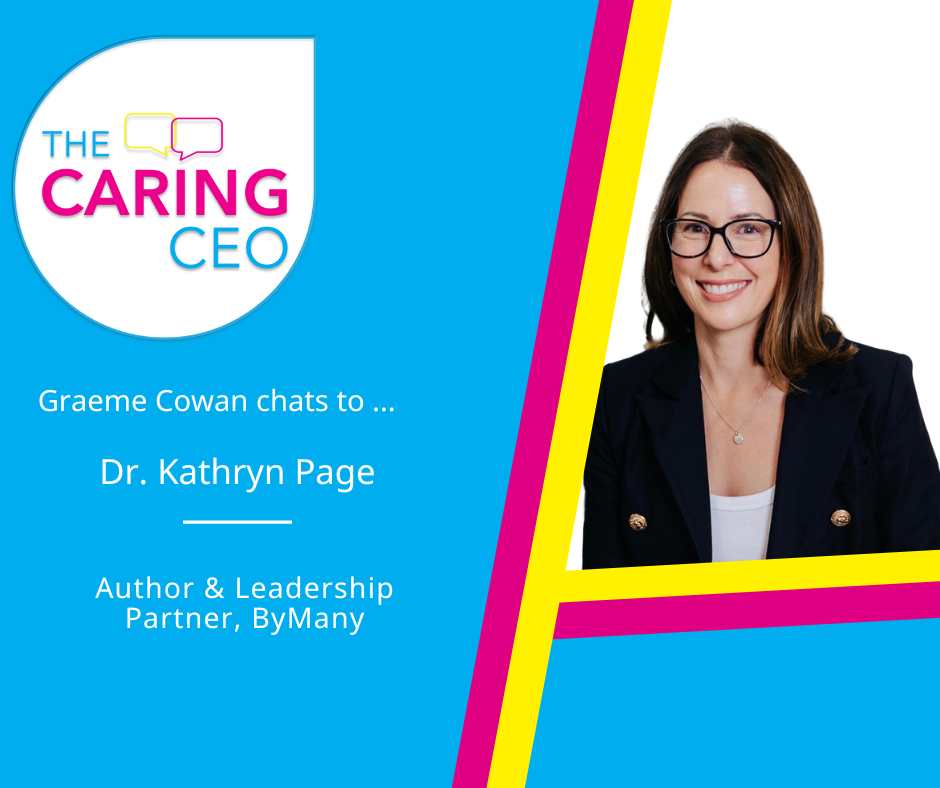
#96 The good work path, Kathryn Page, Author & Leadership Partner, ByMany


DISCUSSED IN THIS EPISODE
- What caring in the workplace means for Kathryn Page.
- The importance of autonomy, connection, purpose, growth, and psychological safety.
- Exploring leadership, workplace culture, and the opportunities AI presents for the future of work.
RESOURCES
Want to learn more about what you can do in workplace mental health training?
Want to to reach out, share a great leader we should interview or learn more about The WeCARE Way, click here to contact us.
Transcript from the interview
Disclaimer: The following transcript was generated using a specific tool. It serves as a convenient method for converting our podcasts into text and allows for easy text searches. However, we kindly ask for your understanding if any typos have inadvertently occurred as a result of the tool’s usage.
SPEAKERS
Graeme Cowan, Kathryn Page
Graeme Cowan 00:02
Today’s guest is Dr. Kathryn Page. Kat, as she prefers to be called, spent nearly two decades chasing a single question: What makes work good for us? After leaving full-time academia, she moved through a series of roles with Deloitte, Tennis Australia, and NAB. She’s now a partner at By Many, which helps leaders create more effective teams. She’s the author of a new book called Good Work: Transform Your Work from Inside Out. Coincidentally, Great Leaders Care came out on exactly the same day. We have a great chat about what our books have in common and why they’re different. If you’re trying to find work that is good for you, Cap provides many helpful hints. Enjoy. Welcome, Kat Page, to the Caring CEO.
Kathryn Page 01:04
Thanks so much for having me,
Graeme Cowan 01:05
Kat, what does care in the workplace mean to you?
Kathryn Page 01:09
So, I was thinking about that a lot this morning, and I think if you if you strip it right back, for me, it’s about treating people as as human beings, so not as resources. So, I actually hate the phrase human resources because humans aren’t resources; they’re humans, you know. And if we extrapolate from that, it’s about recognising that we as humans we’re not machines; we can’t work indefinitely. We need breaks. We need recovery. Sometimes we break down. We make mistakes, and I think it’s also recognising that we as humans we have human needs, and by that I mean emotional needs, social needs. So we need to feel like we actually matter. That that people see us, that we’re valued, and value for our uniqueness, not just valued as somebody who can do the work. But I see you, Graeme, and what’s unique about you, and what your strengths are, and and how you can fit in here, and and just appreciating that about people, because I think in some ways we often think about care, and we’ve almost made it a bit too small. And I mean that in good and bad ways. So obviously, care is about being
able to reach out to people and check in when we think that they’re struggling, and that’s absolutely important. But if we extrapolate from this idea of care being treating people as humans, when we think about work, I think it’s then more about how we design work to to work more for humans, as opposed to trying to optimise humans for work, and creating those conditions where people can do their best work, where they can contribute, where they can do work that matters, they can grow, and they don’t have to actually sacrifice themselves for the organisation.
Graeme Cowan 02:43
Yeah, I’ve always hated the term work-life balance because to me that implies that life is good, work is bad, and both of us following different tracks, and you with your new book Good Work and my new book Great Leaders Care, you know, really show that you know with the right environment, work can just be so important and central to our well-being. In fact, Gallup today they had a book called Well-being, and they looked at five different parts. You’re familiar with that, and what surprised me was that the career was the biggest predictor of overall well-being, which I thought was really interesting and very consistent with the message in good work.
Kathryn Page 03:22
I love that you cited that because I was at uni, I think, when that book came out. Gallup were actually well ahead of their time as it came to well-being. Although they were thinking about well-being, particularly as engagement, it was really sort of how they were defining it, which of course is an important part of well-being. But yeah, you’re right. Some of this is like is an issue with the research as well because I know in the early 2000s when I first started studying this topic, I was very interested in what we called then the happy productive worker thesis, and the the research had kind of been difficult because even though people felt those two things were connected, and and I think we know that they are connected. They were having trouble sort of proving that, if you like, in the research. And sometimes it just comes down to how we’re measuring those different things. So potentially, that’s what what was happening with regards to that research as well, because it’s how you measure things actually makes a big difference in whether or not we can prove that they’re connected.
Graeme Cowan 04:20
Absolutely. And what what makes up good work?
Kathryn Page 04:24
So, good work is essentially the idea of good work is that when we when we design and and lead work, there are certain characteristics that make work good for us. So, and that work can be good for us when we design it this way. So, I think of it in terms of the 6c’s, and care is one of those you’ll love, actually, Graeme. But it’s the 6c. But so I’ll come back to that. But so one of the most important things about good work is that we give people a sense of control. So when people feel they have autonomy, that’s incredibly important. So we feel like we are choosing how we work, and that work is not something that happens to us. Connection, which you talk about. A lot in your book as well is just absolutely vital as humans, a sense of contribution as well. So feeling that the work that we do matters, that we matter in the context of that work as well, sense of competence so that we’re growing, that we have enough challenge to give us that stretch and that growth, but not so much that we’re overwhelmed or beyond our capacity. Care is is is my definition of care. As I said in the beginning, is treating people as humans. Is that six?
Graeme Cowan 05:27
Close enough.
Kathryn Page 05:28
At some point, I will I will forget one. But essentially, yeah. But when those things are present, work is more likely to be good for
Graeme Cowan 05:36
- Yeah. One of the things I’m not sure if that was included, but you know, one of the other things I think is really important is that people use their top five strengths rather than things try and correct things they’re not good at, but really focus on that. And you know, the Gallup research is pretty clear around that. You know, people are much more engaged, report a higher higher life satisfaction if they do use their top five strengths every day. And with the C, did you have a purpose in there? Was there a C that related to purpose?
Kathryn Page 06:05
Contribution.
Graeme Cowan 06:06
Contribution. There you go. There you go. Yeah, yeah. And and I guess the other thing that I have put there is, I guess, just a a sense of gratitude as well. You know, gratitude has been shown to be so good for us, and you know, just to be very, very tempting after going home for a day at work to focus on the things that went wrong or didn’t go perfectly, rather than most of the things that go right. You know, that’s all. Again, it’s a very human quality, isn’t it?
Kathryn Page 06:34
Yeah, yeah. Mindset is really important. And and when I first started out in in this area, I was focusing more on on the positive psychology, which is what you’re really talking about of of work. And our mindset does matter to a degree, but often I find myself engaging with more occupations these days where you know they might seem incredibly resilient, and they are incredibly resilient. Their mindset is actually fantastic, but when the working conditions aren’t actually conducive, even being grateful is not helpful. This is not to discard the benefit of gratitude, though. You know, I talk in my book about my son Alfie. See, I told you I tell stories, Graeme, that just come out. So my son Alfie, who’s six now, he’s in he’s in prep for his first year of school. He was born with a congenital heart condition called transposition of the great arteries. So his arteries were actually wired incorrectly; they hadn’t. And he had to have open heart surgery when he was born, and and that was my first child as well, which was really hard. And he was in hospital for six weeks in the ICU. And to come back to the point around gratitude, you know, I think where gratitude is particularly important is when you’re facing hardships as as a human being, which might be at work or outside of work. Sometimes it’s just the small things you try to be grateful for, because and that does help. Like my husband and I used to sit down at the cafe each you know each afternoon, and we would just try and write down the three things we were grateful for from that day, because you could just find yourself getting overwhelmed by all of the things that are outside of your control. And Thich Nhat Hanh, I quote him sometimes, and his idea of appreciating the non-toothache. So when we have a toothache, it’s all we can think about until it goes away, and then all of a sudden you appreciate it.
Kathryn Page 08:23
So,
Graeme Cowan 08:24
what a grape metaphor! Yeah, so I think
Kathryn Page 08:27
I think mindset is really important as well. You know, I think that we’d be oversimplifying things to say that it’s not.
Graeme Cowan 08:33
Yeah, and I know that you know you’ve been a real fan of Amy Immenson’s work, as have I, and we’re both very fortunate to have a that she endorses both our books on the cover. What did you? What gravitated you to her work?
Kathryn Page 08:48
A couple of different things. I think. I think firstly, I just as a human, I really just like her her approach. So I’ve always followed her work because of she’s just I like the combination of the very strong empirical research that she has, and she has done a huge amount of research in this space. But also, she just has a way of communicating her research that just feels very compelling, makes it really practical, and it’s really meaningful. I also like that a lot of her early work was with healthcare workers, so I’m really passionate about them as well, and that she was focusing on this idea of psychological safety, which is a team a team construct. And what I like about that as well is that teams have some control over that. So even when you don’t have control over the full environment, and the full environment is really important as a team, there is there is something that we can create that’s beyond us, that is good for us, and actually can be buffering or protective for the team against things that are happening outside.
Graeme Cowan 09:48
Yeah, one of her really early studies was interesting, wasn’t it? Where she looked at healthcare teams and mistakes, and she found that the best teams had more mistakes and. This makes no sense, but you know, finally, what she worked out-they didn’t have more mistakes; they just reported them. Whereas the bag teams hid them or blamed others, sort of thing, for it. And that’s quite a change, isn’t it, for workplaces? And I remember I first heard of Amy. There was an article in the New York Times called “Google’s Quest to Find the Perfect Team” and Project Aristotle, which I know you know about as well. But yeah, no, very, very. So that and it just really confirmed stuff that I believed and thought was intuitively right. That you know, if you’ve got a mentally healthy team where people are treated as humans. People are encouraged. You’re going to do better, and you know it was wonderful to see that first come out. And when I interviewed Amy on my podcast, you know, she said that was a big breakthrough for her work. She’d been ploughing her there for about 20 years, I think. And this article came out, and suddenly, you know, she got global fame, and and she’d had her 10,000 hours of working on it, so she was already a great speaker. I saw her speak last year.
Kathryn Page 11:07
Yes, I was very jealous of everyone getting to meet Amy last year.
Graeme Cowan 11:11
So yeah, no, it was was wonderful, and she she is a very very good communicator, very good keynote speaker. So it was great to to see her in action. Have there been other mentors in your life that have really contributed to the work you do?
Kathryn Page 11:27
So many. A couple of them I mentioned in the book, actually. So Sir Carrie Cooper, who wrote the foreword for my book, was probably one of the most early organisational psychologists or occupational psychologists to reach fame, like well before Adam Grant. So Adam Grant’s probably the most well-known organisational psychologist today. But Carey was working in the leadership and stress and team space for gosh, many, many, many, many decades now out of the UK. And I met Carrie in 2008 when he was being inducted into so it was at the European Academy of Occupational Health Psychology. He was being inducted as like into the Hall of Fame because of the contribution that he’d made, and I in that conference won the Early Career Achievement Award. So, which was just a really nice moment to me because I was at the very beginning of my my studies. I was still doing my doctorate at that point, and he-I mean, I wouldn’t even say he was at the end of his career because he’s still going. It was, you know, almost 20 years ago, but he was sort of at that that level, and he was so generous with his time, and he sort of adopted me at that point on, and and has sort of mentored me since that time. We’ve done a couple of books together, so I’ve actually written a couple of books that are more academic books, and I edited those volumes. And this was my first one that I did. And when I lived in London, I said to him, “Kerry, I want to write a book. And he said, “Cat, let’s do it. And he’s just one of those people who just believes in people’s infinite potential. So finally, got around to doing that. So he’s definitely one of them, and then another one, Tony La Mantaña is the professor I did my my postdoc with, and again, incredible influence. I’d cited him in my doctoral research, where I had started already looking at the connection between promoting the positive aspects of work and the positive psychology of of things, and his work looked at the systems approach to stress prevention, and I was already trying to sort of look at how you might combine them at that point. And then when I got the opportunity to do my postdoc with him, we’re incredibly different people, but we were united in our shared love and passion for this work. And he never made me feel like my work was less than his, even though again he was at a very different level of his career with me, and really heard my perspective and the uniqueness, I suppose, that I brought into his team. And then, together with a couple of other scholars, we developed the integrated approach to workplace mental health, which we published in 2014, and that has since become a document or an approach that’s really influenced policy in this space, like not just in Australia but internationally. You know, the International Labour Organisation, World Health Organisation, picked it up. He’s been published in the Lancet as well, which is a huge thing for an academic to to be in the Lancet. But he’s far more proud, actually, of the and same with me that it’s had that policy and practice impact.
Graeme Cowan 14:26
So, just explain what that integrated approach was.
Kathryn Page 14:30
Sure. So, terrible name for a model, and you can tell it was made up by
Graeme Cowan 14:34
academics.
Kathryn Page 14:34
Yeah, because we. So, the integrated approach. So, at this point, or prior to this time, when I first started working with him, which was in 2011, we had three fields of research that were all making progress on this idea of mental health in the workplace, but were looking at it from very different angles. So we had the the systems approach to stress prevention, which was Tony’s space, which was more that public health working. Conditions OHNS kind of prevention piece that was that had a lot of epidemiologists OHNS professionals public health people looking at that, and then we had the psychologists like myself looking at how we can promote the positive aspects of work or promote positive individual characteristics, including using strengths. Graeme was part of that resilience. More of that positive psychology kind of framing, purpose was kind of part of that as well. But that was all being published in psych journals, which were very independent from those other journals.
Graeme Cowan 15:32
Yeah,
Kathryn Page 15:33
and then the third piece was more around mental health literacy. So a lot of people were doing mental health first aid. A lot of researchers were looking at how you promote mental health, meaning you know mental illness, I suppose, in the workplace and help to destigmatize that and provide help seeking as soon as possible. And I would say, “Are you okay? was kind of a part of that as well, like a really important part of that that campaign. And no one had really brought them together. Yeah, and so we brought them together into one model, which was around essentially the premise was if you want to make an impact at a population level in workplace mental health, given that we know that mental health problems are common in working populations, even without taking into account work, and that some conditions are actually caused by or worsened by mental health conditions. So, some mental health problems are worsened or caused by working conditions. Then, the greatest impact would come when you combine those three fields: so, preventing harm, promoting the positive, and then responding or supporting workers who who come to work with a mental health problem, and when you do all three things at once, that is a holistic strategy.
Graeme Cowan 16:46
So, just summarise those three again:
Kathryn Page 16:49
prevent harm.
Graeme Cowan 16:50
Yeah.
Kathryn Page 16:50
So we need to make sure that, firstly, we aren’t doing anything in the workplace that’s actually causing harm to people’s mental health.
Graeme Cowan 16:58
Yep.
Kathryn Page 16:58
Promote the positive, which is around. Hey, we know that the workplace is a great place where we can actually give people skills around mental health that kind of are positive, and also that we can make use of people’s skills and strengths and give people a sense of purpose that kind of more positive, and then respond to mental health problems. So the idea being that some people come to work with mental health problems, or they have mental health challenges that don’t have anything to do with work necessarily, and so we should be able to respond when those things pop up.
Graeme Cowan 17:33
Yeah,
Kathryn Page 17:34
treat people with compassion, respect, fairness, and and provide appropriate pathways to help seeking.
Graeme Cowan 17:41
What sort of progress are you seeing in workplaces around that now?
Kathryn Page 17:45
Well, it’s been 12 years now since we published that study, and I would say in the last five years in particular, we’ve seen huge progress. So, particularly policy responses. So, in Australia and in other countries, there is now a recognition that you do need to apply an integrated approach, and we’re seeing that translate. We’re seeing that in government reports and policy guidance, and we’re also seeing that translate into organisations. So many of Australia’s largest corporates now have well-being or mental health strategies, and if you actually look at those strategies and look at them in detail, most of them apply an integrated approach of some form.
Graeme Cowan 18:26
Yeah.
Kathryn Page 18:27
So whether or not they cite our model or different models, it’s just fantastic that that vernacular is now out there. I think there is now definitely an increasing recognition of the harmful aspects of work.
Graeme Cowan 18:40
Yeah.
Kathryn Page 18:41
So when we first started working in this space, we used to joke that the doors would slam whenever Tony would want to talk to organisations and CEOs about mental health working conditions. But they were very happy to open the doors to people who wanted to do health promotion within a workplace.
Graeme Cowan 18:59
Yeah,
Kathryn Page 19:00
and they were quite happy to talk to people around resilience training, positive psychology type approaches, and so in some ways we had a Trojan horse with this model because you might go in at one point in the roundabout, and then once you’re in with that organisation, you can start to introduce other pillars.
Graeme Cowan 19:17
Yeah.
Kathryn Page 19:17
But these days, I think doors now do open for the for a conversation around working conditions, although it’s more probably to respond to the new regulations, but regardless, there’s an appreciation that work can cause mental health problems, as well as there being a duty of care for workplaces to respond.
Graeme Cowan 19:41
Yeah, very good. We have some helpful resources that you can find at wecare365.com.au. The first is our mental ill health calculator, which is a quick and simple way to work out what poor mental health costs your organisation. In lost productivity and employee turnover, you’ll also find our building a mentally healthy culture checklist, which shows how to launch a great initiative and keep that momentum going. These resources can be found at wecare365.com.au. I just got a bit of a tangent now. You grew up in the country. I think it was a farm with two parents who were policemen or police women in the police. Police
Kathryn Page 20:32
people.
Graeme Cowan 20:33
Yeah, police people. What was that like?
Kathryn Page 20:37
So, I interestingly, I don’t remember my parents as police officers, I because I was too little at that stage, and they had been they had been police officers in Melbourne, and then had both left the force for various reasons. Mum left after she had her kids, and then Dad left because he was injured on the job, and then we chose to. Dad always wanted to work on a farm, so we moved to Benella, and we lived on a farm 10 kilometres out of Benella. So very
Kathryn Page 21:08
much very rural. We had a 40-acre goat farm. So it probably wasn’t until later that I really started to understand the impact that those jobs had had on them, so I think both of them were harmed by the job in different ways, physically and mentally, if you like. So, mum was a police officer, like when at a point where women were not treated very well in the police force. It’s it’s a lot different today, and we know now that sexual harassment is a real issue, and even sexual sexual assault was a real issue in policing way back in the day. And so, they just weren’t respected or held at the of the same regard as men. So, she had some like I don’t think she was exposed to anything sort of terrible, but still, it’s just that daily lack of respect and civility that she, I think, was exposed to, and it was a tough job.
Graeme Cowan 22:06
Yeah, she
Kathryn Page 22:08
was a very tough lady in a good way, but she had a very, a very kind of dry sense of humour, and my dad does as well, which is very typical of police officers, and I think that’s why I have such a blunt sense of humour now. And then Dad was injured on the job as well, and although I may not have had the language for it at the time, like I’m, I think that they probably both were suffering from impact to their mental health when I was a child, which you can’t. Kids don’t really understand that at the time, but it does kind of set you up for a certain trajectory in your life when your parents are really suffering when you’re children, which, which I mean, the mum’s an incredible lady. I’m really lucky to have her, but unfortunately, she and dad then split up. I think when I was about seven, which again is not that unusual for
Kathryn Page 22:57
police officers, and she did an amazing job bringing this up, but she had lots of chinks in her armour by that stage.
Graeme Cowan 23:05
Do you remember being lonely on the farm, having come from Melbourne?
Kathryn Page 23:10
Interestingly, I would say the opposite was true. So I think when you live in those really rural areas, community is so important because not so many of you. And as a child, I remember actually running to the neighbouring farms because you kind of were free range. Like my childhood was free range, and
like so we just leave the house and just wander across barbed wire fences and through the paddocks to get to friends’ houses that I had on on lots of different farms. I actually would say I was probably more lonely when we moved from the farm to Melbourne.
Graeme Cowan 23:44
Right.
Kathryn Page 23:45
We moved back to Melbourne when I was in high school. I think it was in halfway through year seven, and so I didn’t have any friends when I first came to Melbourne because they were all I’d grown up on a farm. Very different feeling, being in the city, if you like, compared to to on the farm, but I imagine my parents were probably had some loneliness.
Graeme Cowan 24:06
Yeah, I remember I grew up in the country as well, and you know just had a great childhood there. And you know you talk about free range. We used to head out after school and go into the river, and we came back when the sun went down. Basically, that’s how it worked. No phones, no checking, no nothing, and yeah. So it is a bit of a contrast what what we see today. For our listeners, can you give them a brief overview of your career and and how you come to be where you are and with an organisation by many?
Kathryn Page 24:39
Sure, I’ll give you the succinct version, but we can expand as you like. So, I started. So, I did my first degree in professional writing and psychology through a Bachelor of Arts, which is a very underrated degree, I would say. So, I loved doing my Bachelor of Arts and exploring those two parts of my, I guess, my personality and my skill set. But it was psychology that I. Ended up taking forward. I did a doctorate in psychology, focusing on the wet place. And I was from a very young age, like probably from from my honours degree, I’d already sort of landed on what I wanted my life to be about, which is a very young age to have stumbled across that. But I was 21 when I stumbled across this idea of happiness, and I was working at that time with a professor Bob Cummins, who was big in the quality of life space, and I just fell in love with this idea of happiness because, I guess, you know, as I look back now, I probably was in love with that concept because I’d struggled with that myself as a young person, and so learning about happiness, I thought it actually made me happy to learn about happiness because there’s so much that we don’t get exposure to as as kids, but I always sensed that there was something about the connection between happiness and work, and so that’s what piqued my interest at that point. And when I did my doctorate, I was designing and testing interventions for happiness in the workplace, and that was my first kind of practical experience of that. And then when I finished, I I started my postdoc with Tony, which I’ve just talked about before, and ended up working for three or four years in research with police officers. Actually, so my life kind of came full circle at that point. I had the opportunity to test some of the interventions that we were designing on police officers, and focus in particular on leadership and teams, would you like Graeme? Because we saw that as being the real opportunity. Is if you create that in a station, with the sergeants and senior sergeants being the most senior people in a station, you you could sort of really benefit the whole the whole station,
Graeme Cowan 26:42
yeah. And
Kathryn Page 26:43
then in 2014, I just had this sense that I needed to leave research. The primary reason for that being that a lot of the work that I was doing was more intervention work, and I knew that as an academic, I had skills in academia. I didn’t have enough of the practical skills, and I was worried that some of the interventions that we were doing wouldn’t be as effective because I didn’t have that practical experience. And so I left academia and I went to Deloitte at that stage and spent five years working in leadership consulting. And that’s really where I learnt how organisations work and started to to learn about that, including a stint in London for a couple of years. My husband and I moved to the UK and and I worked over there in consulting for several years. Then I came back and started working for a bank, Bernab, and I was there for four odd years leading their talent and careers function. And then my role was made redundant a couple of years ago, which at the time was the worst thing that I thought could happen to me. But ultimately, ended up being the best thing because it gave me space to actually take a break from my own life and try to tune into what my own voice was saying and reconnect with my purpose because I really lost my way by that stage, Graeme. I think I’d sort of gone into large corporates. I’d lost a sense of why I did this work and what what value or what contribution I was making. And with a couple of time, a couple of months out of work deliberately, I chose to write this book instead, which took me back to my calling. And then I found this wonderful organisation called Buy Many. I’ve been here now for two years, and it feels like I finally found my home, my my forever, my forever home.
Graeme Cowan 28:34
Your crew, your tribe. Absolutely, because I
Kathryn Page 28:39
feel like I’m surrounded by people who who care about the same things that I care about.
Graeme Cowan 28:43
Yeah, just jumping back to when you talked about working with police to improve their well being, did that work help you understand your parents better?
Kathryn Page 28:54
Hugely, hugely. Yeah, that was a real turning point for me, actually. And it’s interesting because they embrace me because my parents were police officers because they are naturally a very sceptical bunch, a bit cynical, which is necessary because of the kind of things that they endure. They have this strong sense of sort of in group, out group, and that kind of put me in the in group, which was useful because you know I would have been 24 at the time. Like who who was I to tell them how to do things? But because I never pretended to be something that I wasn’t, and because I think I could demonstrate that I understood them, they embraced me, and that was a wonderful couple of years. Just spending so much time in the station, deeply understanding what my parents had been through, both the good and the bad, by the way, because they’re very purposeful, very very team oriented. They really care about each other.
Graeme Cowan 29:46
Yeah,
Kathryn Page 29:47
policing, but also interestingly, Graeme, the things that actually cause them the most harm is not just the things that might create PTSD. Of course, there’s a lot of trauma in that job. As you can imagine, but often the biggest drain on them is the day in, day out kind of strain that they experience through things like poor technology, politics, just the amount of admin that they have to do, not necessarily being trained to do that admin. So it wasn’t anything unique in some ways,
Graeme Cowan 30:21
yeah,
Kathryn Page 30:21
like it was actually the same stuff that causes all of us stress.
Graeme Cowan 30:24
Yeah, yeah. And then jumping forward a bit, why do you think it was such a tough moment when you were retrenched from NAB?
Kathryn Page 30:34
Probably there were probably two things. Like one is that at that point I was so fused to this idea that work was my identity. I couldn’t actually separate who I was and what my worth was from what my worth was to an employer.
Graeme Cowan 30:53
Yeah,
Kathryn Page 30:54
so then to be told that that I no longer had a job really just triggered for me all those feelings around not being good enough. It felt like they were saying not just your job is no longer available. We no longer actually think that you’re worthy of being here, which of course they were not saying. That’s just sort of how it feels in the moment. But I think the other thing that that really struck me about that experience was that I had really lost connection with my with myself, and that had happened over a series of years where my own voice had become really quiet. I could no longer hear my own what I what I thought about things myself, and it was more about my environment. The environment was more important than what I what I felt, and I’d lost my way. I’d lost my purpose, and it wasn’t until I left that I realised how unhappy I’d been. And I’m now actually really grateful that that happened to me because I think I would have kept trying to make it work.
Graeme Cowan 31:53
How did you rediscover your voice?
Kathryn Page 31:56
I think just having space because I’m I’m one of those people who keeps herself incredibly busy because when I stop, that’s when your mind starts to really get busy, and there is some neuroscience around that. Actually, that that actually happens to most of us. That when we create space, our mind really starts to to chime up more. So I think just giving myself that space to actually sit in the feelings and sit in the nothingness, and not rush to finding a new job, and be very deliberate about it. And I also did a lot of reflection. I worked with a coach. I spent time just thinking about what kind of impact that I wanted to have and what kind of contribution I wanted to make, and not just what kind of job I wanted. And I actually did pull out of a job, a couple of jobs that I’d been going for, because I thought this is too soon. I’m just going to end up putting myself back in that same position. I won’t actually give myself time to just feel my way into something different.
Graeme Cowan 32:58
Yeah. Yep. So you’ve been, you know, done a lot of work around the system side of things in looking at the things that harm work, you know, the psychosocial hazards and risks, and you’ve also done a lot of work with leaders and leadership teams. I know, just know that by many, that’s that’s the sort of work you do there. So in terms of delivering the best workplaces, is it having the right psychosocial risk process or great leadership that matter most? Yeah, I know they’re both really important. What do you think matters most?
Kathryn Page 33:36
I mean, I’m biassed. I think probably leadership is probably pretty primary. It’s hard to separate them because I think they’re both important. So I would say I don’t think it’s about having a policy that’s in place that tells leaders what they need to do. I think it’s about leaders feeling that they have agency to create the culture and the conditions that actually that actually supports the well-being and the performance of their teams. Often, the leaders that that I’m working with today have this real sense of not having that agency. Even the most senior people in the organisation, interestingly, don’t feel like they have control over some of the things that impact mental health. So the systems, the complexity, there’s just the layers that we’ve put into organisations that just make things really, really difficult, and the tax that that sort of creates, and they don’t really feel like they can change that. It feels too hard. But even in the absence of those systems being changed, I do think that when leaders work together, that they can actually start to make progress as a collective. I think individual leaders, there’s only so much they can change, but when leaders actually come together as a community and start to to push for change or to to kind of challenge some of the assumptions that they might be holding about the system,
Graeme Cowan 34:53
yeah,
Kathryn Page 34:53
then you can see amazing things happen. But I don’t think it’s something individual leaders can necessarily. Change, if that makes sense.
Graeme Cowan 35:03
Yeah, I’d like your chance. I mean, I
Kathryn Page 35:06
think they can change it. Let me rephrase. I think they can change it for their for their own teams.
Graeme Cowan 35:11
Yeah, yeah.
Kathryn Page 35:12
Without a doubt, like I think if you work for a for a brilliant leader, and I and I’ve been lucky to work with many many amazing leaders, they can actually create a wonderful environment for you, even if the organisation is, if the culture is not great.
Graeme Cowan 35:27
Yeah, yep. But
Kathryn Page 35:28
over time, that that’s it’s just hard to sustain that,
Graeme Cowan 35:31
and it’s probably hard for the good leaders. Quite frankly, they will leave. They will they will leave if it’s you know if they find because I saw a Gallup estimate a leader contributes 70% towards engagement of their team, and so on face value you say, well, you know, you control most of it. But if they’re looking for their development as well, if they’re looking for opportunities themselves, if they’re looking to be in a continual improvement environment, if that’s not given to
Kathryn Page 36:02
them, even
Graeme Cowan 36:02
though they might do it for their teams, they’re going to leave. So, so yeah, you know, it does start so much from the top, and that’s been one of the real joys of the caring CEO being able to, you know, interview leaders that huge span of people and control and everything. And of course, no job is perfect, no organisation is perfect, no leader is perfect, but there’s certainly patterns. And you know, one of the people I interviewed for the book was Mike Schneider, the CEO of Bunnings, and he talks about you know his 4h’s, how he guides his life, and that’s around honesty, humility, helpful, and happy. And I don’t think when you’ve got a leader with those priorities that it’s a coincidence that Bunnings is the most trusted corporate brand in Australia over two years. It just it just flows through, and he does so many things about connection, you know. During during COVID, he started the push-up competition. Someone challenged him, and there was sort of a group challenge to do have the most people do push-ups in in that particular warehouse or store. And one of the groups even broke out Guinness Book of Records a number of push-ups because they’re not only got the staff involved, they’ve got their customers involved as well. You know, little things like that to show that you know we’re all human, and and everyone in Buddings is described as a team member. You know, they got this sort of that’s that what that’s what they are first and foremost, and and you know Bob Chapman, you know the author of Everybody Matters, and the amazing leader who grew a business from $20 million to $3.6 billion, you know, just showing that creating environments where people thrive, where he even had as a a goal that there were less divorces in his only only half jokingly, but his theory was like: if you go home happy from work, you got to be in good shape for your family, and and
Kathryn Page 38:09
exactly
Graeme Cowan 38:09
that is so true. It is so true.
Kathryn Page 38:11
Yeah, and I wonder if it’s the level of leader we’re talking about because I think your audience and the people that you’ve spoken to are often the most senior person in the organisation, and if you’re the most senior person in the organisation, the the impact and the shadow that you cast is enormous.
Graeme Cowan 38:25
So
Kathryn Page 38:26
I think if you are the more senior you are, the more that that individual leadership can matter. Often the the groups that I’m trying to activate are often leaders who are kind of more in the middle, who are senior, but they’re not necessarily that at the C suite table. And what I’m really saying is that in some ways we set up this this idea, this hero leadership idea that that that individual leaders can change things for everyone. That we’re just waiting for this leader who was really charismatic and visionary and supportive and and incredible to come and kind of save us. And I don’t disagree with that that that that can happen. But what I’m more interested in is how do we actually get leaders operating as a collective? Because when you get leaders operating as a collective, they are more likely to be able to work together to solve some of the adaptive challenges that are more difficult to solve that no one individual can actually have the answers for because a lot of the problems that organisations are facing today are multifaceted. They’re complex. There’s no technical fix. We can’t even look to the past necessarily to solve them. It’s about bringing leaders together. So that’s probably what I mean by saying that an individual leader can’t solve everything. They can certainly they can certainly protect their team without a doubt, without a doubt, but they can’t really shift the needle on those big societal things without coming together as a as a collective.
Graeme Cowan 39:48
Yeah, definitely, and that’s where you know culture comes in, and how you recognise culture, and how you reward culture, and how you have role models of people across the organisation. I remember once reading about Qantas. They were going through organisational change, and they’re trying to identify who are the most influential people, the most trusted and influential people in the organisation. The most trusted person was a guy called Elvis, who worked in logistics, but he just had a reputation for, you know, if he said he was going to do it, he did it. He was very good at reaching across the organisation. He led by example, and you know that’s what those types of people are also fantastic and central to culture change as well, aren’t you? If you get them buying in, it’s got so much more credibility if it’s just you know put down from below.
Speaker 5 40:39
One
Graeme Cowan 40:40
of my first jobs in culture change was with Ramsey Healthcare, and this goes back about 2525, 30 years ago. But the time Pat Greer was the CEO, and it was in real trouble. You know, they their share price had plummeted and everything. And I worked in recruitment. I helped Pat recruit his chief operating officer, who was Chris Rex, and then they went to an event in Uluru, like a conference for just 13 hospitals they had at the time, and there they had for each hospital they had the CEO, director of nursing, and the CFO, and they came up with what they thought was the key to, you know, change in and high performance in Ramsey, and they you know come up with a few things, and I was in charge of overseeing this process. And but then Pat, I think, and Chris quite wisely said, “Well, let’s reality check it. And so I went around to did about 20 focus groups in all their hospitals, and you know there was a little bit of push up, but there was a lot of commonality, but it was given that reality check. And so, when it was issued, it’d already been reality tested. You know, they they came up with what they called the Ramsey way, and they still have today. It’s still been absolutely central to what they’ve done, but their their vision, which you know, as you can imagine, I really like was people caring for people. You know, we care for our patients, their families, our doctors, our nurses, everyone. And so, over the 15 years that Pat was the CEO of of Ramsey, the Australian Stock Exchange had a total return of about 460% Ramsey had a return of over 5,000% during that period, and interestingly, they also had half the injury rate of comparable hospital groups. So they delivered this incredible performance, but people, you know, went home safer and that and that or better and a greater sense of well-being. So it’s wonderful being able to show this stuff is in theory. You know this this this works, and and I’m sure you had the great opportunity to do that with all the work that you do with with by many. But you know it does have to be more human centred, and and ironically even more so with AI and yes, the absolute chaos that that’s creating across organisations. What’s your been observation about how leaders are coping with AI?
Kathryn Page 43:11
Gosh, I think I think a lot of them are in a big phase of uncertainty at the moment and grappling with with that as a disruption. I think oftentimes what they’re talking about in many of the organisations with at the moment is how can we actually use AI to be more productive and more efficient. What I’m not seeing, and I would love to see more conversations about, is how do we harness AI to solve people problems as opposed to using AI to solve the problem of people or make reduce the cost of people, so
there is some amazing work that’s starting to be done in the space in in some spaces. But I think that’s the next conversation: is how do we actually change organisations or redesign work to be good for humans, and then use AI for the bits that aren’t good for humans, as opposed to just for the bits that cost money, and then unleash
Kathryn Page 43:59
the human, you know, the strengths that make humans human.
Graeme Cowan 44:02
Yeah, yeah, I couldn’t agree more. And you know, I’ve heard someone say, you know, that leaders need to learn themselves, but also need to be able to coach their staff on how to how to use AI. You know, to ask simple questions like, you know, you know your process better than anyone.
Kathryn Page 44:20
Yes,
Graeme Cowan 44:20
what you’re involved with, your responsibilities. What do you hate?
Kathryn Page 44:24
Exactly. And what’s draining?
Graeme Cowan 44:26
What’s what’s the part of job you just don’t like? Well, let’s just let’s just work on that. You know, why don’t you? That’s your project for the next six months, and then when you say five hours, work out what you’re going to do for five hours doing what you really love. Yes.
Kathryn Page 44:38
Yeah. I love the idea of AI reducing job strain by that, and and the chronic the chronic strain that an admin load that a lot of people are under.
Graeme Cowan 44:47
I normally finish by asking people, knowing what they know now, what would advice would they give their 20 year old self? But for you, I’m going to flip it. I know. Because you said that at a remarkably early age you knew what you wanted to do. You you had a firm eye on the future. What advice would that 20-year-old self you give to yourself today?
Kathryn Page 45:15
I love that. I think what I hope she would say is to don’t don’t forget what we already know, so listen to your own voice and don’t assume that your youth is is somehow a disadvantage. Because I think I actually probably knew more as a 20 year old, and then I’ve gone the next 20 years. I’ve forgotten all of that, and I’m now just remembering. I’m re remembering what I already knew as a 20-year-old, which is that other people matter, and and that I mean, I always knew that, but I think I had to climb the corporate ladder, and and I’m glad I did because that’s made me better at what I do now. But I’m so
glad that I’m able to come back to the the wisdom of that 20-year-old who already knew what her life was going to be about.
Graeme Cowan 46:00
Excellent! What a great advice, and you might even find some old journals from that period to to reread. Thanks so much for being part of the caring CEO cat. I’ve really enjoyed our our chat, and look forward to staying in contact going forward.
Kathryn Page 46:15
Yes, me too, and thank you so much for all of the amazing work you’re doing with leaders. It you know together. Hopefully, we are starting to make an impact.
Graeme Cowan 46:24
Thanks for joining us today. We hope you’re inspired to strive for a culture of care that also leads to great results. If you’ve enjoyed this interview today, please rate us on your favorite podcast platform, and don’t forget to subscribe so that you don’t miss an episode. We also welcome any comments. If you’re interested in seeing details about our scalable WeCare365 mental health training programs, please visit us at WeCARE365.com.au, our goal is to make these programs accessible, practical and ongoing. You can also find me, Graeme Cowan, on LinkedIn, and I’d love to hear from you. And finally, if you’ve come across a senior leader who has impressed you and you think they’d be a great guest, please email us at support at WeCARE365.com.au. Thanks once again for listening today.

Oh, you are inquisitive… getting all the way to the bottom of the page!
Thanks for listening 🙂
From all of us at The Caring CEO, and the WeCARE team, keep listening, keep caring and lead with your heart.
P.S. If you want to reach out, share a great leader we should interview or learn more about The WeCARE Way, click here to contact us.
