
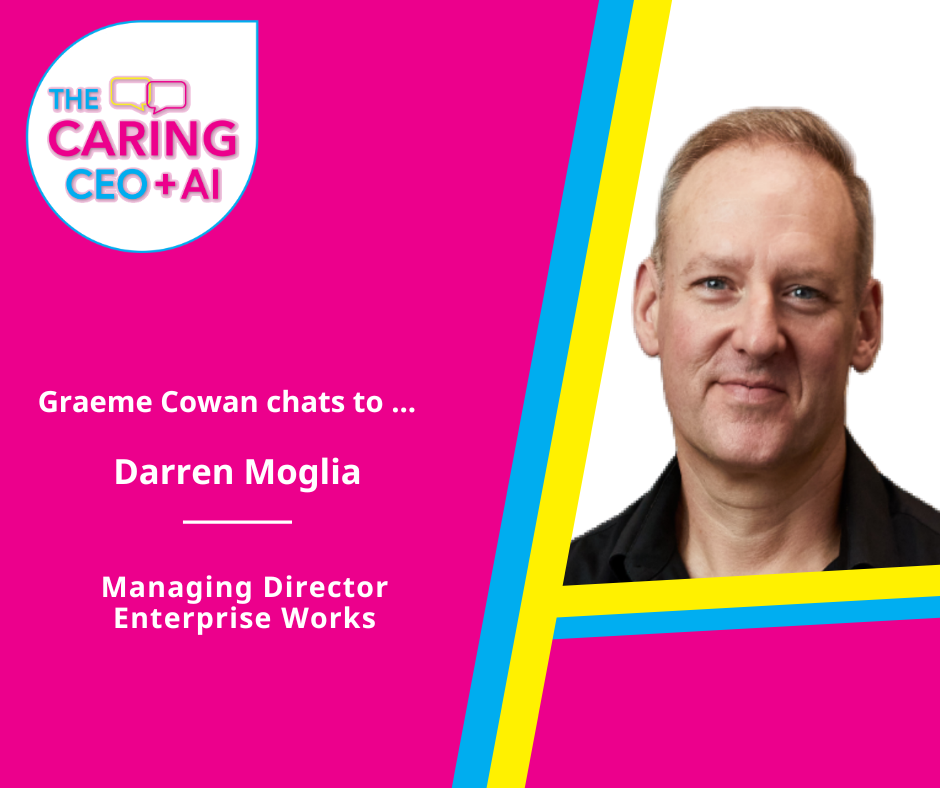
#97 Leading with Care in an AI World, Darren Moglia, Managing Director, Enterprise Works


DISCUSSED IN THIS EPISODE
- Why workplace complexity and overload are driving declining productivity and rising stress
- How leaders can use AI to amplify human potential without losing the human connection
- The role of simplicity, clarity, self-care and crew care in creating healthier, more productive teams
RESOURCES
Transcript from the interview
Disclaimer: The following transcript was generated using a specific tool. It serves as a convenient method for converting our podcasts into text and allows for easy text searches. However, we kindly ask for your understanding if any typos have inadvertently occurred as a result of the tool’s usage.
SPEAKERS
Graeme Cowan, Darren Moglia
Graeme Cowan
Today’s guest is Darren Moglia, and he’s the managing director of a research firm, an education firm called Enterprise Works. After working in senior roles in Macquarie and also at Westpac, Darren embarked on a new career, and it was looking at a very topical subject, which is a new perspective in the age of AI, a new productivity perspective. So he has found that in the last 10 years, productivity has gone down virtually every year, and at the same time, stress has gone up. We’re using more AI, but it’s not helping productivity. It’s not reducing stress. So we have a very wide-ranging discussion. As you’ll hear, we both have our lived experience with burnout, but there’s some really practical tips and ideas that Darren talks about, which I know everyone will find helpful. Enjoy. It’s a real pleasure to welcome Darren Mogliard to the Caring CEO. Welcome, Darren.
Darren Moglia
Thanks so much for having me, Graeme.
Graeme Cowan
Darren, what does care in the workplace mean to you?
Darren Moglia
Well, at an individual level, it’s the responsibility of leading a team, but also being part of an organisation. And one of the the things when I first started doing my research into ultimately how do we build a better future of work was I looked at this definition of organisation, and it means a group of people working together towards a shared purpose, yeah. So I think holding that at the centre of what we do increasingly, though, that means creating the organisational conditions where people feel not only safe but actually have the space to do great work, to learn, to innovate, and you know, one of the big things I’m talking to a lot of leaders about at the moment is when teams are overloaded.
Graeme Cowan
Yeah,
Darren Moglia
we’ve got lots of technology, AI coming at us that actually doesn’t create the right conditions of care. So, is actually how do we create the right organisational environment around people?
Graeme Cowan
Yeah, in fact, I’ve began to use the word crew rather than team because team is about, as you said, a group working together towards a common goal. But a crew is also, but a crew is a bit different. They also look out for each other, feel responsible for each other, encourage each other, you know, care about each other. And you know, I think there are so many stresses and strains in the workplace that you know that’s got to be become part of the DNA of every team and every leader. Today is a a big event because we’re just launching what we’re calling the Caring CEO Plus AI, and you’ll see in a moment, listeners, about why Darren is the the perfect person to start this, so in essence, we’re looking at how to lead with care in an AI world, and you know, with every article you see in business magazines and things you hear from clients, you just hear that AI, in particular, is having a massive impact on organisations. And Daryl, if you wouldn’t mind just explaining to our listeners your journey and how you come to start Enterprise Works,
Darren Moglia
and just the top line to start with of the research you’ve just completed. Sure. Well, I have actually spent the last 28 years of my career working in large organisations and amazing organisations with amazing leaders and people. So, 13 years at Westpac, nine years at Macquarie before that, and in the last few years, I was at Westpac. I was in a role where I could kind of see the plan orchestration across the organisation. So, we’re connecting up all the different parts of the business, trying to create a central plan. And what I could see is, and and in other organisations as well, you’ve got amazing leaders and amazing people, but the work tends to break down. And so, really, the fundamental thing out of all the research I’ve done, and we do talk a lot about future of work and AI. We talk a lot about how do we enable people to lift productivity in a way that actually improves engagement, well-being, but really at the heart of all that is is the connected organisation. And so, how do we design work that connects organisations? And so, some of the top-line insights from our research are: 83% of people understand the strategy of the organisation, but only 51% say their daily work is organised around those priorities. That’s a big gap. It’s a it’s a 32 point gap from a productivity perspective. That’s huge. But I look at it both ways. It’s not just are people working on the right things, but we know there’s a lot of metrics that show that people are at their best when they. They can see how their work is connected to the mission of the company.
Graeme Cowan
Yeah,
Darren Moglia
so it’s critically important. And then there’s just a level of complexity. We’ve got more systems than ever, more data than ever, more notifications. And so some of the statistics, when I talk to leaders, and I talk about the average organisation has 305 systems. On average, we spend 42% of our time doing manual reporting, and 49% of people say they waste effort due to rework and changing priorities. So there’s just this complexity and overload in the system, and so really, it is fundamentally about: we’ve got great leaders. We’ve got great people. We have the technology investment. We’ve got all the conditions, not only to thrive now, but to set us up for an AI future where we can thrive with humans empowered by AI. But we’re not connected, and there’s a lot of complexity getting in the way. Yeah.
Graeme Cowan
Before we go too deeply into that, I want to just jump back to you know your time at Macquarie and then Westpac. What did you enjoy about working for organisations like that? You know, good reputation, lots of resources. What were the elements that you got the most? What really turned you on? What was your favourite part of working in organisations like that?
Darren Moglia
Well, people. I mean, people, and I know a lot of leaders would say that. A lot of people would talk about that, but it really is the number one thing. And when I left West Bank last year, that was that was the hard bit. Leaving what what I thought of as my family, my second family, and so when I left Graeme, I got this beautiful picture, which is here next to me, of all the team holding up a love heart, so if I could sort of put that in one image, that’s what it is. But it is interesting because now the the sort of the word work and certainly the word productivity tends to sometimes have negative connotations. But I often strip back and go, almost universally, people choose to work. And what does work mean if we were sort of think about it as in a different way, and we strip it back to, and it goes to kind of where I’ve really thrived in my career and loved what I was doing, which is social connection, routine, intellectual stimulation, learning, and this sense of achievement.
Graeme Cowan
Yeah. And so when I think
Darren Moglia
about a better future of work, and I think about where I’ve thrived, it’s it’s the same conditions. We work best when we have a routine, when we’re working with great people, and we feel that social connection, where we’re learning constantly, learning at the right rate, and where we’re feeling that sense of achievement that we’re moving forward together.
Graeme Cowan
Yeah. So you left Westpac, and did you straight away say, “I’m going to create and start Enterprise Works. What was your journey to eventually launching that organisation?
Darren Moglia
Look, and it’s a great question because there’s a lot of people out there, whether they’re going through change or whether it’s change happening in the market, that are going through this process. And I actually, when I left Westpac, I had a very strong conviction around this concept of work design. How do we connect up organisations? But I thought I would be doing that working for another company, and so the first thing I did was I actually had about 60 conversations, and I just listened and got advice from people, and a wide range of people. And little things came out. Little things came out like go independent. Little things came out like the the concern around productivity, which is
Darren Moglia
an issue in most advanced economies, but is a big issue in Australia at the moment. This you know burnout, this stress, this overload was coming through, and so that led me down a path of what has led to nine months of deep research, and so it sort of started with 60 conversations, led to probably another 200 conversations, surveying 400 people, reviewing 150 studies, and I think yeah, conviction is the word there because every day I have been just almost obsessed with this, but driven by, driven by this incredible potential I see, I really do feel like when I’m looking at the insights, I’m looking out over Australia or looking out over our leaders and people, and looking at this incredible potential. But a lot of things are getting in the way at the moment.
Graeme Cowan
Yeah, yeah. And I don’t know if you know this, but the word culture comes from the Latin word cultus, which means to care. And so, when we refer to culture, that’s what we’re really talking about. And it’s interesting hearing you describe your time at Westpac. It was all about people. You know, you’re doing great work. You’re solving problems, but it’s not the same, is it? Isn’t it? Is if you’re not with people that you respect and like that makes a massive, massive difference.
Darren Moglia
And when I think about this this concept of the connector organisational work design, what I what I have seen almost everywhere is you have amazing leaders at the top of the organisation, amazing leaders through the organisation, and. Then amazing teams, and so every CEO when they turn up on day one wants to leave a legacy, wants to move that company forward. When every person turns up on day one, they want to be part of a mission, and so that’s where I’ve increasingly focused on what I think is kind of the root cause, which is it’s not that people don’t care or don’t want to be part of something bigger. It’s that work breaks down, and the more you’ve layered on systems and complexity, the more that has occurred. So, really, is yeah, getting back to that word culture, getting back to the word organisation. Because if I’m yet to, and I’ve had a lot of conversations, but I’m yet to meet any leader who doesn’t really care about their organisation and their people, or any member of the team who doesn’t want to be part of the mission and and you know part of something bigger than just doing a job.
Graeme Cowan
Yeah. And when did you actually launch Enterprise Works, and how did you choose that name? The
Darren Moglia
ABN was set up, I think in October last year, but what I realised was, I think when you when you start your own independent business, and we basically do research, education, and a little bit of advisory. And the reason I say a little bit of advisory is because I fundamentally believe we need to strengthen organisations. So we, at the moment, for example, are rolling out a future of work executive series and a HR leader series, which is to go in and share the research, facilitate a conversation, help them with an action plan, and then we’re about to roll out a work design service, which is a four to six week kind of sprint where we go in and and help with a diagnostic and understand where work is getting stuck, understand how we can strengthen it, but my fundamental belief is we don’t want to stay right, and then and then project manager. We need to build the strength in organisations. We need to build that muscle in organisations. So I I sort of realised pretty early on that we needed to. I needed to become an expert, but I also was just obsessed with getting to the truth. And one thing, Graeme. I know we all see a lot of. In fact, LinkedIn has now put a. I think it’s an AI slop button on. There’s incredible amount of noise, and so one of the first things we actually did was we set up a signal system where we’re starting to ingest a lot of data and basically identify what was high quality data, what was coming from multiple sources, and so we saw this productivity issue. Australia, we could also see a lot of signals around AI. For example, when throughout this year, when we look at the signals around AI, there is an increasing trend towards AI augmenting people, and there’s a decreasing trend to fear of AI replacing jobs, right? So, so sort of getting to those data signals, and then we do deep research to get to the heart of why work is breaking down in organisations. And when I talk to leaders about that, work has just gotten a lot more complex over the last 10 years, and it’s crept up on us. And so, you know, the external environment has become more complex. We’ve got more regulation. We’ve got really good things like climate, privacy, but all these extra things we need to manage. But then the advent of what they call SaaS systems, so the ability just to download systems with a monthly, you know, small monthly fee, meant we end up in a situation where the average organisation, not in a large organisation, but an average organisation has 305 systems, but only 15% are centrally managed. Wow! And then, of course, all of those come with notifications. Many come with chat tools, and so the the current data is about 275 distractions a day. So, coming back to your question of why enterprise works, fundamentally, I knew that the way we work together in this sort of work design concept was very important, and enterprise was how, particularly the technology providers talked about large organisations. And so I kind of went for where can we, where can I have the biggest impact in improving the way we work, I’ve since discovered is the same things can get in the way whether it’s a person, a business with three people or five people or 10 people or 10,000 people. So again, all these kind of things, and so when I talk about what happened over the last 10 years, we the world got a bit more complex. You know, some of the regulation external programmes we now manage, but also we’ve layered on systems. There’s a lot more data. There’s a lot more notifications, and when teams don’t have clarity, or don’t know what to do, or feel uncertain, we book a meeting. So in our research, around 45% of the work week is spending meetings, but only about 44% of those, less than half of those, are actually moving work forward. So, the way we work and the way we free people up to move forward and to be human and to innovate and to learn and all these things that we know are really important is really what we’re focusing on.
Graeme Cowan
Yeah, in my book, Great Leaders Care, I talk about the mindset of self care. Taking care of ourselves, crew care, and red zone care, being able to identify and support those that are struggling. So, just from your personal perspective, what do you do to keep yourself in a positive mood? What are the things and the elements that you find really helpful?
Darren Moglia
Well, I think the self care, the concept of self care, is more important than ever, so I love that. In fact, all the three of those things, I think you’ve absolutely nailed it, Graeme, and I love that. That is the way you framed it. Self care is is something I think we’ve almost forgotten we have the ability to influence, and so we the data is very clear that people who are switching off from work and having downtime after hours, people who are taking breaks throughout the day, exercising, getting sunlight, but also people who are able to do focused work and learn and innovate. That is where not only people are at their most productive, but is where the innovation in companies comes from. And so the little things, like since I’ve started doing all this research, my desk is clear. My notifications all go into an inbox that I check once a day. Very conscious of distractions, and also there’ll always be something that feels urgent. And so, prioritising the things that are really the fundamentals: nutrition, sleep, exercise-all of those things are really important. So that’s that’s the self-care, and and one of the things I think is going to be really important for all of us is actually turn off the notifications. Like we choose how we spend our time, we choose what goes into our calendar. So that’s a self-care, and then the same kind of applies to the crude care. I know Gallup have have sort of said that one quality conversation between leaders and their teams a week is is kind of the magic formula at a minimum, and so we focus on some of those things. So making sure leaders have the time and understand the importance of having that one real conversation, which sort of touches on the red zone because that’s where you’re actually tuned in and you can identify when something’s not right. I also am a big fan of get the team operating rhythm right. So, for example, a kick off on a Monday around the team’s plan, the cruise plan, if I if I use that term, and and actually regularly talking about the mission and real storytelling about the mission in action, and then Wednesday status update sharing. But again, around the work, and again on a Friday, whether it’s daily or every couple of days, that those routines are really critical. The self care daily routines, but also the team routines, because when the team collaborate around their shared work, people are clear on the plan. People are clear on what everyone else is doing, the status of work, and so too often what happens is if that is not working properly, we go and book a lot of meetings, and the meetings are not effective. So I kind of go almost meetings by exception, but the self care practices as a leader, those that weekly rhythm around really having at least one quality conversation with your people, but as a team coming together, almost viewing the plan and the execution as the collaboration hub.
Graeme Cowan
Yeah, it is. You know, it’s such a simple thing to do, but being reminded on the priorities is really really important, and I guess also just being aware of the the mood of individuals in there. You know, I talk about red zone, amber zone, green zone, and even just asking people if they’re green or amber is a very very good insight into how they’re going as well. The reason I don’t include red zone in that. There’s quite often a lot of stigma still around you know mental ill health in the workplace. But even if you know who’s in the ember zone as a leader, you get a good indication that we might want to have a conversation, and someone could be off track. Yeah. What? So integrating
Darren Moglia
AI with your work as an individual, what? How do you use it? What’s what have you found really works for you? Well, I’ll also be really honest, Graeme, and talk about what hasn’t worked because when I when I started on this journey of research and starting a business, I became over dependent on AI, and that was a good learning that I sort of quickly identified, but it’s one of the things I talk a lot about now. So the way I use AI, but also the way I talk to liaison things about AI, is the kind of three things that are really important. The first is understand kind of the risks around AI and ethics and those sort of things. Now that’s very relevant when you’re using it inside a company, because things like data security, so that’s a that’s a bit of a sort of hygiene element. The second is increasingly important in a conversation that I’m having with a lot of HR leaders, which is don’t give away your cognitive ability to AI, and that’s where I fell down last year. I started doing everything, including sort of. Counselling around my own mental health, I just go lay on, and the challenge with that is, you know, not only is it not perfect, it is getting better, but it’s not perfect, and it doesn’t. It relies on context, right? So if it doesn’t have all the rich context around you and your history and what you’re going through, then it can give you the wrong information. But also, and this is really important for the growth of organisations and how they think about the future of AI, is our brain is like a muscle. It’s like going to the gym. We train it; it gets stronger. So I advocate for use AI for real time learning, real time research, doing the work you don’t want to do that really isn’t amplifying your intelligence,
Graeme Cowan
yeah.
Darren Moglia
But use it to amplify your human potential, and so what we see. So that’s kind of the second thing. And the third thing is use it in ways that adds value. And that’s actually something that you know I think many people are aware. Lots of companies have run ahead and experimented, but it’s not really creating value. So for teams or in our individual individual lives, we we talk about what are the problems you want to solve. What are the things that are manual, or you might need you know multiple people and handoffs, and that you can actually get AI to do.
Graeme Cowan
Yeah,
Darren Moglia
focus your AI skills on doing those things, right? Because it basically means you’re learning at the same time as using it to create value.
Graeme Cowan
Yeah, yeah.
Darren Moglia
But in the future, organisations-if we think about how organisations have always grown and will grow-it will come from using AI to free up some of the low-value time we spend.
Graeme Cowan
Yeah,
Darren Moglia
enabling people to innovate,
Graeme Cowan
yeah,
Darren Moglia
and so our how we work with AI, but also our human ability to innovate, collaborate, explore new ideas, build new things,
Graeme Cowan
yeah, is
Darren Moglia
actually fundamental to the future.
Graeme Cowan
Yeah, I I don’t know where where I heard this, but it’s something that I’ve really found to be true is human first, AI human last. So you know, you set up the problem, you describe the problem, you give AI a task to do certain things. You can collaborate with AI and say, you know, is there things that are missing here? Any other suggestions, and so there’s. I think that back and forth is can be very, very, very, very helpful. But at the end, you know, you also have to say, well, does this make sense? And sometimes you need a clear head for that. It’s often, you know, maybe walking away, but does it make sense? And is it actionable as well? And yeah, you know, my my personal use. I started with ChatGPT, but for the written word, I’ve really used Claude. I found that to be most helpful for me. What do you find most helpful from which model do you use the most?
Darren Moglia
We use because we do a lot of research. We use actually three tools. Yep. So we we use ChatGPT, Claude, and Plexity. Plexity is very good for research and citations and things like that. But to your point, there’s there’s a real understanding, and this is sort of I think important for anyone who’s got kids or is advising people sort of coming into the workforce. Yeah. Context is more important than ever. So whether that be training a Claude cowork, you know, type agent, or whether that be just putting in information, AI will work off the context you give it. And so an example of that is I heard a couple of times last week someone saying that in a workplace, a leader in a workplace saying that we’re using AI more and more, but it’s producing 25 page presentations. That’s actually we haven’t given it the right training context to say
Darren Moglia
we need it in five, right? So it’ll it’ll kind of do what we give it. So across all those tools, we are increasingly look where the conversation is at, and how how we’re increasingly using it is, if you think about agents as each person will have a team of assistants, and you think about those a little bit like we think about employees today. Now, I have a very strong personal view, which is I don’t like to give my agents names, and a lot of people do. I’m very clear on a human versus an AI agent.
Graeme Cowan
Yeah.
Darren Moglia
But beyond that, if if I think about, there might be five or six things that I do on a regular basis. Often it’s things like manual reporting or you know things that you kind of don’t really enjoy doing that take up a lot of time. You want to train those agents, so you want to give them the context up front, and you want to regularly retrain them. And so I have a process called monthly calibration, where we come back and we I say this has changed, this is the context that’s changed, this is what we’re seeing in our business, this is what we’re hearing from our customers, and that context makes those agents a lot more useful. A lot more accurate, so that so that’s going to be really important for us. Some of these sort of work disciplines, if you like, that have always been there, like standard operating procedure or having a clear procedure when you train an agent. You know, if you think about, ideally, you would onboard a new starter. You would give them regular training. It’s exactly the same with an agent. And I was in an interesting conversation last week where we were talking about actually, agents probably do need a salary in that there’s a lot of money being spent at the moment on agents, but they they they consume tokens, they they all they cost tokens, right? So again, like to your point, there’s a lot of examples where a a person is going to do something way more efficiently, so it tends to be higher volume manual tasks that are very repeatable. And if the cost of tokens, you know, is sort of justifying having the agent, then then that makes sense. So increasingly, it sort of comes back to rather than having a lot of chat and a lot of agents, I need to think about what are the maybe five or six, maybe eight, you know, but but it’s a small number that I need that you know help me going forward and and help them be really good, and then do everything else myself, you know, because it’s those you can spend more time often like writing the prompts and it will produce endless documents. It will it will produce lots of stuff, but that isn’t always productive and the best thing for you.
Graeme Cowan
Yeah, well, in this world, volumes of information isn’t an asset, is it? It really isn’t. No, I think
Darren Moglia
started with the signal. You know, I call it signal versus noise because not all data is equal. There is an incredible amount of noise, and and I do think one of the things we need to talk more about is how much noise we’re creating for others?
Graeme Cowan
Yeah, yeah.
Darren Moglia
So when we fire off a chat or sometimes a LinkedIn post, right? It’s we are consuming a little bit of somebody else’s capacity, and if that’s valuable,
Graeme Cowan
yep,
Darren Moglia
great. But there is a lot of of noise we create for each other.
Graeme Cowan
We have some helpful resources that you can find at wecare365.com.au. The first is our mental ill health calculator, which is a quick and simple way to work out what poor mental health costs your organisation in lost productivity and employee turnover. You will also find our building a mentally healthy culture checklist, which shows how to launch a great initiative and keep that momentum going. These resources can be found at wecare365.com.au. I want to move on to crew care now and how we achieve goals, but also take care of each other. And in your research about AI and productivity, and people can download that from from the website, which is enterpriseworks.com.au. There’s one page there which I think is pretty extraordinary, and basically it looks at the last 10 years, and so the last 10 years productivity has consistently declined and is at its lowest level ever, which is just gobsmacking. Yet stress for the last 10 years has increased consistently each year as well, so they’re going in opposite directions, and the one interesting part, and might this one I think is probably just the last five years, not surprisingly, the use of AI, the capability of AI has increased. So something’s not working, and and teams or crews are the are the drivers of performance of productivity, providing they get good direction as well from you know other parts of the organisation. So first of all, what do you think is going wrong? Where we’ve got this amazing technology capability increasing every month, but productivity is still going down. Stress is going up.
Darren Moglia
Yeah, well, technology and AI, and this is not just my belief, but this is, I think, pretty much universally everyone I’ve spoken to, including the leading AI model providers. It should all be in service of people. And so, what’s happened over the last 10 years, and you’re absolutely right, and this is absolutely the case in Australia, also in New Zealand, but also pretty much in every advanced economy around the world, is productivity has been productivity growth has been declining at the at the and it’s a downward arrow, and the upward arrow is stress and burnout risk, and it’s showing up in mental health claims, and when we diagnose what has happened there, it’s it’s effectively complexity and overload. And so we’ve layered on more systems. And I’m talking to CEOs and boards at the moment about who think they’ve done the right thing because it’s intuit you would think intuit. We want to invest more in technology, but we’ve been increasing our technology investment year on year. And what has resulted, as I said before, is we’ve got an average of 305 systems, and only 15% of them centrally managed. And so, what our people are telling us are statistics like 38% are saying they spend significant time on manual tasks working in between systems. 37% don’t have access to the data they need to make decisions. As I said, 42% spending significant time in reporting, but that number goes to 62% for people leaders. So we’re now managing all this complexity, and and that’s where a lot of the meetings come from. So, what the simple message that I’m saying to leaders is, don’t let go of your people. Your people are about to get equipped with AI. Your people are about to go through the biggest transformation of work we will see in our lifetime. Strip back the technology spend. Get back to your core systems. I talk about one system for each need. Get the data flowing into those systems. And so, if I was to kind of draw draw this for our listeners, Graeme, I would draw it as kind of four layers. The first is data is really important. In fact, when I talk to leaders about your competitive advantage in the future, is going to be number one by far people, and number two is data. So, getting the data layer right is really important. Getting it flowing into a small number of core systems, and then equipping AI embedded in those systems because a lot of what we’re seeing at the moment is AI as a tool off to the side, so it’s sort of just another system for people.
Graeme Cowan
And
Darren Moglia
then, really importantly, skilling up and creating the learning and innovation space for our people. And so it really goes data systems. AI is simply an intelligence tool over the top of that stack, particularly over the data. But all of that goes in service of people, and so I did this piece of work early in this year, which is quite emotional for me because, and I’m sort of having shared with your listeners that I’ve had two periods in my career where I’ve broken down and hit rock bottom. So, you know, thinking about the future of work, thinking about those rising stress mental health statistics is very personal for me. And when I looked at, I did all this modelling to answer the question of what do I tell my children who are all in their teenage years about to go into the workforce, and I took all the current current state data. I looked at historical human adoption patterns and what does this look like when you model it out to 2050. And there’s a good and a bad version of the future. The interesting thing is what we do in the next three to five years is what really matters. And the best version of the future is where we equip our people to use AI to amplify human intelligence and drive innovation, and a lot of that will lead to things like medical breakthroughs. A lot of that will also free up people and loop back on well-being. In fact, one of the best conversations I’ve had in the last week was with one of the team from OpenAI, who was talking about and Gallup, I actually had Gallup and OpenAI on the same table, and we were talking about voice AI has come so far recently to the point where you can almost dictate an idea and it will generate a presentation. Now that led to a conversation about maybe deep work in the future looks like going outside with sunshine, walking, being creative, and actually just downloading our ideas-yeah, yeah-something that would have been spending hours at a desk doing a PowerPoint presentation. So, this idea, and it really has resonated with all the leaders I’ve spoken to the last few weeks. Of we’re in control of our future.
Graeme Cowan
Yeah, this is not
Darren Moglia
something we want to watch play out.
Graeme Cowan
Yeah,
Darren Moglia
how we free up our people, how we get our data and our technology right, and how we set ourselves up. And and one thing I do, the final point is I say to everybody is, you’re not behind. If there’s anxiety that you’re behind, you haven’t started, you haven’t not doing enough, you’re not. We are so early in this journey, and the companies who have started are largely doing experimentation. So it really is about getting those foundations right now, and in the future you’ll be in a good place.
Graeme Cowan
I just so happened to get a newsletter from Shane Parish this morning, and he is the author of Clear Thinking, and he often has, you know, really good quotes. One of the quotes there was from Dave Fird Ogilvy, you know, the legendary advertising guy. But he was stressing in terms of priorities exactly what you talked about: getting outside, going fishing, playing with a dog, getting the sun. And he said, you know, that’s when big breakthroughs come through, not when you’re busy, not when you’re focusing, when you’re having a shower, or when you’re gardening, or whatever. All those things can help provide clarity from the noise. And I think this is just so important because. Busyness isn’t going to do it because busyness is infinite, and and if it doesn’t have clarity and context, you know you really can’t assess what’s a good idea, what isn’t a good idea. The other element that I think also is really interesting about crews and teams is this concept of team psychological safety-you know, where people all feel included, they’re invited to contribute, they’re invited to suggest ideas, knowing that they won’t get shot down in flames. They’re encouraged to challenge ideas that they don’t agree with, and you know, that long bit of research by Google, which was covered in a New York Times article called “Google’s Quest to Build the Perfect Team, just said that it was that that that because the they found that there were five team norms for their best teams. Number one was psychological safety. Number two was dependability. You you said you did what you said you got to do. Number three was clarity. You know we we knew what our goals were this week, next week, what have you. And thirdly was around purpose, and the final one was meaning, personal meaning, and it’s it’s it’s almost like a Maslow’s chart, you know. You get get those things right, and they build on each other. Because if you don’t have, you know, strong psychological safety, you can’t have robust discussions about, you know, what’s more important this week. What’s more important? And it’s so important to have that clarity, and you know that was a consistent message I saw come through in your research as well. The importance of of clear thinking and not choosing to focus on 20 things. You know what are what are five things? You know what are five things we should do to focus on?
Darren Moglia
Yeah, and it’s a really important point because the antidote to complexity and overload is actually we actually need to overcorrect. I believe on simplicity and focus. And the other point you just made, which is fundamental, and when people ask me what’s the one thing I can do, and the truth of that is that actually that work is a system, and we need to. It is get get the team operating rhythm right. It is make sure everyone’s clear on their top three. It’s you know shift back from meetings to more protected focus time. It’s a it’s a number of things, but the one thing is actually engagement and well being, and so our data is really clear. And but as part of our work, we looked at 125 studies globally. The link between engagement and wellbeing and long term performance is so clear. Yeah, it is it is more powerful than any other factor. And so I’m I’m literally saying to CEOs and boards at the moment because because that’s the other thing I think when I talk to teams, they they don’t realise how overloaded our our leaders are, and and how much they’re feeling the pressure.
Graeme Cowan
Yeah,
Darren Moglia
and it’s also not told enough the mental health issues at that level.
Graeme Cowan
Yeah,
Darren Moglia
they’re they’re really feeling it. So I say to them that if you could just give your people clarity and the space to deliver on on a fewer number of things, and then put all your effort into engagement, well being.
Graeme Cowan
Yeah,
Darren Moglia
and you think about that. Like the people we we we bring into our organisation, they’ve got the skills, right? They’ve got the ideas and the innovation, and so it is often clarity is missing. They’re overloaded, and this is my my argument around AI is the biggest threat for leaders for the future with AI is your people are so overlooked right now they don’t have the time to learn or to innovate.
Graeme Cowan
Yeah. So
Darren Moglia
for most organisations, it’s just another tool off to the side. People feel like they’re behind. They might be learning it, but it’s actually just another thing that’s being added on to their job. So it’s get the data and tech foundations right, but actually create the space because like learning or continuous learning is a bit of a lost art. Innovation and time to actually step back from the inbox and the notifications and everything, and actually think about ideas and try new things. Like that is where company growth, but also economic growth, will come from in the future.
Graeme Cowan
Yeah, and and it is it the leaders are the pivotal group. Leaders and managers are the pivotal group because they have the greatest influence. Gallup estimate they contribute 70% to the engagement and well-being of their team, and a study I shared in Great Leaders Care is a study from the American Psychological Association, and it said that when a leader supports a well-being programme, if they do, 91% sorry, 81% of. Employees are motivated because of that, whereas if they don’t, it’s 38% So this mood is contagious. You know, I talk about green zone, and I think one of the most important things that management leaders need to embrace is if they’re in a good place, if they have clarity, if they can provide good context, if they can provide focus, that’s the best thing you can do if your team’s worldwide. By far, you’re spot on. That number is 70% It is Gallup a right. It’s very very clear. Leaders have the most impact, and I think in the latest Gallup data, the number one thing people are looking for from their leaders is actually hope.
Darren Moglia
And I’ve found that even just talking recently to we’ve done a number of events with sort of fairly large rooms of CEOs and board members,
Graeme Cowan
the
Darren Moglia
sense of hope and optimism. In fact, what we can see in most of Asia is actually that they are really doing quite well, you know, almost the opposite of Australia. And there’s different reasons, given you know we’re we’re a more advanced economy than some of those economies. But a lot of what I’m hearing on the ground there is actually they’re just going for it. And so there is this, I think, how do we remove the complexity and free up our people and realise that a smaller number of things, more space for learning, innovation, wellbeing practices. The evidence is very clear into to the point, Graeme, where I’m I’m advocating strongly now for wellbeing engagement should be hard lead indicators for performance in scorecards.
Graeme Cowan
Of course, of course, not because because they have you know you got immediate indication on revenue and costs and sales, but they’re all lag indicators. We need to know what’s happening this week, and that’s you know what you’re advocating is having real time measures of how people go. And and even if it was just as simple as rating yourself one out of 10, you know, for your mood and energy this week, that’s a very, very important thing to know. Now, it doesn’t go into depth about root causes, but if you’re the right sort of manager and leader, and you see a problem, you know how to have that conversation. You know how to be curious rather than demanding, and you know this curiosity has become a key asset, and you know everyone’s got to learn more about it. One of the people I interviewed on this show, and unfortunately passed away about about three months ago, Bob Chapman, he wrote a book called Everybody Matters, and he was the leader of a group, and it was a U.S. manufacturing company. It wasn’t a glamorous.com, but over time he had there. He grew it from $20 million up to $3.6 billion, and his greatest his greatest contribution, I think, is extreme curiosity and listening with empathy, he discovered it was so important that they set up their own listening with empathy course in the organisation. Everyone went through it, and they found that not only did their team and organisation perform better, so did their families, because people going in a better place than if they were distracted and just endlessly, endlessly busy. And he also said something else, which I thought was very interesting as well. You know, there’s the old thing: get the right people on the bus, and you know everything will take care of itself. And he said, “Yeah, that’s really important. But for senior leadership, in particular, you’ve got to make sure you’re on the right bus. You know, one that can cope with setbacks, changes, disruption, all that sort of thing. And you know, it’s a simple concept, but I think it is just so relevant when there’s so many moving parts at the moment.
Darren Moglia
Absolutely, absolutely. If I go back to the the sort of the two futures or two pathways, and which one do we want to choose? There’s one where we’re all overloaded with notifications and systems and just stress, and there’s another where we get good at turning off a lot of those things. And some of those self care practices you spoke about, we’re focused on smaller number of things that really matter, and we stay on those things, and we’re allocating some time to learning and curiosity, and you can really clearly see which company, you know, which company is going to be in perpetual cost cutting, versus which company is actually going to have a thriving culture and be innovating. Yeah. So, so, so that is that is the truth of the AI picture for the future. Like I typically talk about, there’s two things that are really important. One is you can start now, which is really removing that complexity, getting the right operating rhythm, clarity on a small number of things that matter, create the space for learning and innovation, while you kind of do. The work, which is more of like a one to two year piece around getting the data layer right, stripping back the systems. But when we’re facing into, as you said before, productivity growth that has more than halved in the last decade, stress and mental health statistics that are peaking, and then AI moving at a way faster rate than any organisation can. Yeah, there is there is an honest conversation around urgency. Like it’s not it’s not a time to kind of watch all this play out. It’s a time to really set
Graeme Cowan
our organisations and our people up for the future. Yeah, yeah. And you know, I love what you know Jeff Bezos has sent about decisions and acting, and you know he maintains that you only need 70% of the information to make a decision. If you wait for 100% it’ll be too late. And you know he’s done some pretty ruthless things, but you know you can’t argue with the success that they’ve had. And you know you do you do have to pick a lane as well, and it doesn’t mean you’re stuck in that lane forever. You’re just starting, and if better options come up, or you have the, you know, the peace of mind and the clarity to say, “Well, this I’m going to change lanes now. This is this is a better option for me. But delaying procrastinating isn’t just going to work. It’s just not going to happen, is it? If people don’t have a bias for action,
Darren Moglia
yeah. And look, to make that very real, I just did three events actually with the CEO Institute, about 500 leaders, and it was Brisbane, Brisbane two weeks ago, then Sydney, then Melbourne, and Melbourne was last Thursday. And by the time I got to the third, I was having a much more real conversation, which is based on the modelling we’ve done, which is that if we don’t get these things right now, there’ll be many organisations that are either really struggling or just won’t be here in three to five years’ time. Yeah, and if you just you just look at those statistics, and you know we do have to turn around productivity because productivity is the longest in the long run, is the best predictor of living standards, right? So the cost of living pressure and and the things we’re feeling at the moment, we have to actually get back to growth, but we need to do it in a way that isn’t burning out our people, and how Australia or any country will thrive from AI is being the best at equipping its people and innovating with it, and you know, like AI models and the capacity are doubling about every five to seven months at the moment, right? So it’s moving so fast that I talk about hope with urgency.
Graeme Cowan
Yeah, the
Darren Moglia
hope is we are in control. Absolutely, no one should be feeling like they’re just watching this play out at a company level, as at a community level, as as an economy, we are in control. But the urgency is we sort of we if we keep working the way we’ve been working with all the complexity and the overload, and the inability to actually you know for AI to actually read our data, then it’s going to get harder.
Graeme Cowan
Yeah,
Darren Moglia
and so now’s the time for like leaders to really, you know, just just remove all that that load, really strip it back to simplicity, double down on engagement, well-being, and just set the right foundations for AI.
Graeme Cowan
Yeah, if you were speaking to a leader and they said, “I want to spend half an hour on Saturday, Sunday, thinking about the week ahead, about what’s important. What advice would you give them?
Darren Moglia
Oh, well, it’s advice I’m also giving myself right now, to be very, very honest. But it’s I think the points you made around self care, because all those things that demand our attention, the inbox and notifications and everything else, right? Take away from some of the fundamentals that have been lost: nutrition, sleep, exercise. So they’re actually the things I’m really prioritising. The crew care. Yeah, I’m really focused on my role as a leader and my role as a father and husband. And if you do those things well, you’ll be better at actually leading your organisation forward, and so I think you know, like the one-on-one conversations have kind of fallen away, but also a lot of the personal care has fallen away. Yeah, we we feel guilt getting out for exercise, and we will be our most productive, our most innovative. Also, we will actually enjoy the experience if we’re actually taking care of ourselves and looking after everyone around us. So, it really is. There’s a false economy there. I think with all the notifications, the meetings, all the things that kind of feel urgent.
Graeme Cowan
Yeah.
Darren Moglia
With it’s very. We we’ve got to get good at really challenging all those things. Really setting our own agenda, calendar, everything. Typically, don’t. I think we’re going to have to overcorrect to do that. I think we’re going to have to really strip it back to the smallest number of the most important things, and I think we’re going to have to really think about things like sleep, nutrition, exercise, being present with family, all of those things. We’re going to have to think about them as mandatory foundations because a lot of them have been lost. And behaviours kind of crept in now.
Graeme Cowan
You’re like yourself, and in fact, I probably have more setbacks or breakdowns than you over the years, including a very long one which went for five years. But as I sort of came out of it, I really decided there were, you know, three priorities in the week, and that was vitality, which is our physical health. So all the things you talk about: move well, rest well, eat well, intimacy, and you know personal relationships, both at work and also at home. You know you’d be aware of Gallup research that found if someone strongly agrees against a a best friend at work, they’re seven times more likely to be engaged if they don’t have a best friend at work. Like so, those relationships make work really golden, but they also are our scaffolding if things go go wrong. And the longest wellbeing study ever done, the the Harvard Adult Development Study, said that those caring and supportive relationships are the number one predictor of great life, an affluent life, and a healthy life. So, because I went into such dark places, I make it a priority to catch up with people regularly. And then the last part is what I call prosperity. This is our career or contribution energy. Yeah, what are the three things I want to get done this week? The three most important things to get done, and often takes some time to to work that out. But then the next part is thinking: okay, when and where am I going to do these things this week? And the professor Peter Gollwitzer at NYU, he’s a he’s a specialist in intention to action, and if you decide when and where, it increases the chance it’s going to happen by 300% I think
Darren Moglia
that that that word intentional is coming up a lot.
Graeme Cowan
So you know that’s how you do it. You know you make an appointment in the diary to to do the things that are important to your well being. And
Darren Moglia
Graeme, just you know a final point. I know this is very much what you are about, and the work you started with. Are you okay? But the two times in my career where I’ve hit rock bottom, and if I didn’t have children and a wife, I probably wouldn’t be here. I’ve very much leant on my wife, but I’ve lent on people I trusted at work. So that that concept of a best friend at work, somebody I trust at work. I remember those conversations. Those people kept me safe in those moments. And since then, a lot of the conversation I’m having now, we, you know, there’s this stigma about talking about mental health at work. What I can tell you is that the CEO networks, the board networks, the exec networks, they lean heavily on each other, we all we all feel it. Almost all of us feel that and have those moments. And so, you’re absolutely right. And you know, I think one of the things with the red zone is if we’ve got we’re so overloaded, it’s not just we’re going to miss out on May our opportunity, but we miss those things, right? Or we we let them, you know, get worse before we have the right conversation. And so, you know, the self care, the crew care, really the human connection.
Graeme Cowan
Yeah, is
Darren Moglia
more important than ever. And actually, as AI plays the bigger role, I think we’re going to find that there is a much bigger premium on human connection.
Graeme Cowan
Yeah, yeah, it’s amazing, Darren. Our time’s gone so quickly, and we really haven’t got too much onto red care, but maybe that’s a the subject of a later one. We’ve talked about our own personal experiences, and and that’s a really really important component because the more it’s normalised, the more people understand what’s happening. The more more people who realise they’re not alone, the better that situation becomes. And you know, some other research I shared earlier in my book was Monash University research that showed that 27% of Australian employees have had a mental health condition of at least six months for that year.
Speaker 1
Wow!
Graeme Cowan
So in every team, one in four has had an issue, a longer-term issue with mental health. So the you know the the biggest thing that that can help with that, the closest thing to a mentally healthy workplace nirvana is prevention and early detection. So having the right culture vaccinates you against burnout. Having a culture where we ask, “Are you okay? when we notice someone isn’t themselves, you know, and encourage them to take action-that’s the best thing that we can we can do. And I guess as a final note, Darren, what changes would you recommend organisations and leaders adapt to help them spot red zone in people faster?
Darren Moglia
Look, I think that the number one thing, pretty much for all of this, is is the complexity is getting in the way at the moment. That’s coming through really clear. In fact, we just surveyed 350 CEOs, but also it’s exact same results coming through in our team level surveys. Which is number one thing is we’re trying to do too much. Number two is fragmented systems and data. So the more we can cut down that complexity, because what that makes way for, which we’ve kind of lost, is the team connection time.
Graeme Cowan
Yeah.
Darren Moglia
So the leader having the conversation.
Graeme Cowan
Yeah. And
Darren Moglia
I know when Gail talk about that kind of that one conversation a week being the magic formula, that might only need to be 15 minutes, but it’s but it’s a real conversation. Yeah. And that’s similar to that person who might be struggling. I can let you know, and someone’s here for me. But you’ll also see it. Like I think most leaders will see it, and you’ll see it early. And I think that the the effect at the moment is we’re rushing through all of like we’re rushing through the workplace, overloaded, trying to do all this stuff, which actually isn’t really driving value. And we’ve lost some of those things, like the weekly one-on-one conversation, the team routine. So I think that is the number one thing. And as you say, like the early detection, but also the 70% the role of the leader, so important. The social connection, support of your team, and so when I advocate for like a Monday planning kick off and the sort of team coming together around the work and that one conversation a week, it’s not a lot. It’s actually a lot less than what we’re doing right now, but it’s these touch points that really matter.
Graeme Cowan
Yeah, yeah. Final question, as I always do. Knowing what you know now, what advice would give your 20-year-old self about to enter the workforce?
Darren Moglia
Look, I think it’s the it’s the managed self. I mean, look, the work I’m doing now is a good example. I’m trying to improve the system, but it starts with managing myself. And so, the times that I stress, the times I let my fitness go, my sleep go, everything just gets harder. And so, yeah, I think that that managing yourself and knowing that ultimately you are in control of how you allocate your energy and your time, and there’s these fundamentals that will enable us to be at our best, to to be the best leaders, to be the best carers for everyone around us. And so, yeah, I think the the times where I have, and it’s probably impacted my mental health, but also I just haven’t been at my best. Is when I’ve really let that that self care those those self care basics slip.
Graeme Cowan
Yeah, great advice. Thanks so much for being part of the caring CEO, Darren, and look forward to some future conversations.
Darren Moglia
Thanks so much, Graeme.
Graeme Cowan
Thanks for joining us today, we hope you’re inspired to strive for a culture of care that also leads to great results. If you’ve enjoyed this interview today, please rate us on your favourite podcast platform, and don’t forget to subscribe so that you don’t miss an episode. We also welcome any comments. If you’re interested in seeing details about our scalable We Care 365 mental health training programmes, please visit us at wecare365.com.au. Our goal is to make these programmes accessible, practical, and ongoing. You can also find me Graeme Cowan on LinkedIn, and I’d love to hear from you. And finally, if you’ve come across a senior leader who has impressed you, and you think they’d be a great guess, please email us at support at weekcare365.com.au. Thanks once again for listening today.

Oh, you are inquisitive… getting all the way to the bottom of the page!
Thanks for listening 🙂
From all of us at The Caring CEO, and the WeCARE team, keep listening, keep caring and lead with your heart.
P.S. If you want to reach out, share a great leader we should interview or learn more about The WeCARE Way, click here to contact us.
