
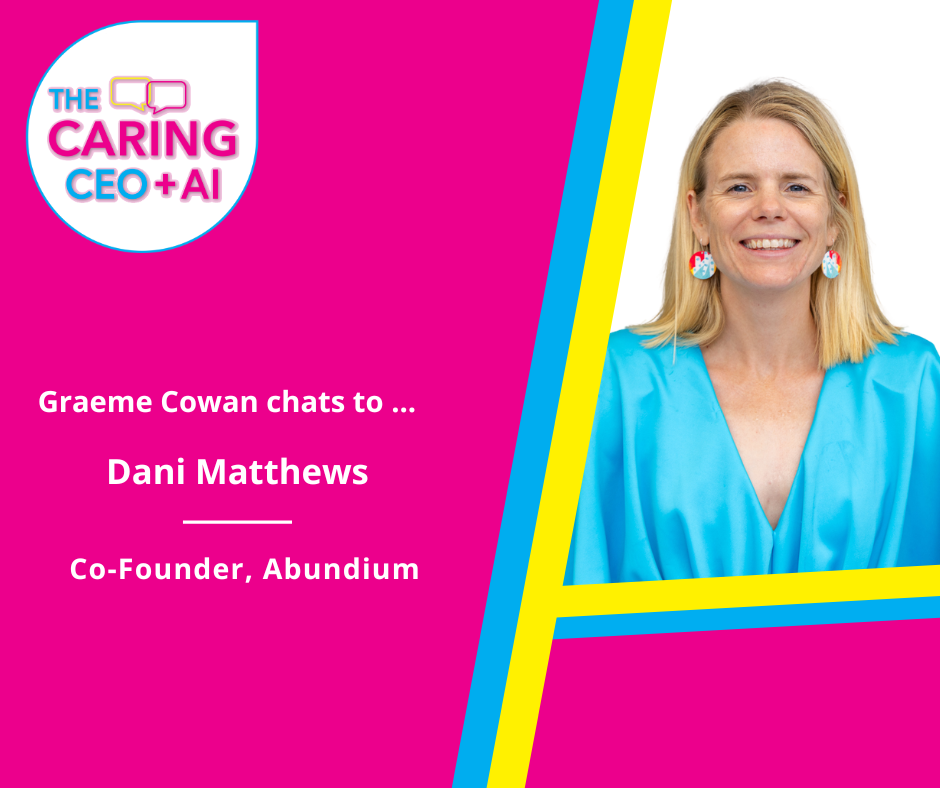
#98 The care belief loop, Dani Matthews, CEO Abundium


DISCUSSED IN THIS EPISODE
- Leading with care in an AI-driven workplace, while balancing productivity, wellbeing and human connection
- Building resilient, high-performing teams through self-care, recovery, psychological safety and meaningful connection
- Keeping the human at the centre of AI, including how leaders can use technology to create new opportunities rather than simply replace people
RESOURCES
Transcript from the interview
Disclaimer: The following transcript was generated using a specific tool. It serves as a convenient method for converting our podcasts into text and allows for easy text searches. However, we kindly ask for your understanding if any typos have inadvertently occurred as a result of the tool’s usage.
SPEAKERS
Graeme Cowan, Dani Matthews
Graeme Cowan
Today’s guest is Danny Matthews, and she is the CEO ANZ of Abundium. They are a membership group that provides services to CEOs and C-suite executives who work for multinationals in Australia. Danny talks about self-care and applies the concept of the corporate athlete, which we’ll hear more about. This is also part of the Caring CEO Plus AI series, and Jenny describes the platform which she’s used and found to be very helpful for her own productivity. We also explore how leaders can utilise AI to still provide a culture of care and high performance. Since arriving in Australia with no job to go to, Danny has built a remarkable career and was recently asked to deliver the graduation speech to business graduates at UTS, and in that she discusses the belief loop, which is relevant for all of us. There’s great gold nuggets in our chat with Danny. Enjoy. It’s a real pleasure to welcome Danny Matthews from Abundium to the Caring CEO. Welcome, Danny.
Dani Matthews
Thanks, Graeme. It’s a real privilege to be here. Thank you for having me.
Graeme Cowan
What does care in the workplace mean to you?
Dani Matthews
Care in the workplace means to me knowing your people well. You know, if you’ve got hundreds of people, you know their name, you know their families, you know what matters to them, you know what the career they want to have. I think it means really getting to know the human behind the title.
Graeme Cowan
Your business Abundium is a very interesting concept. You mind just explaining to our listeners who your audience is and how you help them?
Dani Matthews
Yes, thanks, Graeme. So our vision is better leaders, better world. So very synergistic with great leaders who care as well, and really we’re a local home for global leaders. So we represent subsidiaries in the area. So we’re subsidiary specialists. So our leaders are miles away from the mothership. They’re in the forgotten time zone here. It can be a lonely place, and we really exist to help them feel connected, informed, and enabled to be the best country leader and leadership team that they can. And close to both of our hearts is not-for-profits, and we have the social impacts at the heart of our strategy. So every multinational company can nominate a local charity, and the not-for-profit CEO and their team get free access to our curriculum, so we’re really trying to promote good growth in the region.
Graeme Cowan
That’s brilliant. What are the major problems? Do you see a common problem that local subsidiaries have when they’re away from the mothership? One of the big things that I would guess is time zones because so many time zones to the US or Europe? What else do they really struggle with, or what’s difficult about being this far away?
Dani Matthews
I think one is isolation that can come and be in the forgotten time zone. Also, often our members are two to 5% of global revenue, so it’s hard to stand out in the global scheme for your revenue. So we think, what else do we want to be famous for? Is it the innovation nation? Is it being a great talent hub? Is it for having Australia, New Zealand as a great test market where, if it works here with our amazing multiculturalism, it’s likely to work in other parts of the world. So I think problems are that loneliness. You’re a small part of a global machine, yet we try and flip that to an opportunity that actually let’s punch above our weight, be the innovation time zone. As one of our members said, we’re in the future, so the rest of the world is trying to catch up with us with the time zone. I
Graeme Cowan
like that. That’s a nice little twist, isn’t it?
Dani Matthews
Yes, this is
Graeme Cowan
a special series on the caring CEO, and what we’re really focusing on is leading with care in an AI world. And we were talking before we started about so many people we speak with in our weeks grappling with this, what it means for our workplaces, what it means for our teams, is there one sort of or a couple of questions that are coming through from your members about how to integrate AI into the workplace?
Dani Matthews
Yeah, it’s a great question, Graeme, and we’re we’re in a unique position because we represent you know over 100 multinationals, so we get to hear themes across industries, across different countries of origin. So we feel quite privileged to see across the board what are we hearing, and I think one thing is how do we keep creating a culture of care in an AI era where we might be making restructures as we do this. There’s a lot of unknown, so how do we be transparent enough with our people? So there really is a question around that: how do we keep a culture of care in an AI-driven world? Is one, and also what’s the opportunity cost if we’re not embracing this? And our competitors are is one we hear a lot as well.
Graeme Cowan
And one other very interesting thing, and I think it was Deloitte Research that found that 93% of expenditure is the technology, is what you know companies are spending on the technology, and only 7% on how to integrate humans with the technology. That seems very flawed combination. Are you seeing common questions across your membership group about AI? I
Dani Matthews
think we got that one, wasn’t it? The technology piece, the training of
Graeme Cowan
people. Yeah, yeah. Good point. Good point. So, yeah, source of research recently that companies were spending 93% of their AI budget on the technology, and only 7% on the people and how that will integrate with the technology. How are your members looking at that? Do they see a problem in that in that ratio?
Dani Matthews
Yes, I’d say there definitely has been a problem in that ratio. That pretty much most of the companies we work with, everyone now has access to the technology and the tools, but as you say, investment in them and their leadership-like we see a big gap. How do you lead people through this transformation? And there’s-you can have the tools, but if you don’t have those human leadership skills to lead your team through the change, I think there’s a big risk. So we’re definitely hearing that tension as well.
Graeme Cowan
Yeah, integrate leaders’ care mindset, we talk about self-care, crew care, and red zone care. So, we’ll take that approach with this AI series as well. So, with self-care, it’s really been stressed that it’s much more important to be adaptable than you know super smart and be able to be ready for changes is a really important component. What do you do to keep yourself adaptable?
Dani Matthews
Yeah, thanks, Graeme. And I’m loving reading about those elements in your book. So I think it’s great you have that structure. So personally, I’m a big fan of a corporate athlete mentality. And you may remember there was a famous making of a corporate athlete HBR article in the early 2000s by the late Dr. Jim Lehr, who Rich and I, my co-founder, have had the privilege to interview, and Tony Shorts, and he talked about managing your energy across the pyramid of physical, emotional, mental, and spiritual. And I really do think about that myself. You know, the foundation is my physical health. So you know, I’m training for a marathon at the moment. I’m constantly managing my energy by keeping active. I meditate every day, and that’s really important to me to keep that mental fitness high as well. And then I think emotionally and spiritually, being connected to a higher purpose, and then the extra one I’ve added myself there. Pyramid is social because I think we need to build our capacity. Like I think of friendship as a leadership activity because if we neglect time for our friends and our family, we don’t have our best energy. So they’re sort of the different aspects I think when managing my own energy, and then I try and encourage our team to manage those as well.
Graeme Cowan
One of the things I talk about is a personal moodometer and a crew moodometer, and there are unbelievable benefits of people being in a positive mood and covering all those elements that you talked about. There’s research there which shows that when we are in the green zone, we’re 31% more productive. We sell 37% more, and we’re 200% more creative. And that has all got to be just a huge priority for this workplace. Now, we need to be productive. We need to be more innovative. We need to try new things. And so, you talk about recovery, but being able to bounce back from that, knowing what to do to go for the green zone again, is a really important skill as well.
Dani Matthews
I love those statistics, Graeme, and I think it’s a superpower. You know yourself when you wake up energised, you feel like you can take on the world. You’ve got that courage to make that extra call. Be bold when you’re not feeling in a positive mood, all those things are harder. We’ve talked before about emotional contagion, and you become the energy you surround yourself with. And I think if you can surround yourself with believers and people who are realistic but optimistic, then there’s a knock-on effect to that as well in the workforce.
Graeme Cowan
And I talk about three elements of well-being, and the first one is vitality. So that’s same as you. It’s you know move well, rest well, eat well, and like you, I’m a really regular meditator. In fact, I use Insight Timer, and I got notification this week that I’ve had 200. Consecutive days meditation. I use
Dani Matthews
that as well. And do you have a favourite? Do you have a favourite? I love it. Jason McGrice’s morning ritual. Do you have a favourite one?
Graeme Cowan
There’s one that I really, really love, and it’s by two Western experts in mindfulness. So it’s Tara Brach and Jack Cornfield. Oh,
Dani Matthews
I love both of those.
Graeme Cowan
Yeah, they’ve actually got a 40-day programme, and they alternate. You know, so you hear different. It’s about 10 minutes, but that they’re brilliant because they also tell you and reinforce that your thoughts aren’t real. You know, they can drift away, and you don’t have to engage in negative thoughts and that type of thing, but on that topic, I’m just jumping around a bit here. But I’ve heard you talk about the belief loop. What is that, and why is that important to you?
Dani Matthews
Yes, thanks, Graeme. I was actually reflecting in the school holidays. My boys were going to an indoor trampoline place. Those high noise environments, and it made me really creative. I was reading through my old journal, and all my synapses were fired with the crazy noise and music that drives many people crazy. But it just got me into this creative zone. I was looking back on my journals, and I was sparring with Claude and trying to synthesise some of my learnings. And I created this model called the belief loop, that from my experience and working with 1000s of leaders, we really need to believe before we have the proof. Because if we disbelieve, you’re almost guaranteed not to get there. I mean, belief doesn’t guarantee you’ll get somewhere. But as leadership teams, if we’ve got these goals and there’s disbelief in the team, we know it’s really hard to get beyond that. So I came up with a cyclical model. It’s got different stages, including alignment, awareness, gratitude, service, receiving, and I think the receiving one’s interesting because a lot of leaders I work with sometimes they can’t receive the success, so they generate all this success, but slowing down enough to actually receive that. Be grateful. Move to that model of service and start the model again. So it’s been a really nice. I’ve sort of been writing blogs on different stages and taking a group along with me, and it’s just been great because I think confidence often comes from action, not before it. So you’ve got to be brave, and then as you build that braveness muscle, belief grows, and I think I just realised that belief is such a key part of high performance.
Graeme Cowan
In preparation for this, I watched your graduation speech at the University of Technology in Sydney, and you spoke to those themes there for all those people graduating.
Dani Matthews
Yes, Graeme, that was such an honour, and it was really humbling to. I took a lot of care over that speech because I thought, wow, I’ve been trusted to impart some learning with 200 plus graduates and their family, so there are over 800 people in the room, and I thought, what’s going to help them with their career? And I had spoken to a professor there, and said a lot of the graduates are nervous about artificial intelligence taking their jobs. So as you saw, I focused it more on the human and on heart intelligence and that ability they have to beyond the algorithm, make people feel truly seen. The judgement calls we build, being brave and bold, and it was yeah really quite a humbling experience. So thanks for for watching it as well.
Graeme Cowan
How do you engage with AI personally?
Dani Matthews
Great question. So our Bundium team have Claude cowork, so that’s our sort of LLM of choice, and it’s become a bit like a companion to me. I actually because I’m often on the go and maximising, I love the audio piece in Claude. So you know, when I’m walking in between meetings and it’s got all my save projects, I can give it some instructions. Can you reference that? You know, the notes from that piece and add in this. I’ve been running. Oh, I’ve got a great idea, Claude. And so it’s almost like a great assistant on the go that can collate my thinking, and then so what I do is prompt, and then you know I still use my judgement and my editing and my you know flavour, but I just find it’s a great way to capture all my thinking because you’ll know this as well. You have a great idea when you’re over here, and it’s just somewhere that you can collate all your thinking.
Graeme Cowan
Yeah, I I also have really embraced Claude when I began writing my book. One of the big things I had to do was know how to make sense of all these transcripts from interviews, and the thought of going through them word by word, each one was very overwhelming. And so I basically set up all these prompts, and I looked at ChatGPT. I looked at Jeremiah. I looked at Claude, and for me, Claude was by far the best with the written word. I tend to use ChatGPT for formulas or trends or strategies and that type of thing, and for images, I tend to use Nano Banana, which is. A Gemini element sort of thing, but yeah, I also think it is really great to be involved in conversations, and I’ll often put something together and ask it to rate it out of 10 in terms of how they would score it and what would improve it, and that sort of interaction I find really really helpful.
Dani Matthews
We’ve actually got an event with Anthropic’s head of AI for APAC next week, and I was speaking to her this week. And I’m not sure if you’ve seen their recent economic index, but it showed that Australia usage per capita we’re number one in the world for Claude. So Australians have really embraced it, and then when you dig under it, it shows you actually homework was number one for usage before business. But I just hope that we use it in. I’m you know mum of two young boys for critical thinking, and like we’ve explained here, it’s it’s making us better, but we’re keeping our brain muscles active because the risk is if that we just get the vanilla effect of everyone asking the same thing, spitting out the same thing. We’re just reducing that creativity.
Graeme Cowan
Yeah, yeah. I’ve heard the you know the term like start with human AI, end with human, and I find that really really helpful because there are some strange things that come up sometime, and it takes your experience and judgement to recognise that, and not just to go along with you know with what it says blindly. Are there any AI tools you’ve started and have given away because they didn’t really provide value for you?
Dani Matthews
I mean, we started with Chat GPT, and and to your point, I think everyone’s got its thing that it’s great at, and for what it just wasn’t quite the right fit for us. So we moved to to Claude. We’re trying. My co-founder Rich is trying lots of different tools for for content because we get so much content, and you know he loves a notebook. Some of the great things it can do to put conversations, you know, presentations into podcasts as well. There’s a great tool that I need to go back to called the Leadership Companion that two of my friends have co-founded. What they’ve tried to do is create a leadership coach in your pocket, but hardwire the bias out of the large language models, which you can imagine is quite hard because whoever’s coded this, there’s so much bias in there, so they’ve worked really hard to get it out, make it private, encrypted, so that when leaders are sharing sensitive information, they feel secure that it’s not going to go to other people. So I was part of the beta testing, and then I got sidetracked by Claude, but I do intend to go back and try that again because I do like the idea of something a bit more personal that’s got their heart intelligence built into it, and years of strategic thinking and coaching as like a framework within that system as well.
Graeme Cowan
Yeah, there are just so many options and things evolving, and yeah, you know, I guess the important thing is to be in the game. It is an extraordinary tool. I was sharing before we came on air that I’m old enough to remember when computers first appeared in workplaces, and everyone, all the futurists, were saying you’ve got to get used to having so many holidays because the computer’s got to do do everything. That never quite worked out, and we have assumptions now with AI that it could replace 1000s of jobs, and it could well, but we don’t also know about additional jobs it could create. And or move now on to I guess the crew care, and the reason I talk about crew, like we have teams, and teams work together on a common goal, a crew works together with a common goal, but it’s also really mindful of looking after each other. You know, supporting each other, encouraging out each other, having each other’s back. And again, we was talking about this a bit previously, but there’s a wonderful example with IKEA. You know, that they had this chat bot, and the chat bot ended up doing over 50% of the client interaction. So rather than you know dismiss 50% and this was like 8000 people, like he came up with the idea of offering them the opportunity to train as an interior designer, and a huge percentage did, and it’s led to this brand new income stream. So, what you know, I really want to embrace in this series, and I know this is your mindset: is the and side of things. How can we improve productivity and also people’s well-being. So, on that concept of identifying other ways to utilise people that have been replaced by a chatbot, are there any examples you’ve seen in your network where people have thought creatively about how to build value and not? Necessarily, just lose people in the process.
Dani Matthews
Yes, a great reflection, and just a comment on the job shift. We had a session this week with one of the world’s largest advertising companies, and they were saying 10 years ago, 50% of the jobs they have today didn’t exist. So they’re seeing this as an opportunity and thinking, what jobs is AI going to create that in 10 years is another 50% of new jobs. So rather than it being this, you know, losing of jobs, as you said, it’s a yes and like let’s actually think about what this brings up to create as an opportunity rather than a you know a negative to the company as well.
Graeme Cowan
We have some helpful resources that you can find at wecare365.com.au, the first is our mental ill health calculator, which is a quick and simple way to work out what poor mental health costs your organisation in lost productivity and employee turnover. You will also find our building a mentally healthy culture checklist, which shows how to launch a great initiative and keep that momentum going. These resources can be found at wecare365.com.au. I was also reading about how teams can work better together, and one of the things I do in my workshops and keynotes is ask people to reflect on a great team they’ve been part of, and I share my story of helping to start “Are You Okay” in 2009, and just how that’s grown and evolved, and how it was a very very special team that helped make that happen, but then I ask people to reflect on a great team they’ve been part of. It could be in their current job or a previous job, or when they worked at McDonald’s, or when they were in a netball team or a footy team. What was it that made that team different? And in 95% of the cases, there’s three things that come out. I give about 10 options, but there’s three things that come out in 95% of the cases we had each other’s back and we encouraged each other, and they’re all they’re just
Dani Matthews
gave me goosebumps. So beautiful, aren’t they? The human side of things, yeah. But
Graeme Cowan
they’re all human, and you know I think that you know as we navigate the integration of AI into businesses, that we don’t forget that because it’s how we apply it that makes the difference. You know, and and how we work together to make make it happen. Have you heard of other groups that measure how the team is going on a so we’re talking at team level now, not an organisational level. But are you aware of examples where people do regularly tap into the the human centred insight to work better together?
Dani Matthews
Yes, and just a quick comment on that human side. I heard a stat this week which I thought was worth sharing that human beings in the form of Homo sapiens have been around for about 300,000 years, yet reading and writing have only been around for about 5000 years, and then you think AI, you know, 50 years, 60 years. So you think for 98% of our existence, the way we conversed was inhuman, in groups, you know, around campfires, and it was a great reminder that let’s not forget the importance of being in a room together, being human, and it just reminded us that we can’t lose that in this ever connected world. So I thought that was just a nice frame to what you were talking about with teams, but one of our friends, Steve Vamos, who you may know, who formerly led Microsoft ANZ Apple Asia Pacific, and then Xero globally. He does a lot of work with teams, and he gets teams to rank, you know, on a scale of zero to 10. How effective do they feel as a team at the moment? And you know, he’s he’s a master of making things simple, like the complex. And you’re great at that too. And then just looking at all those different ratings of a team and just having an open conversation. I heard a great question recently from a friend in diversity, equity, inclusion who asked leadership teams, “What’s one thing you felt unsafe to share in the last couple of months? And when people then share it, it gives this permission, and it might be, “Oh, I wasn’t recognised for this project at the global town hall, and just the conversations that has then enabled that team to break through. So that was a great exercise that I thought might try with some teams we’re working with.
Graeme Cowan
Yeah, it is a fabulous approach, and you know, it’s also one of the foundations for psychological safety. Team psychological safety is that people can be vulnerable. And I remember doing a session in Melbourne once with it was a large division of a multinational company, and the CEO of that division shared that at one stage he was. Homeless and living in a car, and you know he’d had a marriage breakup, and you know he had to leave the home, and it wasn’t that he had no money, but he had no cash and no card to compensate for that, and yeah, you know you could see the room shift when someone shares something like that because it’s what you just don’t expect from a CEO. But it was a great foundation for then thinking about people are able to to admit what they weren’t good at or didn’t know or what could help the most people. But just a very very human thing that could make a big difference. I really like what you talked about with Steve Vamos, and you know how effective are you? I also think I talk about a crew mudometer, and that’s also nought to 10, green zone, amber zone, red zone, and even just asking each week what you know what each member is. Are you in the green zone or the amber zone? And at this point in the Australian workplace, is that I don’t even recommend saying red zone because no one wants to admit they’re in the red zone. It’s it’s very very still a lot of stigma associated with it. But even knowing which people are in the amber zone is incredibly helpful stuff. But it’s such an interesting element, especially you know when you talk about the benefits of being in the green side. You’re more productive, more influential, more creative, and there are also you know other groups out there which do provide pretty quick feedback. You know, there’s groups like Culture Amp and Crew Mojo, a few ones that just really provide that rapid feedback, and you know leaders know their financial performances to the dollar every week to the dollar, but they’re all lag indicators. You know the really current ones, the energy and the resilience and the creativity of the people in the room.
Dani Matthews
You just reminded me, Graeme. Our leadership team do a quick, simple one every Monday. So out of 10, we say how are we personally feeling and why? How’s our family and why? And then how are we feeling about abundium and why? And to your point, it’s just a really quick insight into. Okay, something’s going on. Let’s really lean into that person and give them some space because they’ve got something going on personally or with family. And I was actually at the Corporate Mental Health Alliance Australia’s annual gathering this week, and I know their purposeful work too. And their CEO Kim opened up with she had a moment recently where she saw a carbons emissions dashboard in a lift, and she thought, “Why can’t we see that? To your point, a real time indicator of the health of this company, and I think it needs to be permission based. But what great insights for leaders and the humans if, like you said, people can just get a read. Where’s your energy? How can we help? Who can lean in more here because they’ve got something else going on. So I just think it’s such a great conversation that you’re bringing to the forefront.
Graeme Cowan
There’s some recent research that Darren Moglia has brought out, and it’s about productivity in Australia and the use of AI. And his business is called Enterprise Works, but there’s a few things which are very confronting about it. One is looking at per person productivity, and it’s declined for the last five years, down, and then looks at workplace stress. It’s gone up for the last five years. So with all these tools, something isn’t working, you know. And I remember we shared a bit previously that the sad thing is, a lot of young people are feeling burnout. These are people that should be so excited about everything, but there’s a really high level of burnout in sort of 15 to 25 year olds, and so we had this situation where productivity is going down, stress is going up, and AI usage is going up. Something’s not working. Do you have any thoughts about what may not be working?
Dani Matthews
Yes, I was actually talking to an ANZ tech CEO about this this morning, and apparently there is a term I don’t actually know what it is, but when you’re addicted to the new technology, and some young people are getting so addicted to building their agents because it’s instant gratification. You feel like you can create a business in a couple of hours. But the dark side of that, you know, with gaming addiction, social media addiction, alcohol addiction, any addiction, is that if you do it too much, it just becomes such a problem, but I think people are getting wired with the instant hit of the output. I mean, you know what Claude can do in five minutes, and also to your point on individual productivity, we’re seeing individually you could feel super productive. My swim lane, I’m flying, yet actually you all could be going in different directions because you’re not aligned. And Steve Vamos actually says the number one job of a CEO is to fix misalignment. So I’m often thinking at that at a Bundium. You know, how do we make sure we’re all being productive, but in the same way? And I think then we actually have to prioritise recovery. Like when I was speaking to Anthropics head of AI for APAC, if you’ve been there for three years, you get a six-week sabbatical to recover, and they’ve started doing like a company just rest for a week because it’s almost like I think leaders have to build it into the system because if people they’re so passionate and motivated, there’s a high cost of high performance. And at Abundian, we talk about performance learning and well-being in a growth triangle because if you’re stuck in chronic performance, you’re never going to be able to sustain it. So if you’re not stopping to focus on your well-being or your learning, you may perform in the short term, but as we know, that never seems to end well.
Graeme Cowan
I think the term you might have been alluding to was token maxing. Was that the thing you were thinking? Oh,
Dani Matthews
maybe yes.
Graeme Cowan
Well, the token, you know, are the little tablets that allow you to use Claude and ChatGPT, and there was this real trend of token maxing, and what that meant was that people were being measured by how they were engaging, and the more tokens they could use, the more heavily they were involved, but it led to just a ridiculous blowout in cost because they were using tokens even for simple things that didn’t require that. But that was sort of how they were measured for a while. And recently, I saw something in the business pages about are people cheaper than AI for certain things, they were basically saying that these tokens are becoming so expensive that for other tasks it would be simpler to have people involved rather than AI. So, yeah, there’s many, many moving parts in this whole equation going forward.
Dani Matthews
On that note, Graeme, I was talking to a girlfriend recently who works at a small software company, and she shared their token usage was getting close to you know 100k a month, and they had to pause because you just get in this cycle, and you know token creep like people have lifestyle creep, and you realise that you get you just get used to that, and actually taking a step back, you know that’s over that’s like one point million dollars a year. What is the human capital equivalent of that? That it’s just like I feel like we need to almost slow down to speed up and just take a breath, realign, and and just make sure we’re still asking some quality questions about the the return on the investment.
Graeme Cowan
And the other thing to consider as well is that tokens aren’t at their real cost yet? You know, all these huge firms like ChatGPT and Claude, they want market share. They’re burning billions of dollars a month to finance these things. So, if they go public, they’re suddenly accountable for the profitability of the business. So, and to be fully accountable, you’ve got to increase prices substantially. Anyway, there’s many different elements to that. I also want to just talk now about the red zone care and how people are coping and how they’re going. And I shared previously that stress is increased each year for the last five years in a row. Monash University did a study which showed that 27% of Australian employees have had a mental health issue for at least six months in that year. So it’s more than one in four employees have had a significant mental health issue with AI. How do we address this? How can it help us to catch this early and to provide help pathways for those that are struggling?
Dani Matthews
Yeah, it’s a great, great question, Graeme. And I mean, I’ve personally started using some of the AI insights on an Aura Ring. I don’t know if you have one of those, just to so it sort of measures your, you know, your heart rate, your heart rate variability, your body temperature. So I can sort of, you know, track for my own energy management. You know, when I need to take it a bit easy, and the AI advisor gives me suggestions, you know, especially being a female. If it’s you know that time of the month, you might need a little bit more rest than you know, etc. And I think if there was a permission-based way, because I think permission is very important in this, because you know if you’re tracked without knowing, like I’m even hearing people are getting anxious about being tracked by swipe cards now going into offices, they feel like they’re being surveyed by every which you know transcription tools on all online meetings. So I think there needs to be a smart way that you know permission baked in. But but how amazing if we could do this at a collective level? Like I’ve heard leadership teams who are buying their leadership team ring and then. They’re actually having conversations like, “How’s your REM sleep? Here’s a tip. Actually, when I eat late, my heart rate lowers later, so I don’t sleep well. And actually, normalising these conversations. So I and at the Corporate Mental Health Alliance annual gathering, there was talks about this. It was you know needs to be permission based, but what an opportunity to get real-time data, but to your point as well, I think where does the human conversation end? Because AI can’t look at that quiver of a lip you see from someone, the shaking of the hand when that human empathy kicks in, and and that just you know the are you okay? The great movement you helped found. I feel like it can’t yet read our body language, and that’s such an important part of, you know, leadership is noticing those signals and being attuned to to creating the space for those follow up conversations.
Graeme Cowan
Yeah, and as you say, you know, the human component is way more important than a technological component. Technology can give you some insight, but it’s what you do with that insight. You know, it’s it’s how you ask, “Are you okay? How you listen with empathy. That’s going to have a way higher probability of success than you know lines on a page or a graph or or what have you, it can play a good role, and I know that there’s some technology developed by a lady here in in Australia, and it basically looks at the language people use for emails that they use on documents, and it’s been shown that it can predict when someone’s stress levels are rising, someone could be really, really struggling. Knowing that, of course, people must have control over that. Musk give permission to know about that. But it’s what happens with that insight. You know, it is having the right conversations in the right place, and you know, as we are coming into the lead up to “Are You Okay? Day and the theme this year, which I love, is “Are You Ask Are You Okay” any day.
Dani Matthews
I love that.
Graeme Cowan
So it’s a 365 day thing, which of course it always should be, and there’ll always be one day because it provides a sense of focus and momentum. But of course it is 365 days of the year. One of the things that I’ve been involved in co-founding is a business called We Care 365, and it trains. We’ve now trained over 300,000 managers around the world about how to have better burnout prevention conversations, and it follows an eye care framework. I is identify noticing the changes you’re seeing in a person, change in mood, how they speak, the reliability. C is for compassion, listening with empathy, asking, “Are you okay? A is for access experts, encouraging them to see their GP or a psychologist, or a or EAP, R is for revitalising work, and that’s the science of recovery that tells us that there’s a much better likelihood of recovery if the person still stays connected with their teammates, even if the time decreases or hours decrease. In most cases, that’s preferable. Of course, when you’re at bullying situations, that’s not appropriate. But most situations, they’re better off being connected. And then the ears for exercise. And as you and I passionately believe, our physical health is very connected to our emotional health. And yeah, because one thing that we really discovered with “Are you okay? and this applies just as much to the workplace now. Is that there’s a lot of people that want to help, but they don’t know how to help. And one of the two biggest objections for not asking “Are you okay? was they didn’t know how to start the conversation, or they were afraid someone might say, “No, I’m okay, and not know what to say or do. So I think potentially those insights could be provided to leaders in real time to have conversations, just with some hints, some guidelines. That’s the dream.
Dani Matthews
Oh, I love it, Graeme, and I love that you’re making it an everyday conversation as well. And on that note, I should ask you: Are you okay today?
Graeme Cowan
Thank you. I’ve had a good week, and yeah, you know, I like you. I have a morning routine, and it starts with meditation, and then it usually goes to a walk or exercise. Live beside the national park here in in Gordon, and then you know, I actually write down three things I’m grateful for in the last 24 hours, and then think, what good can I do in the next 24 hours? And that’s my reset. I went through five years of horrendous depression where I never. Thought I would ever ever come out of it, and consider myself very very lucky to have done that. But I also still am vulnerable. Like sometimes I can feel the stress rising, and for me, my early warning signs is early morning wakening and sense of anxiety. And I just know that I’ve got to stop. I’ve got to recover. Got to do things a bit differently, and in one of my books, I interviewed Bob Borstein. He was the director of public policy at Google in Washington, and he said, “You have to learn how to be your best therapist. Now, you’ve talked about you know your O ring that helps to monitor that, which is fantastic, but we also need to, as well, I believe, just know what our early warning signs are when we’re slipping down the mood element to going into the amber and, God forbid, the red zone.
Dani Matthews
Thanks for sharing, Graeme, and I love how you’ve used your experience to really help others. and And a personal example of that for me, I’m training for the marathon. I had a really abundant week where I had three evening events in a row. There was a lot going on personally. I’ve got a dear friend through our triathlon club going through end of life, and there’s just lots happening with that. And I just realised, okay, something needs to. You get those early warning signs from the aura ring, but also from your intuition. And I thought, okay, I’ve just got to create some boundaries. So I just said for the next three weeks before the marathon, I’m not going to go out in the evening. I’m not going to drink any alcohol. I’m just going to protect my my energy. And it’s amazing. Then you see the impact. You know, quality sleep. You start to get that resilience up again. But you have to be able to make those pivots. Otherwise, you know it can all just become too much. So I love that you’re encouraging the early wardy signs. It’s so important.
Graeme Cowan
Yeah, thank you. Our time’s gone very quickly. It has. I could speak to you all
Dani Matthews
day.
Graeme Cowan
Is there anything relevant we haven’t discussed?
Dani Matthews
Great question. I think we’ve covered most things. I mean, I think just for your listeners, let’s just remember that humanness. This taking that moment to check in with someone. Let’s remember that health and friendship should be a leadership activity, and not neglect. Rich and I, my co-founder, talk about. Let’s keep the main thing the main thing. You know, what are we going to remember at the end of our lives, and when I see my dear friend at the moment, her bank account’s not coming to the hospital. Her car, her home-it’s people, it’s her family, it’s her friends. They’re saying she’s the most popular people in the hospital. She’s part of a community. We’ve got all of our triathlon friends lining up to see and sit with her, and you know you don’t always know what to say when someone’s not okay, but I think you’ve just got to be there. It’s better to fumble than not show up and say anything. So if you think someone is not okay, just that humanness of being there, looking them in the eye. Yeah, I think that’s what it’s about. Let’s just keep human.
Graeme Cowan
Keep human. That’s fantastic. Thanks for being part of this special edition of the Caring CEO, Danny. I’ve really enjoyed our chat.
Dani Matthews
Thanks, Graeme. All the best to you and the community. I love what you’re doing, and amazing the ripple effect of your work. So please keep it going.
Graeme Cowan
Thanks for joining us today. We hope you’re inspired to strive for a culture of care that also leads to great results. If you’ve enjoyed this interview today, please rate us on your favourite podcast platform, and don’t forget to subscribe so that you don’t miss an episode. We also welcome any comments. If you’re interested in seeing details about our scalable We Care 365 mental health training programmes. Please visit us at wecare365.com.au. Our goal is to make these programmes accessible, practical, and ongoing. You can also find me Graeme Cowan on LinkedIn, and I’d love to hear from you. And finally, if you’ve come across a senior leader who has impressed you, and you think they’d be a great guess, please email us at support at weekcare365 dot com.au. Thanks once again for listening today.

Oh, you are inquisitive… getting all the way to the bottom of the page!
Thanks for listening 🙂
From all of us at The Caring CEO, and the WeCARE team, keep listening, keep caring and lead with your heart.
P.S. If you want to reach out, share a great leader we should interview or learn more about The WeCARE Way, click here to contact us.
